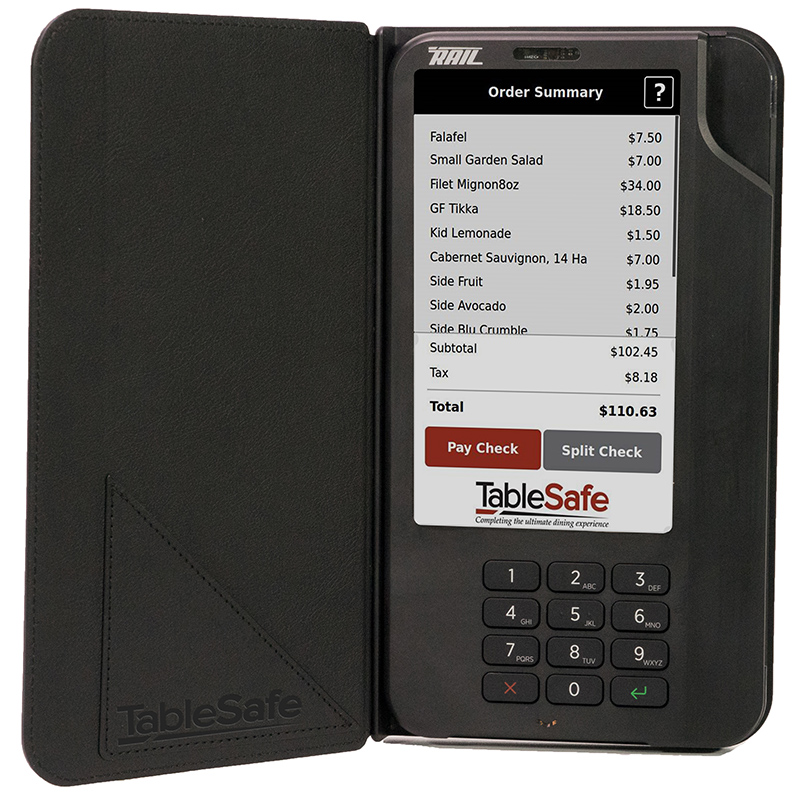
Pay-at-the-table technology changes a familiar restaurant ritual: instead of a server carrying a payment card away from the table, the guest can review the bill, choose a tip, split payment, approve the transaction, and receive a receipt while the card or phone stays in view. What began as a security and convenience upgrade has become part of a larger shift in restaurant operations, where payments, loyalty, ordering, feedback, and guest data increasingly meet at the table.
The original subject of this article, TableSafe's Rail platform, is best understood as an early example of that transition. In October 2017, TableSafe announced that Rail had achieved EMV certification and approval to process chip-and-signature payments. The device was built into a low-profile billfold designed to resemble the traditional leather check presenter used in full-service restaurants, but with secure card acceptance, tip calculation, bill splitting, email receipts, and guest feedback built in.
From Card Removal to Guest-Controlled Payment
For decades, full-service restaurant payment in the United States often involved handing a card to a server, waiting for it to be run at a fixed point-of-sale terminal, then signing a receipt. That workflow was familiar, but it also created friction: the card left the guest's sight, the server made multiple trips, the table stayed occupied longer, and payment data moved through restaurant systems that had to be carefully secured.
Pay-at-the-table moves the moment of payment back to the guest. The payment device may be a dedicated tabletop unit, a server-carried handheld terminal, a smart billfold, a QR-code checkout page, or a consumer phone using a wallet or tap-to-pay flow. The common idea is the same: payment happens where the guest is, with fewer handoffs and fewer delays.
Security Was the First Driver
The earliest pay-at-the-table systems gained urgency as restaurants adopted EMV chip cards and stronger payment security. EMV reduced counterfeit-card risk, but restaurants still needed practical ways to accept chip cards at the table without sending guests to a counter or forcing servers to carry cards out of sight.
Security features such as EMV, point-to-point encryption, tokenization, and PCI-compliant payment flows remain central. P2PE is especially important because card data is encrypted at the payment device and remains unreadable until it reaches the secure decryption environment. For restaurants, that can reduce breach exposure and simplify parts of the compliance burden when a validated solution is deployed correctly.
The TableSafe Rail Example
TableSafe Rail reflected the design assumptions of its time. It preserved the familiar billfold interaction while embedding secure payment hardware inside it. The platform supported chip-enabled EMV cards, traditional magstripe cards, and mobile-phone payment options, with point-to-point encryption and other controls designed to keep guest payment information away from the restaurant POS terminal.
TableSafe also highlighted operational benefits: faster ticket closeout, automatic tip calculation, multiple-way bill splitting, guest surveys, email receipts, and reduced thermal paper use. The company said Rail could reduce the time from ticket presentation to payment closeout by up to ten minutes, giving staff more time for service and table management. Whether or not every deployment achieved that result, the claim captured the broader promise of pay-at-the-table: payment speed is an operational lever, not just a guest convenience.
Handheld Terminals Became the Everyday Version
In many restaurants, the most common pay-at-the-table implementation is now the handheld terminal. A server brings a compact payment device to the table, the guest inserts or taps a card, selects a tip, and receives a printed or digital receipt. This model is familiar in many countries and increasingly common in U.S. restaurants as POS vendors, payment processors, and hospitality systems have integrated mobile acceptance more deeply.
Handhelds are attractive because they fit existing service patterns without requiring a dedicated device to remain at every table. They can also support ordering, menu lookup, loyalty lookup, manager approvals, and line-busting. The tradeoff is training: a smooth handheld payment experience depends on staff knowing when to present the device, how to give guests privacy, and how to handle split checks or payment exceptions gracefully.
QR Codes Expanded the Category
QR-code payment gave restaurants another path. Instead of bringing hardware to the table, the restaurant prints or displays a code that opens a checkout page on the guest's phone. The guest can review the check, pay by card or wallet, add a tip, and sometimes join a loyalty program or request a receipt.
QR payment can reduce hardware cost and help guests pay whenever they are ready. It is especially useful for casual dining, bars, food halls, high-volume venues, and restaurants that already use digital menus. But it also changes the hospitality feel. Some guests appreciate the speed; others feel abandoned if QR payment replaces attentive service. The best implementations make QR checkout optional and keep staff visible for questions, corrections, and accessibility needs.
Contactless and Mobile Wallets Changed Expectations
Contactless cards and mobile wallets made tap-to-pay feel normal in grocery stores, coffee shops, taxis, transit systems, and quick-service restaurants. Full-service dining has followed more slowly because the bill arrives after the meal and often involves tips, split checks, loyalty, comped items, and manager adjustments. Pay-at-the-table closes that gap by bringing contactless acceptance into the full-service workflow.
Guests now expect payment to be fast, secure, and flexible. A modern restaurant payment setup should support chip cards, contactless cards, mobile wallets, digital receipts, accessible screens, clear tipping flows, and easy handling of partial payments. Magstripe fallback may still exist, but it is no longer the center of the experience.
Operational Benefits for Restaurants
For operators, pay-at-the-table can shorten table turn time, reduce server trips, lower receipt paper use, improve tip transparency, and reduce errors from manually reentering amounts. It can also capture immediate feedback while the experience is fresh, which is more useful than a generic survey sent days later.
The operational value is highest when payment is integrated with the restaurant's POS rather than treated as a separate terminal bolted onto the process. Integration allows itemized checks, discounts, loyalty, gift cards, taxes, tips, refunds, and settlement data to flow cleanly. Without integration, staff can end up doing extra reconciliation work, which cancels out much of the efficiency benefit.
Guest Experience Still Matters
Payment is the final emotional moment of a meal. A clumsy checkout can weaken an otherwise good experience, while a clean one lets guests leave on their own schedule. Pay-at-the-table works best when it feels like control rather than pressure: guests should be able to review the bill, ask questions, split payment, tip privately, and choose a receipt method without feeling rushed.
Restaurants should be careful with tipping prompts, default percentages, and interface wording. A device passed across the table can feel more exposed than a paper receipt, especially in groups. Good design gives guests privacy, clarity, and enough time to make their choices.
What Restaurants Should Evaluate
Choosing a pay-at-the-table system is not only a hardware decision. Restaurants should evaluate POS compatibility, processor support, EMV and contactless acceptance, PCI scope, P2PE validation, network reliability, offline behavior, battery life, device management, receipt options, accessibility, training needs, and support for common restaurant edge cases.
The most important questions are practical: Does it handle split checks elegantly? Can it apply comps and discounts correctly? Does it preserve server workflow? Can guests pay with the methods they actually use? Is payment data protected from capture through the restaurant environment? Can managers audit transactions easily? Does the system make hospitality better, or merely move labor onto the guest?
Where Pay-at-the-Table Is Going
The future of restaurant payment is likely to be less about one device and more about a set of connected options. A guest may order through a server, scan a code for another round, pay with a phone, earn loyalty credit automatically, receive a digital receipt, and leave feedback without touching a fixed POS terminal. Another guest at the same table may prefer a server-held terminal and printed receipt.
That flexibility is the real destination. TableSafe Rail was one historical expression of the pay-at-the-table idea: a secure payment device hidden inside a familiar restaurant object. The broader movement is larger than any single product. It is about bringing payment closer to the guest, reducing unnecessary handling of cards, protecting account data, and letting restaurants close the meal with the same care they brought to the service.