Take over a pool with a written operating record: its volume, treatment method, equipment models, normal readings, and service contacts. Clear-looking water is only one observation. A useful routine also checks disinfectant, pH, circulation, access barriers, and changes since the last inspection.
Make a one-page equipment record
Ask the installer or previous owner for the pool volume and how it was established, pump and filter manuals, heater and sanitizer details, and the current chemical labels. Identify whether treatment uses liquid chlorine, stabilized products, a salt chlorine generator, or another system. A salt generator produces chlorine and still needs water testing.
Record the pump’s usual operating program and the filter’s clean starting pressure under the same pump setting. Have a pool professional explain the equipment, valves, shutdown, and maintenance boundaries during a handover. Keep chemical dosing and pressure-vessel service separate from a simple visual check.
Test, compare, act, and retest
CDC’s home-pool testing guidance recommends testing free chlorine and pH at least twice daily and more frequently during heavy use. It specifies pH 7.0–7.8 and at least 1 ppm free chlorine for pools, increasing the minimum to 2 ppm when cyanuric acid or stabilized chlorine is used. These are baseline public-health values; establish the operating range with the treatment product’s label and pool professional, including its upper limit.
Follow the test kit’s sample and reading instructions. CDC favors a DPD kit for accuracy and warns that chlorine above 10 ppm can bleach a test result toward an apparent zero. An unexpected result after chemical treatment deserves verification before adding more.
Write down the reading, target, product used, labeled dose, time, and later test result. Keep swimmers out when readings or clarity fall outside the established operating conditions. Product instructions determine circulation and re-entry requirements. A dose depends on verified volume, measured conditions, and the actual chemical concentration.
Give each check a purpose
| When | What to check | What the record should show |
|---|---|---|
| Before swimming | Barrier and gate, visible bottom, drain-cover condition, water readings. | A clear decision to open or keep the pool closed. |
| At least twice daily while operating | Free chlorine and pH; more often with heavy use. | Time, result, units, target, action, and follow-up test. |
| During regular visual care | Debris, water level, unusual noise, leaks, and filter pressure at the normal setting. | Change from the established baseline. |
| On the equipment’s service schedule | Approved brushing, vacuuming, basket care, filter service, and broader water-balance checks. | Work completed, product/manual used, and next due date. |
Use brushes and cleaning methods approved for the pool finish. Filter service depends on the exact equipment. For example, Pentair’s Clean & Clear support relates cleaning to the rise above clean starting pressure and stresses correct servicing procedures. A single pressure number is unsuitable as a universal trigger across pump speeds and filter models. Have a professional handle service until you understand the equipment; never open a pressurized filter.
Keep access and chemical handling in the routine
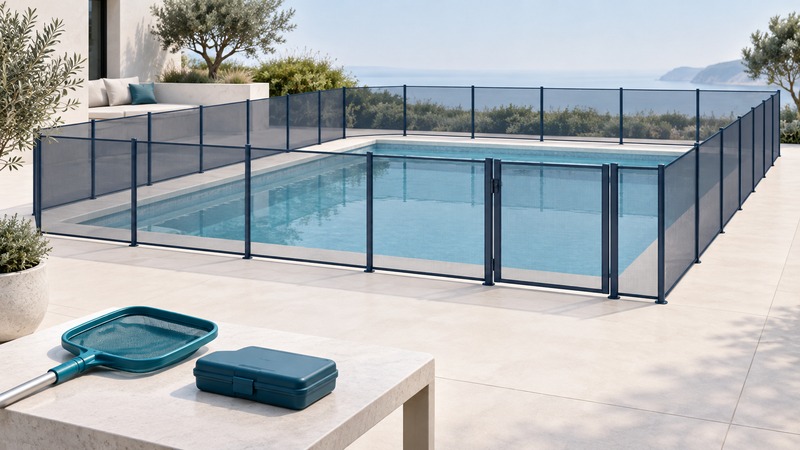
CPSC’s home-pool barrier guide describes barriers and self-closing, self-latching gates that help prevent unsupervised access. Follow local requirements and check that gates actually close and latch. Designate an attentive adult for supervision; equipment and barriers support that responsibility.
Follow the CDC home-pool safety guidance and every chemical label: keep chemicals secured in their original labeled containers, protect them from moisture, and keep incompatible products apart. Never mix pool chemicals. Use the specified protective equipment, and add a product only by its labeled method. Keep anyone with diarrhea out of the pool.
Close the pool and obtain qualified help for damaged drain covers, electrical concerns, persistent cloudy water, unexplained chemical readings, or circulation failures. Follow CDC’s linked contamination guidance and professional direction after a fecal incident; a routine extra dose is an inadequate response plan.
Keep a record that another person can use
Download the pool care and testing record. Fill in your actual target ranges, manual links, and service contact before using the blank entries. It is a handover and observation aid; chemical labels and equipment manuals supply the operating procedures. Review repeated problems with the service provider so the cause is addressed.