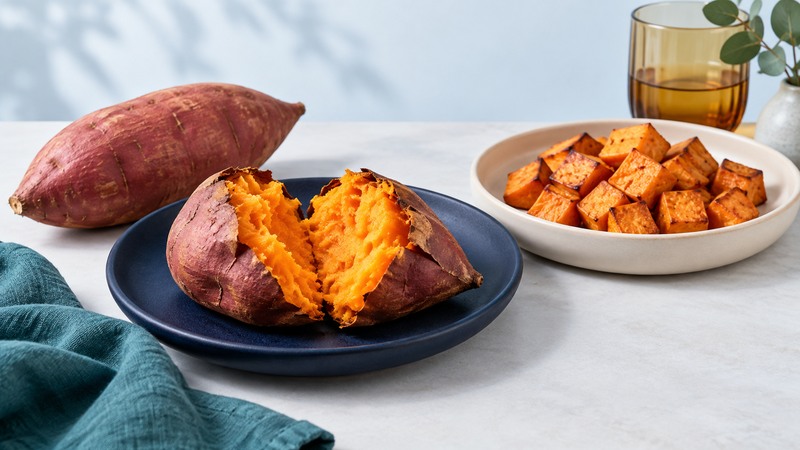
Choose the texture first: orange-fleshed sweet potatoes usually become soft and moist, while many pale-fleshed types cook firmer and drier. Bake whole roots for a spoonable center, or cut evenly sized cubes for browned edges. Both methods below use a conventional oven and ordinary metal baking trays.
Buy for texture and an even cooking time
Look for firm roots with sound skins and few cuts or soft areas. Choose similar sizes if baking them together. Skin color alone is an unreliable guide to the flesh inside; ask the seller for the variety or flesh color. White, yellow, orange and purple types exist. The sweet potato (Ipomoea batatas) and a true yam (Dioscorea) belong to different plant families; US stores often use “yam” for orange sweet potatoes. Illinois Extension explains the naming and variety differences.
Keep uncut roots in a cool, dark, ventilated place and buy an amount you can use within about two weeks for good household quality. Raw sweet potatoes can develop poor flavor and a hard center in the refrigerator. Scrub under running water just before preparing. These storage and texture points follow Oregon State’s sweet potato guide (PDF).
Bake whole sweet potatoes
For two: two orange-fleshed sweet potatoes of about 200–250 g each. Heat the oven to 400°F (about 205°C). Scrub and dry, prick the skins in several places with a fork, and place apart on a rimmed metal tray to catch juices. Bake about 40–60 minutes, checking the smaller root first. A thin knife or skewer should slide easily into the thickest part. Continue in 5–10 minute increments if the center resists; larger or thicker roots take longer.
Let them stand until manageable, then slit lengthwise and open with utensils, taking care with steam. The oven range and tender-center check follow Texas A&M AgriLife’s cooking guidance (PDF); the stated root weights are Yenra’s suggested starting size. Add a spoon of plain yogurt or a little butter, or serve with cooked beans and salsa for a fuller meal.
Roast a tray of cubes
For about three side portions: 450 g prepared sweet potato in ¾-inch cubes, 1 tablespoon oil, ½ teaspoon dried thyme or oregano, ¼ teaspoon salt and black pepper to taste. Use an approximately 13 × 18-inch rimmed metal sheet so the pieces have space. Heat to 400°F (about 205°C). Toss cubes with oil and seasonings, spread in one layer, and roast 20–30 minutes, turning after 10–15 minutes. Finish when tender through and browned at some edges.
This simplified seasoning and tray-size adaptation uses the roasting approach in Food Hero’s sweet potato guide. Peeling is optional after thorough scrubbing. If cubes steam without browning, spread them farther apart next time. If the edges darken before the centers soften, check cube size and reduce the heat for the remaining cooking. Yenra has not kitchen-tested either adaptation.
Choose the method around the rest of dinner
Scroll the table sideways. With a keyboard, focus the table and use the arrow keys.
| Method | When to start | What to check |
|---|---|---|
| Whole, 200–250 g each | Preheat and prepare about 4:45 p.m.; into oven around 5 p.m. | Begin checking at 5:40; allow extra time for thicker roots. |
| ¾-inch cubes | Preheat and prepare about 5:15 p.m.; into oven around 5:30 p.m. | Turn at 5:40–5:45; check tenderness before 6 p.m. |
The schedule assumes a preheated oven and the stated sizes. Serve finished roots promptly; if dinner moves, use proper hot holding or refrigerate them. Leftover cubes can go into a grain bowl, while mashed baked flesh thickens soup. Remove any foil wrapping before cooling and refrigerating.
Refrigerate promptly in shallow covered containers within two hours, or one hour when the surroundings exceed 90°F. Keep at 40°F or below and use within 3–4 days, or freeze. Reheat cooked leftovers to 165°F. USDA’s leftover guidance explains cooling and reheating.