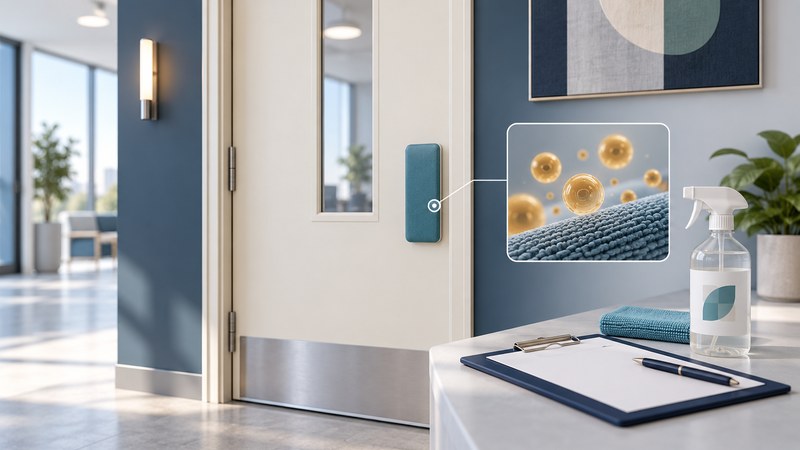
A self-disinfecting door pad aims to reduce contamination on a frequently touched surface. To assess one, ask what was tested, which organisms and conditions were involved, and how the pad will be maintained within the facility's cleaning program.
Surfaceskins provides a useful case study. The evidence supports specific observations about surface contamination and hand-hygiene behavior. A purchasing decision also needs current instructions for the exact product and a clear explanation of the outcome the facility hopes to improve.
How the alcohol-release design works
The University of Leeds' 2017 description of Surfaceskins explains a textile pad with an alcohol-gel reservoir that releases a small quantity when pressed. The pad fits a holder on a door. That historical design was intended for replacement after seven days or 1,000 pushes, whichever came first. Obtain current instructions before applying that schedule to a present product.
The operational aim is to reduce contamination at a contact point between routine cleaning and hand-hygiene actions. Facilities still need to identify and manage other touchpoints, including door edges and adjacent hardware.
Read the measured outcome closely
In the 2017 laboratory study by Best, Parnell, and Wilcox, researchers challenged prototype pads and aluminum controls with contaminated fingers. They measured bacterial recovery from the surfaces. Results supported reductions for S. aureus, E. faecalis, and E. coli in the tested designs; the horizontal tests did not show the same killing effect for C. difficile. Later vertical-pad tests followed two bacterial species across seven days.
Those findings concern particular organisms, surface counts, and experimental conditions. They do not establish a percentage reduction in patient infections. A claim about another organism, heavy soiling, a different pad design, or a different interval needs evidence addressing that condition.
A 2019 service evaluation by Wilcox and Dyche examined routine alcohol-hand-gel use after pads were installed in two operating-theatre suites. It reported an approximate doubling of dispenser use and found no evidence of substitution for routine hand hygiene. That is an observation about behavior in those settings, rather than a controlled demonstration of fewer infections.
Use an evidence checklist
On a narrow screen, scroll the table sideways. Keyboard users can focus the table region and use the arrow keys.
| Claim or decision | Evidence to request |
|---|---|
| Reduced surface contamination | Organisms, controls, sampling method, timing, and results for the exact or justified equivalent design. |
| Reduced infection transmission | Clinical outcomes, comparison conditions, and analysis of other simultaneous interventions. |
| Suitable replacement interval | Current instructions, usage limits, inspection criteria, and conditions requiring earlier replacement. |
| Fits this facility | Compatibility with doors, cleaning products, users, workflow, and local infection-prevention policy. |
Review who funded and conducted a study, what comparison was used, and how closely the test resembles your facility. The biosensor guide offers a related way to separate a measurement from the decision it is being used to support.
Assign ownership before installation
CDC's healthcare surface guidance calls for coordinated product decisions and clearly assigned cleaning responsibilities. Include infection prevention, environmental services, facilities, procurement, and the people using the doors. Confirm compatibility with manufacturer instructions and the existing cleaning process.
- Record the exact pad model, door location, installation date, and instruction revision.
- Assign inspection and replacement to a named role, with cover for absence.
- Plan replacement stock, storage, disposal, and what happens when a pad is damaged or unavailable.
- Ensure the installation preserves safe door operation and access.
- Keep hand-hygiene messaging consistent with the facility's established protocol.
Run a modest, interpretable pilot
A facilities pilot can first test whether staff can inspect and replace pads reliably, whether they fit the doors, and whether cleaning remains practical. Record missed changes, supply shortages, user concerns, and unexpected maintenance demands. Set the review date and decision criteria before starting.
If measuring contamination or infection outcomes, involve the infection-prevention team in study design and interpretation. Several simultaneous changes can make attribution difficult. Download the door-pad evaluation checklist to keep the claim, supporting evidence, maintenance responsibilities, and unresolved questions together.