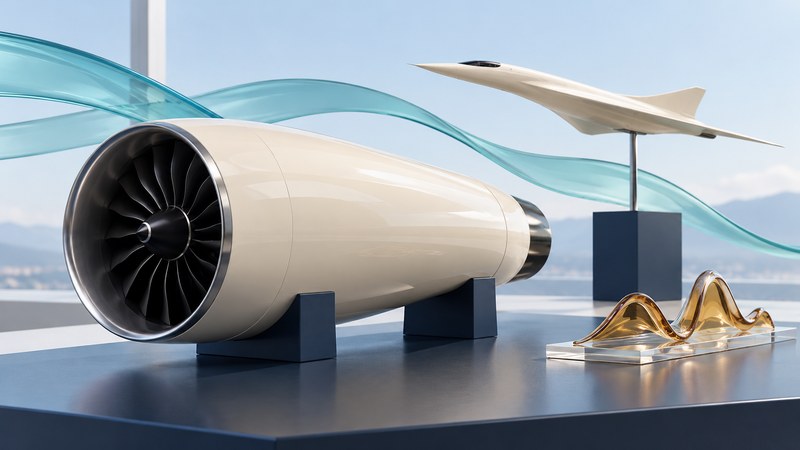
A supersonic business-jet engine has to serve an entire flight, including ground operation, takeoff, climb and subsonic segments as well as faster-than-sound cruise. GE’s Affinity proposal is a useful historical case for understanding those competing demands. Read its launch claims as development objectives in the context of the aircraft program.
Place Affinity in its historical context
In its October 2018 Affinity announcement, GE described an initial design for a medium-bypass turbofan intended for Aerion’s AS2 business jet, with performance goals spanning subsonic and supersonic flight. The announcement outlined intended noise, emissions and engine-control features; a launch release is evidence of those plans.
Aerion ceased operations in May 2021 after being unable to secure sufficient financing. Business Jet Traveler’s contemporary report reproduces the company’s explanation and a customer response. Read the earlier AS2 production and certification dates as historical targets, rather than a current delivery timetable.
Mach depends on the air around the aircraft
Mach number is speed relative to the local speed of sound. Because sound speed changes with temperature, Mach 1 is not one universal miles-per-hour figure at every altitude. NASA’s Mach-number explanation sets out that relationship.
For a journey comparison, ask how much time is actually spent at the quoted cruise condition. Taxiing, climb, descent, routing and time on the ground still contribute to the overall travel day.
Why bypass ratio is a tradeoff
A turbofan divides airflow between the core and a bypass path around it. NASA’s turbofan explanation describes how bypass airflow contributes thrust and why higher-bypass engines are useful for efficient subsonic transport. Supersonic integration brings additional demands, including inlet behavior and the drag associated with the installed engine.
The inlet, engine, nacelle and exhaust need to work together across the intended speed range. A core with a successful history can inform development while the new installation still needs its own analysis and test evidence. Affinity’s medium-bypass concept should be understood as a proposed balance across those requirements.
Separate airport noise from the sonic boom
Airport noise and an aircraft’s supersonic pressure signature describe different phenomena and evaluation conditions. NASA’s sonic-boom research explanation describes the importance of the aircraft’s complete shape, including engine configuration. An engine noise target alone cannot establish the aircraft’s boom signature or permission to fly a particular route.
For any proposed service, seek the applicable aircraft and noise approvals and current operating rules from the responsible authorities. Keep the environmental comparison explicit: the metric, mission, payload and comparison aircraft all affect what a claimed improvement means.
Read the next announcement with four questions
On small screens, focus this table and use the arrow keys to scroll.
| Question | Useful evidence | Interpretation |
|---|---|---|
| What stage? | Initial design, component test, engine test, flight test or certification | Match the conclusion to the completed work. |
| Which conditions? | Speed, altitude, temperature, thrust and installation | Avoid combining figures from incompatible test points. |
| What comparison? | Named baseline, metric and mission assumptions | An improvement needs a clearly stated denominator. |
| What remains? | Integration tests, approvals and operating constraints | Identify the work between a concept and a service. |
Keep a dated claim record rather than a list of promised launch dates. A well-supported update should make clear what changed, what was measured and which uncertainty remains. That reading habit applies to other aircraft concepts as well as supersonic engines.