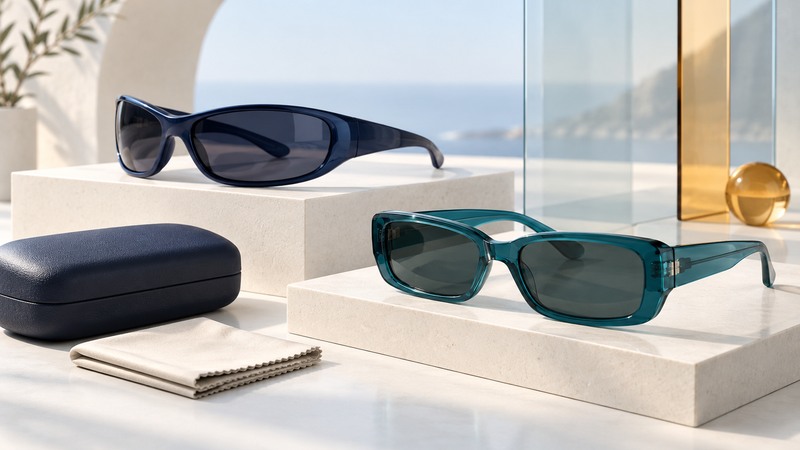
A vintage Von Dutch sunglasses listing presents two separate questions: what pair is being offered, and whether its present lenses and frame are suitable to wear. Begin with model information and close-up photographs. Treat the brand’s design history as context, then check condition, fit and documented lens protection for the actual pair.
The 2006 eyewear launch
In April 2006, optical trade publication Vision Monday reported the launch of Von Dutch Eyes and Kustom Eyes at Vision Expo East. The report connected the eyewear to the brand’s car-and-motorcycle design culture and its effort to carry apparel graphics into frames. It included comments from the head of the eyewear division and illustrated named styles.
That dated account can help place a documented model in context. It does not identify every pair carrying the name or establish what lenses are fitted today. When using an old catalog or advertisement, match the exact frame details and model marking. Separate a period design, a later release and an unverified listing rather than grouping them under “Y2K.”
Build an item record from photographs
Ask for a straight-on front view, both temple arms, the inside markings, bridge, hinges and lenses in reflected light. Transcribe the lettering and dimensions exactly. Keep the seller’s description separate from what the photographs show.
Look for symmetry, missing screws, stress cracks near hinges, distorted arms and worn contact surfaces. Ask whether the lenses or arms have been replaced. Replacement parts can make a pair useful, but they change what an original advertisement can tell you about it. A case or logo is supporting context, not a complete authentication method.
On small screens, scroll the table horizontally. Keyboard users can focus the table area and use the arrow keys.
| Question | Useful evidence | Remaining limit |
|---|---|---|
| Which model is it? | Clear interior markings and an independently documented matching model. | A seller title alone leaves identification open. |
| What is its condition? | Close-ups of hinges, bridge, arms and both lens surfaces. | Photographs may hide optical distortion or looseness. |
| Will it fit? | Frame dimensions and a try-on or suitable return option. | Dimensions do not capture every curve or pressure point. |
| What protection do the lenses provide? | Applicable lens documentation or an optical professional’s assessment. | Tint, price and branding do not measure UV transmission. |
Check UV protection independently of style
The FDA’s sunglasses guidance recommends looking for UV400 or 100% UV-protection labeling. It explains that dark tint and high price do not establish better UV protection. A large or wraparound shape can help cover more of the area around the eyes, while still needing suitable lenses.
The National Eye Institute’s buying guidance notes that polarized lenses help reduce reflected glare and that optical shops may have equipment to check UV-blocking performance. For an older pair with uncertain lens history, ask an eye-care professional what can be checked and whether suitable replacement lenses are feasible.
Keep claims separate: glare reduction, UV filtering and impact protection answer different questions. Use activity-specific protective eyewear where it is required. Fashion sunglasses are also unsuitable for direct viewing of the sun. These distinctions matter more than the original collection’s promotional language.
Try the complete pair, then decide
Wear the glasses normally and look straight ahead, down and to each side. The frame should remain comfortably positioned without painful pressure at the temples or bridge. Check that lashes do not constantly touch the lenses and that ordinary movement does not make the frame slide.
If the view appears distorted, the frame feels unstable or the lenses are badly scratched, ask an optician to assess the actual pair. Avoid bending an unfamiliar older frame yourself; its material and condition affect adjustment and repair options.
Budget the purchase and any confirmed adjustment or lens replacement together. If your purpose is collecting rather than wearing, describe the condition and unknowns in your collection record instead of giving the item an unsupported performance claim.