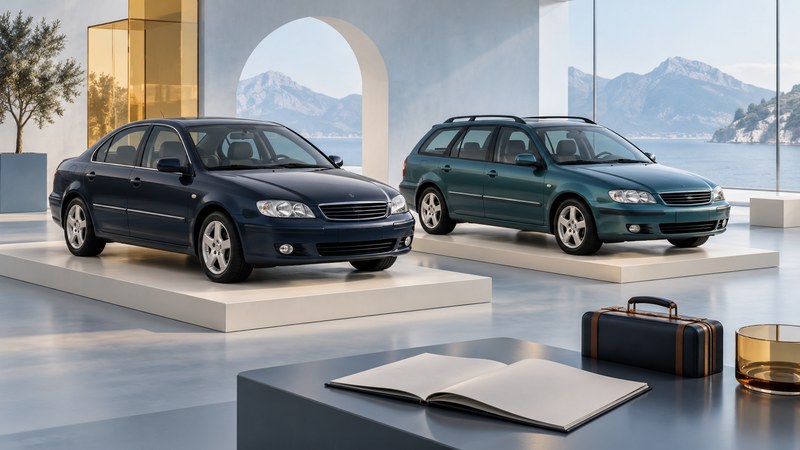
Identify the car before comparing specifications
For a US-market 2005 Subaru Legacy, begin with body style, engine, transmission and records. A sedan and wagon can serve different loading routines, while a turbocharged GT introduces a different powertrain and fuel requirement from a 2.5i. Write down the VIN and actual configuration before using a specification table or requesting service estimates.
Subaru’s 2005 US Legacy brochure (archived manufacturer PDF) lists sedan and wagon versions of 2.5i, 2.5i Limited, 2.5 GT and 2.5 GT Limited. Keep Legacy and Outback identification distinct, even when a shared manual discusses both. Verify an imported or modified example against its own market and equipment.
Compare the choices that affect daily use
On a narrow screen, scroll the table sideways. Keyboard users can focus the table region and use the arrow keys.
| Choice | Documented distinction | What to do with it |
|---|---|---|
| Sedan or wagon | Separate luggage compartment versus a wagon cargo opening | Try the actual bulky item, rear-seat arrangement and loading height; include passengers in the fit check. |
| 2.5i or 2.5i Limited | Naturally aspirated 2.5-liter engine; brochure rating of 168 hp | Confirm the exact emissions specification and service schedule. Compare ordinary use and condition. |
| 2.5 GT or GT Limited | Turbocharged 2.5-liter engine; brochure rating of 250 hp | Budget for the specified fuel and inspect maintenance and modification evidence carefully. |
| Transmission | Manual and automatic versions use different hardware; automatic choices differ by engine | Identify the installed gearbox and assess operation and maintenance against its matching documents. |
These are launch-era identification facts, not measurements of an individual used car. Factory power figures cannot establish the output or condition of a modified example. Use the brochure’s detailed model and equipment tables when a feature matters to the comparison.
Use the matching manual for running requirements
The 2005 Legacy owner’s manual (archived Subaru PDF) distinguishes the fuel requirements of the turbo and non-turbo engines. The turbo guidance specifies premium gasoline of at least 91 AKI for normal use. Include the correct local fuel price when estimating costs and read the full applicable section rather than adopting a generic Subaru recommendation.
The manual directs scheduled maintenance to the separate Warranty and Maintenance Booklet. Ask for that booklet or an equivalent VIN-appropriate schedule, then compare dates and mileage against invoices. Have the inspecting shop identify outstanding time-based as well as mileage-based work. Where records are missing, use the service-history reconstruction guide to create a documented starting point.
Ask for evidence that follows the engine
Request oil-service records, cooling-system work, engine or turbocharger replacement invoices where applicable, and details of any tuning, intake, exhaust or fuel-system changes. An invoice should identify what was done, why, the mileage and the parts used. A list of modifications without supporting installation and calibration information leaves additional questions for a specialist.
Arrange an independent inspection that includes leaks, cooling-system condition, tires, brakes, suspension, corrosion and drivetrain operation. Ask the technician which further tests an observed symptom warrants. Record the evidence and proposed next step instead of assigning an internet diagnosis from the model name.
Check the VIN at NHTSA Recalls and request Subaru campaign and completion records. The VIN lookup has limits, including completed recalls and some older recalls; keep the search date and manufacturer follow-up together.
Compare two cars with the same requirements
Separate purchase price, diagnosed immediate work and recurring costs. Mark an unpriced uncertainty as unresolved. A documented car that meets the essential task can be a stronger candidate than a preferred trim with unanswered mechanical questions.
Save the working record
Download the worksheet (plain text). Record the evidence and unresolved questions, and keep it with the relevant manuals, quotations or booking confirmation.
Explore Autos: vehicle guides, technology and design · Cars: buying, maintenance and ownership