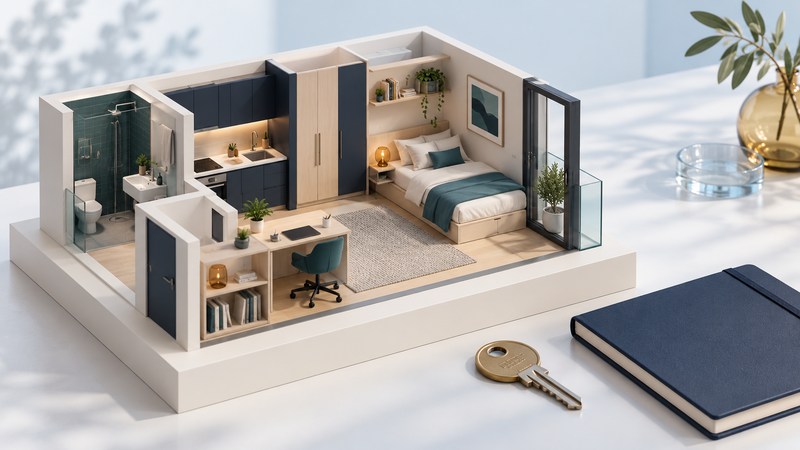
Compare student housing by the full period you must pay for, the conditions you agree to and the daily life the location makes possible. A pool or attractive model room tells you much less than a clear contract, a workable commute and a place where you can sleep and study.
Make a shortlist with three essentials, such as step-free access, a maximum cash commitment or a bus route that serves evening classes. Then use the same questions for every residence. The printable housing comparison sheet separates money, contract questions and tour observations.
Compare the full commitment
Record the move-in and move-out dates, number of required payments and what each payment covers. Establish whether the advertised amount is per person, per bed or for the entire apartment. An academic-year contract and a twelve-month lease can have very different totals even when their monthly figures look similar.
Use the provider's current official rates and the actual offer. For example, UCI's housing rates page separates residence options and meal plans and directs readers to individual American Campus Communities properties for their rates. That structure is a useful reminder to compare the exact room and plan you are offered.
Separate refundable deposits from expenses. A deposit still increases cash needed before move-in; its eventual return depends on the applicable terms and circumstances. Keep unconfirmed summer subletting or roommate income outside the base budget. For each quote, record:
- All required payments and nonrefundable fees over the contract term.
- Utilities, internet, meals, laundry, parking and commuting costs that are additional.
- Move-in cash, including deposits and advance payments.
- Furniture or household items you would need to supply.
- The amount you would still owe if your plans changed, as confirmed by the provider.
Get clear answers before signing
Read the complete agreement and any rules it incorporates. Ask the housing office or provider to identify the clause that answers a question. The UCI housing contract guidance, for instance, explains that withdrawal from the university does not automatically end its housing contract. Treat that as an institution-specific example and check your own agreement.
- Responsibility: Are you renting one bed or sharing responsibility for a whole unit? What does a guarantor promise?
- Changes: What happens if admission, financial aid, a study-abroad plan or a roommate arrangement changes?
- Ending early: What cancellation, termination, transfer or replacement-resident process applies? Who must approve it, and what remains payable?
- Access dates: Can you remain during breaks? Are dining and building services available then?
- Assignment: Is the advertised room guaranteed, or is the contract for a room type assigned later?
- Support: Which office handles accessibility requests, maintenance and disputes?
Save written responses with the agreement. If a consequential clause remains unclear, use your institution's student legal service or another qualified local adviser before committing. Housing rules and rights depend on the location and type of agreement.
Tour for an ordinary weekday
Walk the actual route to a likely class, grocery source and evening transport stop. Check current operating hours as well as distance. A short route with limited service may be less useful than a longer dependable connection.
Request the actual unit or a clear explanation of how a model differs. Look at desk space, storage, natural light, outlets, kitchen access and the path to laundry. Ask how repairs are reported, how urgent issues are handled and how residents receive updates. Request permission before photographing occupied spaces.
For accessibility, confirm the whole route: entrance, lift if needed, doorways, bathroom, room furniture and common facilities. Ask the responsible office to confirm specific arrangements. “Accessible building” is too broad to answer every person's needs.
Record noise and conditions you directly observe, plus anything still unverified. A quiet midday tour does not establish what the room is like during evening activities.
Make shared living expectations explicit
Discuss sleep and study times, guests, cleaning, food storage, shared purchases and how to raise a concern. Write down who pays for each shared service and how to settle a bill when someone leaves. Use the residence's own roommate-agreement process where available.
Agree on a small first step for a disagreement, such as a scheduled conversation, and identify the resident adviser or housing contact if it persists. Private roommate promises do not change the contract with the provider.
Choose with the unknowns visible
Eliminate options that miss an essential requirement. Compare the remaining homes on complete cost, daily fit and the clarity of the agreement. Resolve your highest-impact unknown before paying a nonrefundable charge. Keep your offer, contract, payment receipts and move-in condition record together.
Continue with course-material costs and using a campus laundry service to finish a practical student-living plan.