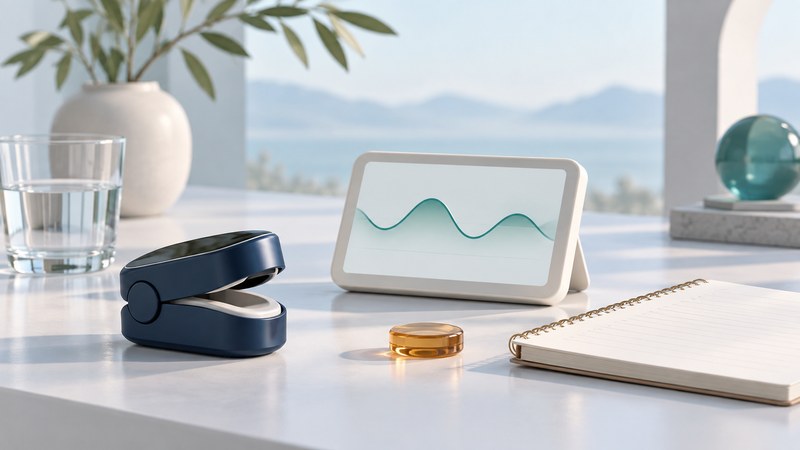
A biofeedback monitor makes a body signal visible or audible while you practice a skill. For stress management, some systems pair heartbeat timing with breathing guidance. The useful outcome is whether the practice helps you function and feel better, alongside appropriate care.
Separate the signal, the score, and the outcome
Heart-rate variability, or HRV, describes variation in the time between successive heartbeats. Heart rate is a different quantity: the number of beats per minute. Breathing can change the pattern of heartbeat intervals, which is one reason breathing feedback can produce a visibly smoother rhythm.
In a published HRV-biofeedback methods study, investigators describe using ECG or optical pulse measurements to provide feedback and emphasize the need to assess training quality. An optical pulse trace, its interval estimates, and a software “stress” score are separate stages. Ask what the particular device measures and how it handles poor signals.
A displayed score may depend on the maker’s algorithm, sensor conditions, and measurement period. Treat comparisons between different products cautiously. A higher session score is evidence about that metric during that session; everyday sleep, mood, and function require separate observation.
On a small screen, scroll the table sideways to read all columns.
| Tool or output | What it offers | Question to ask |
|---|---|---|
| Breathing pacer | A timed prompt to guide practice | Does it sense my body or only play an animation? |
| HRV biofeedback | Feedback derived from measured heartbeat or pulse timing | How is signal quality checked, and what skill am I practicing? |
| Wearable stress estimate | An algorithmic interpretation of recorded signals | What validates this score and which conditions affect it? |
Look for evidence that matches the claim
The NCCIH review of relaxation techniques describes promising evidence for HRV biofeedback in reducing self-reported stress and anxiety. It also shows how results and evidence quality vary by condition. A study of structured training with professional support does not automatically validate every app displaying a breathing animation.
Ask whether the research used the exact system, how many people participated, what the comparison group did, how long benefits were followed, and which outcome improved. A change in a physiological measure and a meaningful change in daily distress answer different questions.
In the United States, the FDA’s general-wellness device policy addresses low-risk products promoting a healthy lifestyle. A general-wellness claim should not be interpreted as FDA verification of treatment effectiveness. If a seller claims a medical authorization, check the exact device and its intended use.
Choose a practice you can use comfortably
For ordinary relaxation practice, begin seated in a comfortable place where you can stop easily. Follow the device’s instructions or a clinician’s program. Avoid forcing very deep breaths or holding your breath to improve a score. Stop if the exercise causes dizziness, distress, or uncomfortable breathlessness, and seek advice if symptoms persist.
Specialist HRV training may involve finding an individual breathing rate. The resonance-frequency assessment guide explains why monitoring breathing and recognizing overbreathing matter. A generic pace on a screen is not an individualized prescription.
A timer, a simple breathing prompt, or a clinician-taught relaxation exercise can be a comparison option. Choose the least complicated arrangement that supports the intended practice. Persistent anxiety, panic, or disrupted sleep warrants an appropriate assessment; a monitor can accompany care without deciding the diagnosis.
Check the practical commitments before buying
- Signal: Which sensor is required, where is it worn, and how does the system flag an unreliable reading?
- Access: Can you read or hear the feedback comfortably? Does it work with your phone and accessibility settings?
- Cost: What remains available without a subscription, and what does replacement hardware cost?
- Privacy: Where are recordings stored, who can receive them, and can you export and delete them?
- Support: Is instruction included, and can you try the system before committing?
Use the biofeedback comparison sheet (plain text) to record these answers and one everyday outcome you hope to improve. For recognizing physical symptoms and knowing when to seek assessment, see physical symptoms of stress.
Researched and updated October 2, 2026. General information for planning and discussion; individual care and technical decisions depend on the circumstances. Sources are linked beside the claims they support.