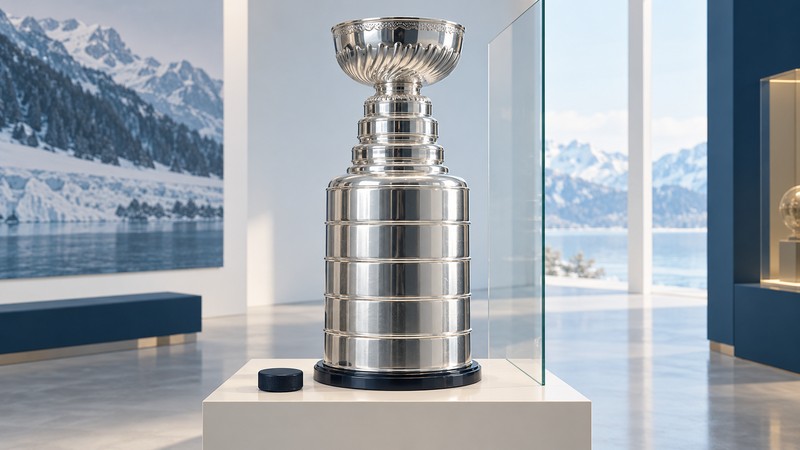
The Stanley Cup is both a hockey championship trophy and a physical record of winning teams. Its bowl, added bands and engraved names connect different generations. Understanding those parts makes a museum visit, an old photograph or a championship celebration easier to read.
From a donated bowl to hockey’s trophy
The Hockey Hall of Fame’s Cup history records Lord Stanley’s donation in 1892 and the first award to the Montreal Amateur Athletic Association in 1893. The trophy’s early competition belonged to a different hockey landscape; only NHL teams have competed for it since 1926.
Those dates answer different questions. Donation identifies the trophy’s origin, first award identifies its first champion, and the later NHL-only period identifies the competition around it. When comparing an early team with a modern champion, establish the season and league context first.
Read the shape of the Cup
The tall trophy developed through additions and changes to the original bowl. The Hall describes the modern form as a bowl, tiered bands, a collar and five broad barrel bands. Older bands are retired to make room for later champions, and the original bowl and retired bands are preserved at the Hall.
Scroll sideways on small screens. Keyboard users can focus the table and use the arrow keys.
| What you see | What it represents | Useful question |
|---|---|---|
| The original bowl | The beginning of the trophy’s physical history. | Does the museum label identify the original object? |
| A broad engraved band | A group of championship records. | Which seasons and teams are visible? |
| An older photograph | The trophy at a particular stage of its history. | When was it taken, and what was its shape then? |
The Hall’s measurement and engraving reference lists the full trophy at 35¼ inches tall and 34½ pounds. The original bowl is much smaller. Museum labels and dated photographs help distinguish the object or historical configuration being shown.
Why the names deserve a closer look
The Hall records the 1906–1907 Montreal Wanderers as the first team to engrave its roster, with annual roster engraving becoming a tradition in 1924. Its reference also documents spelling errors and corrections, including Adam Deadmarsh’s corrected name on Colorado’s 1995–1996 inscription. The metal therefore records both achievements and the practical work of preserving them. See the Hall’s engraving examples for photographs and details.
Read an inscription in three passes: find the team, find its championship season, then identify the person. Check a name against an official team or museum record when spelling is unclear. A partial photograph can omit the surrounding season or another line that explains what you are seeing.
A person’s absence from the visible surface is only a starting point for research. The relevant band may be retired or outside the photograph. Find the season’s record before drawing a conclusion about participation or recognition.
The ceremony and the personal celebration
The presentation after the deciding game turns a team result into a shared moment. In its journal of the 2003 New Jersey championship, the Hall describes custodians accompanying the trophy, preparing it for the ceremony and carrying it to the ice. The account then follows the captain’s lift and handoff to a teammate. It is a useful dated example of the people and preparation behind the television image.
The summer tradition gives winning players and staff time with the trophy, described by the Hall as a day with the Cup. For a particular celebration, look for a dated team account or Cup journal. Those records can establish the person, place and occasion more reliably than an image circulated without context.
Follow the route to a championship
The NHL playoff format has 16 teams and four best-of-seven rounds; four wins take a series.
For a current postseason, start a simple bracket record with the season, round, opponents and series score. Recheck the official bracket after each deciding game. For historical research, use the NHL’s yearly playoff results to identify the appropriate season before following a team’s path.
Four series wins with four game wins in each require sixteen playoff victories. That arithmetic explains the scale of the run; the specific opponents and schedule belong to the season you are following. The Washington Capitals game-planning guide helps connect a matchup to its viewing or travel details.