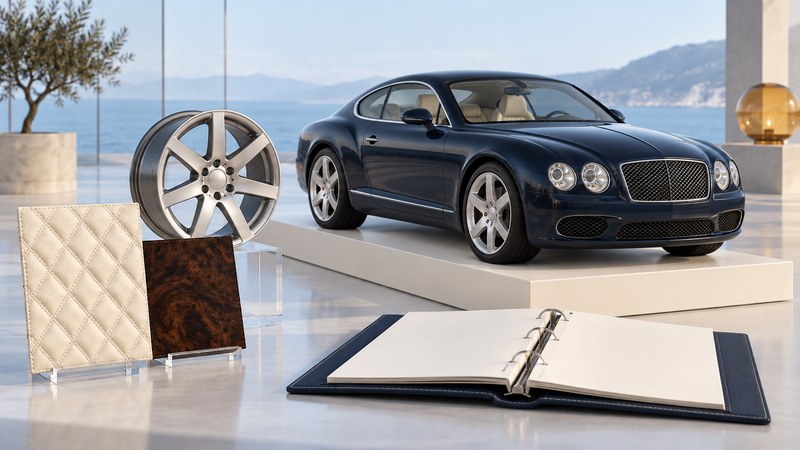
On an early Bentley Continental GT, quilted leather or attractive wheels can suggest a specification, but neither establishes what left the factory. To evaluate a claimed 2005 Mulliner Driving Specification, compare the period package description, records tied to the car, and the equipment fitted now.
This guide is about that early package and the evidence behind a listing. The Mulliner name used for other model years or later Bentley programs does not make their equipment lists interchangeable.
What the period package description contains
Bentley's November 2004 announcement, preserved by Automotive Intelligence, describes the 2005 package with 20-inch two-piece seven-spoke wheels, drilled pedals and footrest, a knurled chrome-and-hide gear lever, two-tone leather, diamond quilting, embroidered seat emblems, an indented hide headlining and specified dark walnut or piano-black trim. These details identify the historical offer; they do not authenticate an individual car.
The same release's wheel-and-tire combination is period specification evidence, not a replacement-tire recommendation for a vehicle whose wheels may have changed. Confirm present fitment against the actual car's approved documentation and a qualified supplier.
Keep four kinds of claim separate
On a narrow screen, scroll the table sideways. Keyboard users can focus the table region and use the arrow keys.
| Claim | Useful evidence | What remains uncertain |
|---|---|---|
| Factory Mulliner package | A build specification or original order record tied to the vehicle, interpreted for its market and year. | A seller description or a single trim detail does not establish the complete factory package. |
| Individual factory option | An itemized original record identifying that option for the car. | An option may be genuine without proving that a named package was ordered. |
| Equipment present today | Dated photographs, inspection notes and identifiable components. | Appearance alone does not establish installation date or factory origin. |
| Later change or restoration | Invoices and part records describing the work and affected items. | A later genuine Bentley component is not evidence that this car originally had it. |
A missing document is an unresolved question, not automatic proof of a false claim. Equally, an impressive folder is only useful when the documents identify the car and the relevant equipment. Keep “factory record confirms” separate from “visible at inspection.”
Audit a listing before relying on its label
- Fix the identity. Record model year, build date if documented, original market and the exact package wording used by the seller. A registration date may answer a different question from model year.
- Request the record behind the claim. Ask for a vehicle-specific build specification or original order evidence. Compare identifiers privately; redact them from anything shared publicly.
- List each claimed feature. Put the period package description in one column and the car's documented and observed equipment in separate columns. Do not infer an entire package from quilting.
- Resolve differences one at a time. A wheel, headlining or trim mismatch could reflect an incorrect listing, a later change or incomplete information. Ask for invoices and a specialist's interpretation rather than selecting the most flattering explanation.
- Write a bounded conclusion. State which claims are documented, which are observed and which remain open. Keep mechanical condition, maintenance and current fitment as separate inspection questions.
Factory specification and present condition answer different needs. Authentic original trim can be worn; a well-documented replacement can be serviceable. Neither status alone determines whether the particular car meets your needs.
Worked example: promising photographs, incomplete records
Fictional listing: photographs show diamond-quilted seats, drilled pedals and wheels resembling the period package. The seller provides an invoice for later wheel replacement but no build specification.
The defensible result is: “Three appearance features observed; wheel replacement documented; original Mulliner package not yet established.” Request the factory record and enough information to identify the replacement wheels. Do not turn “not established” into either “definitely genuine” or “definitely false.”
If a later build record confirms the package, update that one conclusion. The wheel invoice still matters because the car's current configuration differs from its original delivery specification. Keeping both facts avoids losing useful history when new evidence arrives.
Use an evidence record
Download the Mulliner specification evidence record. It includes separate spaces for the seller's wording, historical package source, vehicle-specific records, observed parts and remaining questions.
For a different example of separating an edition claim from equipment and service history, see the Maserati Quattroporte guide. The method transfers; its model-specific conclusions do not.
Explore Autos: vehicle guides, technology and design · Cars: buying, maintenance and ownership