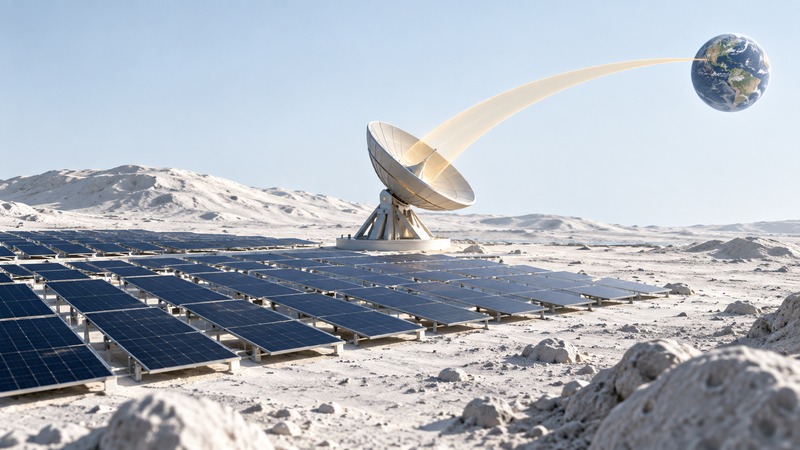
A lunar solar-power system for Earth would need to collect sunlight on the Moon, convert the energy into a transmitted form, deliver it across space and recover usable electricity on Earth. Assessing that complete chain is more informative than comparing incoming sunlight with global electricity demand.
Three applications deserve separate treatment: solar power used by a lunar base, solar power collected by an orbiting spacecraft for Earth, and lunar-surface generation intended for Earth. They share some technologies but have different locations, infrastructure and delivery requirements.
Understand the lunar proposal
David Criswell's Lunar Solar Power System and Lunar Development paper, preserved in NASA's technical archive, proposed bases near opposite lunar limbs, microwave transmission and receiving antennas called rectennas on Earth. Some receiver locations would also require redirecting satellites in the proposed architecture.
The paper's large-scale output and low-cost figures are projections of that proposed system. They depend on assumptions about construction, manufacturing and operation. Hosting in a NASA archive identifies a research record; it is not an approval of a commercial project or evidence that its projected performance was achieved.
Account for every stage
On a narrow screen, scroll the table horizontally. Keyboard users can focus the table and use the arrow keys.
| Stage | Quantity to establish | Practical dependency |
|---|---|---|
| Collection | Electrical output over the illumination cycle | Site, panel performance, terrain and maintenance |
| Transmission | Input power, conversion losses and beam control | Large transmitting equipment and reliable pointing |
| Reception | Captured energy and electrical conversion | Receiver area, visibility and operating conditions |
| Grid delivery | Net power, timing and availability | Conversion, interconnection, storage and backup |
NASA's Moon questions and answers explains the approximately 29.5-day cycle relative to the Sun. A lunar site therefore needs an explicit illumination analysis. Latitude, terrain and horizon matter; tidal locking to Earth does not give the near side continuous sunlight.
Ask how a proposal supplies power when collectors lack sunlight or a receiver lacks a suitable view. Storage, additional bases and relay equipment each add requirements. Include lunar dust, thermal conditions, replacement parts and maintenance in the lifetime plan.
Multiply conversion factors instead of adding them
Fictional transmission-chain calculation
Begin with 100 MW of electricity already produced by hypothetical lunar panels. Assume 70% conversion to transmitted energy, 80% capture at the receiver and 85% conversion to grid-deliverable electricity. The result is 100 × 0.70 × 0.80 × 0.85 = 47.6 MW.
These invented factors are not measured performance for a lunar system. The starting point excludes sunlight-to-electricity conversion, and the example omits other auxiliary and storage losses. Those terms must be added to a real assessment with clearly defined boundaries.
Power at one instant also differs from annual energy. A project supplying 47.6 MW for one hour delivers 47.6 MWh during that hour; annual delivery requires a supported availability and operating schedule. State whether a claim concerns peak output, average delivery or firm service at specified times.
Match demonstrations to the claim they support
Caltech's January 2024 SSPD-1 mission report describes in-space tests of deployable structures, solar cells and wireless power transfer, including a beam directed toward Earth. These results address components and experimental operation in orbit. They leave the construction and operation of an Earth-supplying lunar installation as a separate engineering proposition.
NASA's 2024 space-based solar-power assessment examines two conceptual orbital systems and their lifecycle costs and emissions under future assumptions. Its results should be read within that orbital study boundary, rather than assigned directly to Criswell's lunar architecture.
A strong proposal review ends with an energy-flow diagram, site and receiver assumptions, demonstrated versus projected capabilities, construction and maintenance requirements, and a sensitivity analysis for cost and availability. Include spectrum, exposure and land-use approvals among the unresolved deployment requirements. For a broader comparison of electricity services and system boundaries, read clean-energy options.