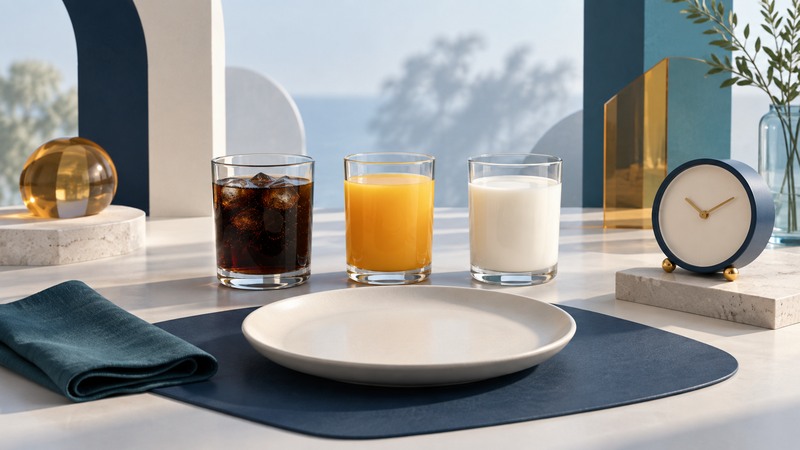
A beverage study can measure thirst, reported fullness, food eaten at the next meal or total energy intake. Those outcomes answer different questions. The cola, orange juice and milk research associated with early-2000s headlines is useful precisely because it shows why the outcome and the time window matter.
Read the experiment before the headline
In a 2003 paper by Almiron-Roig and Drewnowski, 32 adults aged 18–35 attended four test visits. Each breakfast included toast and 590 mL of cola, orange juice, 1% milk or sparkling water. The three caloric drinks supplied equal energy. Participants rated hunger, thirst and fullness over two hours, then ate lunch about two hours and fifteen minutes after breakfast.
The caloric beverages produced greater reported fullness than water, with similar ratings among the three caloric drinks. Lunch intake did not compensate for the beverage energy. The study therefore supports a short-term comparison under that breakfast protocol. It does not measure long-term weight change or establish that the drinks have equivalent nutritional value.
The toast, large test portion and timed lunch are part of the result’s meaning. A small drink with a different meal, or freely chosen portions across a day, would be a different experiment. The publisher’s record also acknowledges support including a National Soft Drink Association grant to Drewnowski. Funding belongs in the assessment alongside the design and results.
Separate four questions
On narrow screens, scroll the table sideways. Keyboard: focus the table and use the arrow keys.
| Outcome | What the measurement can show | What else you would need |
|---|---|---|
| Reported thirst | How thirsty participants say they feel at specified times | Hydration measurements to evaluate physiological fluid status |
| Reported fullness | A subjective response after the test meal or drink | Measured intake to establish how much participants later eat |
| Next-meal intake | Food consumed during that particular meal | Longer observation to describe intake across a day or week |
| Total energy or nutritional quality | The measured food and drink combined, or their composition | Longer and appropriately designed evidence for health outcomes |
An accurate headline names the measured outcome. “Similar fullness ratings after these test breakfasts” is narrower and more useful than treating one sensation as a verdict on a beverage category.
Check what later research adds
A 2013 randomized crossover meal study involved 29 adults offered pizza with water, milk, sugar-sweetened cola, orange juice or diet cola. Participants could consume the offered beverage and food freely. Food energy intake was similar across conditions, while the caloric beverages increased total meal energy.
That experiment changes the setting from a fixed breakfast drink followed by a later lunch to freely consumed drinks alongside a meal. It adds evidence about compensation within that meal. Both designs remain short-term experiments; a claim about habitual consumption needs a study that actually observes or changes habitual consumption.
This is a useful way to read apparently conflicting reports: compare what participants were offered, how much they could choose, when food was available and what the researchers counted. Differences in those details can produce different answers without either paper addressing the whole question.
Add the drink to the meal arithmetic
Hypothetical example: a meal contains 700 kcal and its accompanying drink contains 150 kcal. The combined amount is 850 kcal. If a person ate the same meal with a zero-calorie drink, the combined amount would be 700 kcal. For complete energy compensation, food intake would have to fall by the drink’s 150 kcal.
That example defines compensation; it predicts no individual’s appetite. Feeling fuller and consuming fewer calories are separate observations that can be recorded and tested.
Nutritional comparison adds another layer. Read protein, calcium, sugars and other relevant values from the actual product label at the consumed portion. Similar energy or fullness does not make those quantities equal. Use the soda label guide for portions and sugars, and the hydration comparison for fluid and caffeine context.
A five-minute study reading routine
Write down the participants, sample size, drink and portion, comparison, duration and measured outcome. Then look for the result between groups, uncertainty, funding and the authors’ stated limits. Mark information unavailable in the abstract as unknown until you consult the full paper.
Finally, rewrite the claim with its boundaries: “In this group, after this amount, during this interval, this outcome differed or did not differ.” If the practical question concerns an outcome outside that sentence, look for additional evidence. This small step keeps an interesting experiment useful without asking it to answer more than it tested.