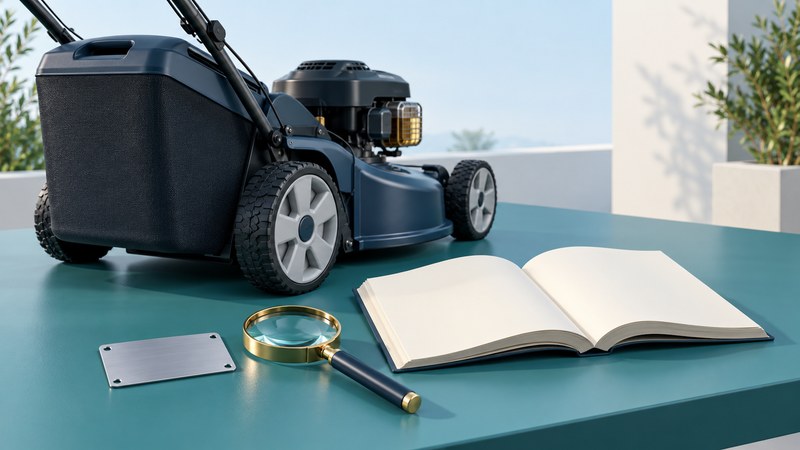
Start a Snapper owner inquiry with the numbers on the machine. A brand name or a familiar-looking mower is too broad for a reliable parts match. Build a short identification record, find the documents that cover it, and use the appropriate regional service route.
Record the mower and engine identities separately
Snapper’s identification guidance directs owners to the product identification label for the model and serial numbers. Photograph the entire tag while the equipment is safely stopped and copy its characters carefully. Record any suffix or revision as well as the main number. Keep this record somewhere accessible when the mower is at a shop.
A gasoline mower may also have separate engine identification. The chassis and engine are different assemblies; the number needed for an engine part can differ from the number needed for a drive cable or deck component. If you cannot locate a label safely, ask support to help locate it rather than tipping or dismantling the mower.
If a label is unreadable, collect photographs of the machine, remaining markings, purchase documents, and known history for a dealer. Treat a resemblance to an online photograph as a clue, not a confirmed identity.
Match manuals before ordering parts
Snapper’s official manual and parts-list search shows several model-number formats, including seven-digit numbers and versions with suffixes such as -00 or -01. Enter the format that matches the product tag. Download the operator manual and the illustrated parts list for the covered model and revision.
| Document | Use it for | Check before relying on it |
|---|---|---|
| Operator manual | Operation, shutdown, inspection, maintenance, storage, and restrictions. | Model, serial coverage, market, revision, and attachments. |
| Illustrated parts list | Identifying assemblies and their listed part numbers. | Variant, diagram reference, quantity, and any superseded number. |
| Separate engine or battery documentation | Care and support for the fitted power system. | Exact engine, battery, and charger identification. |
A parts diagram helps identify a component; it does not supply every removal, installation, or adjustment procedure. Ask the supplier to confirm the part against the complete identification record and clarify returns before ordering. A replacement listed for a similar deck width may still be the wrong part.
Choose the service route for your product
The US Snapper parts and service page separates support routes for certain retail purchases, dealer purchases, and 60V lithium-ion products. Follow the route applicable to your equipment. Owners outside the US should use their regional Snapper support channel, since product ranges and arrangements can differ.
Ask whether the provider supports your model, whether the needed documents or parts are available, and what diagnostic fee applies. Have purchase information and warranty documents ready. Obtain instructions before transporting the mower or shipping a component, especially a battery.
For a used mower, request the manual, service history, included accessories, and any known unresolved faults. Compare identification details with CPSC recall notices when applicable. Inspect condition and operation through an appropriate qualified assessment before putting an unfamiliar machine to work.
Keep one owner record
- Mower model, serial number, revision, and a clear tag photograph.
- Separate engine or battery/charger details and matching manuals.
- Purchase information, warranty documents, and service contact.
- Parts ordered, work completed, and outstanding questions.
- Maintenance intervals copied from the correct documents.
Use the maintenance guide to turn those intervals into a schedule. If the mower develops a fault, the repair guide helps you describe symptoms and prepare a service request. Keep those tasks separate from guessing a part from a general product description.
Recheck support information when buying parts or arranging work. Availability and service channels can change, while a complete identification record remains useful throughout ownership.