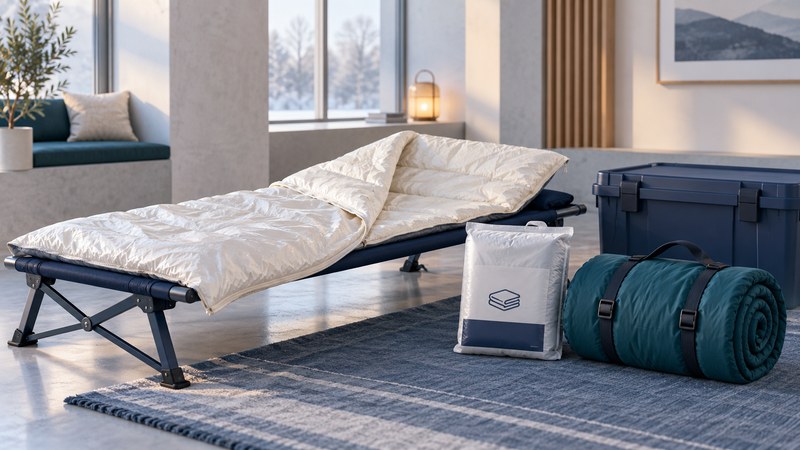
Choose emergency-shelter bedding for the people, room conditions, and length of stay you expect. Disposable sleeping bags can simplify some supply and laundry tasks, while reusable bedding may suit other settings. The useful comparison includes warmth, fit, hygiene, storage, and replacement arrangements.
This guide addresses adult and older-child bedding in managed shelters. Infant sleep arrangements need separate equipment and planning. A sleeping bag cannot compensate for an unsuitable shelter environment.
Begin with the sleeping environment
Record whether the space will be heated or cooled, what happens during a power failure, whether people sleep on cots or another approved surface, and who needs assistance. FEMA's functional-needs shelter guidance includes accessible cots or beds, cribs, placement adjustments, and appropriate environmental temperature among the accommodations to plan.
Ask shelter and accessibility staff how people will get into and out of the proposed bedding. A narrow opening or closure that is hard to operate can make an otherwise convenient product unsuitable. Provide a way for residents to report discomfort, dampness, damage, or a need for different bedding.
Ask what the specifications actually establish
Disposable bedding uses a range of materials and constructions. “Lightweight,” “fluid barrier,” and “compact” describe different properties from thermal performance. Request the exact model's intended use, test method and conditions behind any warmth claim, sizes, materials, storage conditions, and replacement instructions.
ComfortOne was promoted in 2006 as a compact disposable sleeping bag with a pillow. A historical announcement is not a current product specification. Graham Medical's published Comfort1 blanket sheet concerns blankets; it should not be treated as confirmation that the earlier sleeping bag has the same construction or remains available. Obtain a current model sheet from the supplier before procurement.
On a narrow screen, scroll the table sideways. Keyboard users can focus the table region and use the arrow keys.
| Criterion | Single-use option | Reusable option |
|---|---|---|
| Warmth and comfort | Require evidence for the actual item and setting. | Require evidence for the actual item and setting. |
| Turnover | Plan replacement stock and disposal. | Plan collection, washing, drying, and clean storage. |
| Space | Measure packed volume and access to replenishment. | Include clean stock and separate used-item holding space. |
| Resident needs | Check size, opening, skin-contact materials, and assistance. | Check the same factors plus compatibility with the laundry process. |
| Total effort | Count purchase, transport, distribution, replacement, and waste. | Count purchase, laundry, handling, loss, and replacement. |
Plan the path from storage to replacement
Keep clean stock protected under its storage instructions. Inspect packages before issue and record damaged stock separately. Assign bedding to a resident and follow the shelter's hygiene procedure for wet, soiled, or damaged items. Follow the product's permitted use; avoid converting a single-use item into a laundered reusable one without manufacturer support.
Agree with the shelter's public-health lead on handling and disposal procedures. “Disposable” describes intended reuse, while sterility, infection control, and any barrier performance require their own evidence. Keep enough suitable replacements accessible during the hours the shelter operates.
Work through a stock example
Keep infant sleep provision separate
CDC's disaster guidance for families advises placing babies on their backs in their own sleep area, such as a portable crib or bassinet, without pillows, blankets, or toys. Adult sleeping bags and cot bedding do not meet that planning need. Ask the shelter lead to arrange appropriate infant sleep equipment and support.
Download the bedding comparison worksheet. Complete it before ordering, retain the model documentation, and test the distribution process in a planned exercise. Include the supplier and reorder contacts in the facility's outage communications plan.