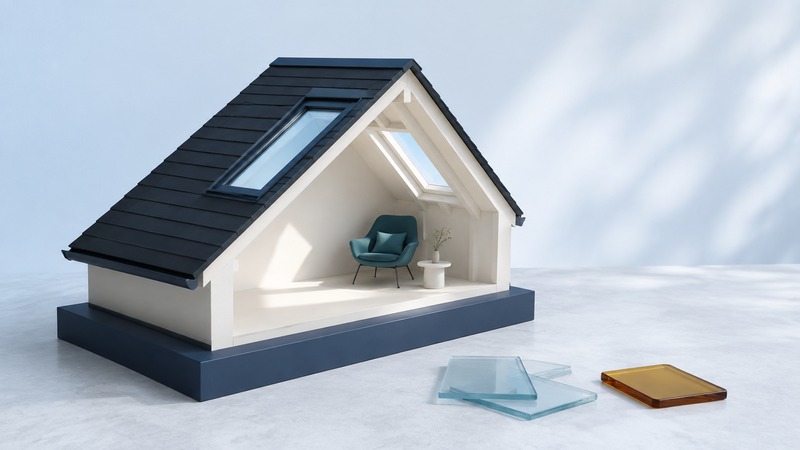
Begin with the room: where daylight would help, when you use the space, and how you want to control brightness and heat. Then have an installer connect that goal to the roof structure, the ceiling, and a suitable skylight system. The most useful proposal explains both the room experience and the construction work.
Choose the kind of daylight opening
Swipe horizontally to read the table, or focus it and use the arrow keys.
| Option | Useful role | Questions to resolve |
|---|---|---|
| Fixed skylight | Daylight and a view through a glazed roof opening | Placement, size, glare control, and cleaning access |
| Venting skylight | Daylight with an opening for ventilation when conditions suit | Reach, controls, power, rain response, insect screen, and service access |
| Tubular daylight device | Bring roof daylight through a tube to a ceiling diffuser | Roof-to-ceiling route, tube length and bends, diffuser location, and available control |
Sketch the room and mark the desk, worktop, seating, screens, and usual viewing directions. Ask for a daylight assessment at the times you use those areas. A ceiling diffuser can suit a compact interior space, while a glazed skylight can provide a direct sky view.
Discuss ventilation as part of the home’s wider plan. Keep bathroom and kitchen exhaust arrangements appropriate to their moisture and cooking loads. An operable skylight can add ventilation when the weather and outdoor air are suitable; plan how the room will function when it is closed.
Compare glazing and light control
Ask for the whole-product ratings for each proposed configuration. NFRC’s residential certification program covers U-factor, solar heat gain coefficient, and visible transmittance, among other performance measures. Use the exact product configuration and rating information when comparing offers.
- U-factor describes heat transfer: a lower value means less heat passes through the product under the rating conditions.
- Solar heat gain coefficient (SHGC) describes admitted solar heat: a lower value admits less.
- Visible transmittance describes the proportion of visible light transmitted. Discuss it alongside the opening size, shaft, and shade.
Department of Energy guidance explains that climate affects suitable U-factor and SHGC choices. Ask the designer to relate the ratings to your climate, roof orientation, surrounding shade, and summer comfort. Request compatible shades and a plan for reaching their controls.
Record the exact glazing option, shade type, and any electrical or communications accessories in the quote. Compare the everyday use: how the shade opens, whether it provides the desired darkness, and who can service the mechanism.
Match the system to the roof
Have the installer verify roof pitch, covering, opening dimensions, framing, and the path through any attic or light shaft. Ask whether framing alterations need a designer or engineer and who handles permits. Include the shaft’s insulation, air sealing, interior finish, and painting in the scope.
VELUX’s replacement guidance explains that each skylight and flashing kit has particular pitch requirements. Obtain the approved combination for your roof. A deck-mounted unit attaches at the roof deck; a curb-mounted unit sits on a raised curb. Have the installer select the appropriate system and confirm the condition of any retained curb.
Flashing directs roof water around the opening. VELUX’s flashing-system documentation distinguishes kits for different roof materials and mounting arrangements. Ask how the skylight, underlayment, flashing, and roofing will form the specified water-shedding assembly, and how concealed deterioration will be handled.
If the roof is approaching planned replacement, discuss the two projects together. Ask which skylight components can be retained, which should be renewed, and how the installation warranty applies. Request separate written terms for the product, flashing installation, and contractor workmanship.
Specify controls and access
For a venting unit, decide between reachable manual operation and an appropriate powered system. Confirm what comes with the product, how power is provided, and what additional equipment is required for the control method you want. Include a demonstration of normal operation at handover.
Some VELUX powered skylight systems include rain sensors that close the opening. Verify the exact model’s functions, sensor care, and behavior during power or communications loss. Choose a practical method for closing the unit and operating the shade that suits everyone who uses the room.
Plan future access to glass, screens, shades, and operating parts before work starts. Put roof access and elevated exterior maintenance in a professional service plan. Keep cleaning instructions and the product identification label or model record accessible indoors.
Use moisture observations to guide service
Record where moisture appears: on the room-side glass, between panes, around the frame, or on the shaft lining. Add indoor conditions, recent rain or snow, and the time of day. Photographs from the same viewpoint help the service technician follow the pattern.
VELUX’s condensation explanation connects surface moisture to humidity and cold surfaces. Ask the technician to assess room moisture, air sealing and insulation, glazing condition, and roof water entry as appropriate. These possibilities call for different repairs.
Arrange prompt service for persistent wetness, growing stains, or damaged finishes. Review the system after work is complete, and keep a record of the diagnosis, repair, and follow-up observations. That record makes future roof or skylight maintenance easier to plan.