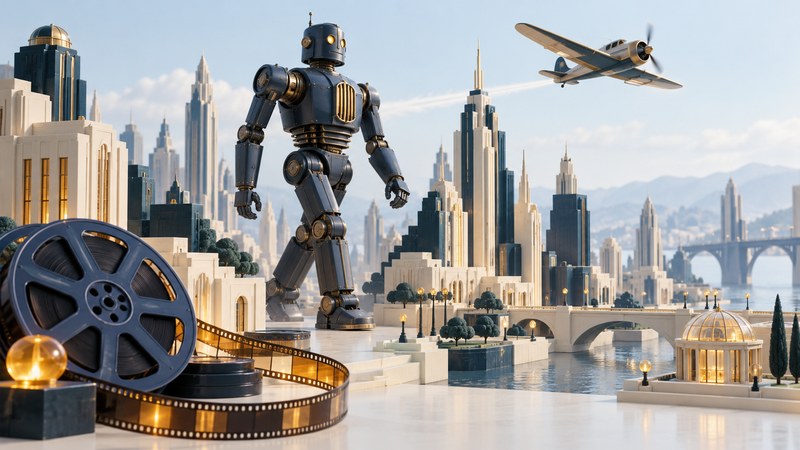
Sky Captain and the World of Tomorrow uses giant robots to make an imagined technological past feel enormous. Its machines belong to a world of propeller aircraft, monumental cities and adventure serials. Placing them beside other screen robots reveals how filmmakers use the same mechanical body to create fear, comedy, companionship or wonder.
Kerry Conran's 2004 film follows reporter Polly Perkins and aviator Joe Sullivan as they investigate disappearing scientists and attacks by machines. Paramount's film page supplies the basic story and credits. The discussion here focuses on visual design and broad themes, without revealing the ending.
Why the giant robots fit this world
The opening attack makes scale part of the story. A robot moving among buildings turns the city into a measuring device: streets, windows and aircraft tell us how large the machine is. Repeated bodies and coordinated movement suggest a force whose individual members matter less than the system directing them.
Read those design choices alongside the human protagonists. A reporter searches for a story; an aviator responds through skill and movement. The robots supply a contrasting rhythm of mass and repetition. This is an interpretation of their dramatic role: the machines make technological power visible before the characters understand its source.
Retrofuturism means imagining the future through the forms of an earlier period. Here, the robot shares a visual world with streamlined transport and monumental architecture. Its apparent age is part of the pleasure. It looks as though an earlier era's drawing of tomorrow has gained the weight and motion of a film spectacle.
The direct connection: The Mechanical Monsters
The strongest starting point is the Fleischer Studios Superman short The Mechanical Monsters (1941). Fleischer Studios dates its release to November 28, 1941. Its mechanical menace provides a particularly close comparison for Sky Captain's robot imagery.
This connection is supported by testimony from the production. In an interview with cinematographer Eric Adkins, he describes Conran's early robot animation work and explicitly connects it to Fleischer's mechanical monsters. That is stronger evidence of an influence than a resemblance noticed afterward.
Watch the two works for silhouette, the relationship between robots and urban space, and the way flying heroes move around mechanical threats. The comparison also crosses media: a hand-drawn animated world and a later film combining photographed actors with extensive digital imagery can share a visual imagination.
The other films below are a viewing framework for comparison. Their inclusion does not assert that each directly influenced Conran.
A selective history of screen machines
| Film | Robot's role | What to notice beside Sky Captain |
|---|---|---|
| Metropolis (1927) | A machine takes on a human likeness. | The robot and the monumental city turn questions about power into visible forms. |
| The Mechanical Monsters (1941) | Mechanical antagonists confront Superman. | The closest documented connection: graphic silhouettes and machines as urban spectacle. |
| The Day the Earth Stood Still (1951) | Gort embodies an overwhelming power accompanying a warning. | Stillness and restraint can make a robot imposing, as well as size and motion. |
| Forbidden Planet (1956) | Robby is an individual mechanical character. | A distinctive voice and manner give a machine an identity beyond its outline. |
| Star Wars (1977) | R2-D2 and C-3PO are companions and active participants. | Contrasting bodies, sounds and temperaments make machines memorable as a pair. |
| The Iron Giant (1999) | An enormous robot becomes a child's friend. | Size can support tenderness; the story determines how the audience reads it. |
| Sky Captain (2004) | Giant machines drive an adventure mystery. | A digital production revives the mechanical spectacle of an imagined past. |
| WALL-E (2008) | A working robot becomes the emotional center of the film. | Small gestures and attention to objects can carry character with little dialogue. |
The BFI's robot-film survey provides historical context for Metropolis and The Day the Earth Stood Still. For character references, consult the official R2-D2 and C-3PO entries, Pixar's WALL-E production page, and the Robot Hall of Fame exhibit's Robby and Iron Giant entries.
The sequence is not a simple change from frightening robots to friendly ones. Both possibilities recur. A robot's shape establishes possibilities; performance, framing and story tell us which of them to feel.
Modern production, deliberately old-fashioned imagination
In his production-design interview, Kevin Conran describes an original ambition to make something resembling a rediscovered black-and-white adventure from the 1930s. That recollection helps explain the film's visual restraint and its fascination with an earlier idea of technological grandeur.
Adkins' account describes the production's early presentation film and its transition into working with actors and blue-screen photography. Digital construction gave the filmmakers a way to place human performances inside spaces and attacks that would be difficult to build at physical scale.
The result invites two kinds of looking at once. You can follow the danger within the story and also enjoy how its world has been designed. Judge the effects by how they support that world: consistency of light, scale, movement and composition matters more here than a claim that the film was the first to use a technique.
A compact viewing path
For a focused comparison, begin with The Mechanical Monsters, then watch Sky Captain, and finish with The Iron Giant. This places a documented visual influence beside a contrasting use of the giant robot. Add Metropolis for the relationship between machines and cities, or WALL-E for a close study of mechanical character acting.
While watching, choose one scene and make four observations:
- Scale: what objects or camera positions establish the robot's size?
- Agency: does it appear to choose, obey, repeat or react?
- Expression: how do posture, sound and timing guide your response?
- Human relationship: who fears it, trusts it or tries to control it—and why?
Those questions connect film history to real robotics without treating fiction as a technical prediction. Explore the Robot Hall of Fame and robotics timeline for the engineering side, or robots and creative collaboration for machines participating in performance today.