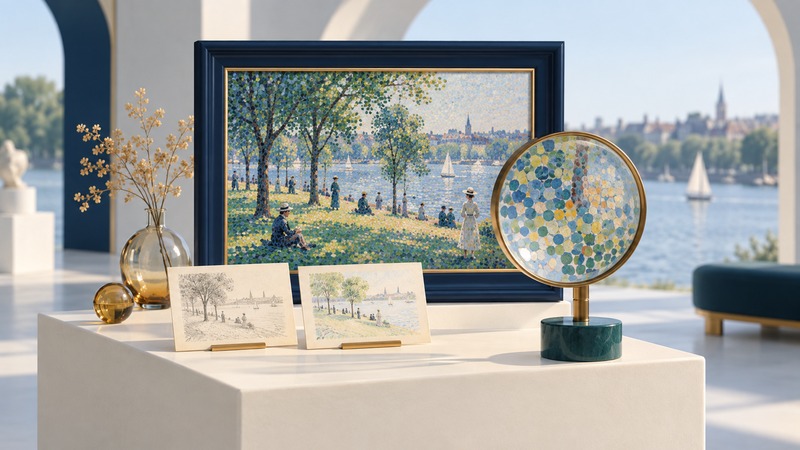
Look at Georges Seurat’s A Sunday on La Grande Jatte—1884 twice: first as a large arrangement of people, light and space, then as a surface built from small marks. The change in viewing distance reveals how a carefully organized painting can make a crowded riverside scene feel remarkably still.
You can use this guide in front of the painting or with the Art Institute of Chicago’s zoomable image. Give yourself ten uninterrupted minutes and a place to record three observations. Begin with what you see, then use the museum’s research to test and extend your interpretation.
Orient yourself to the actual painting
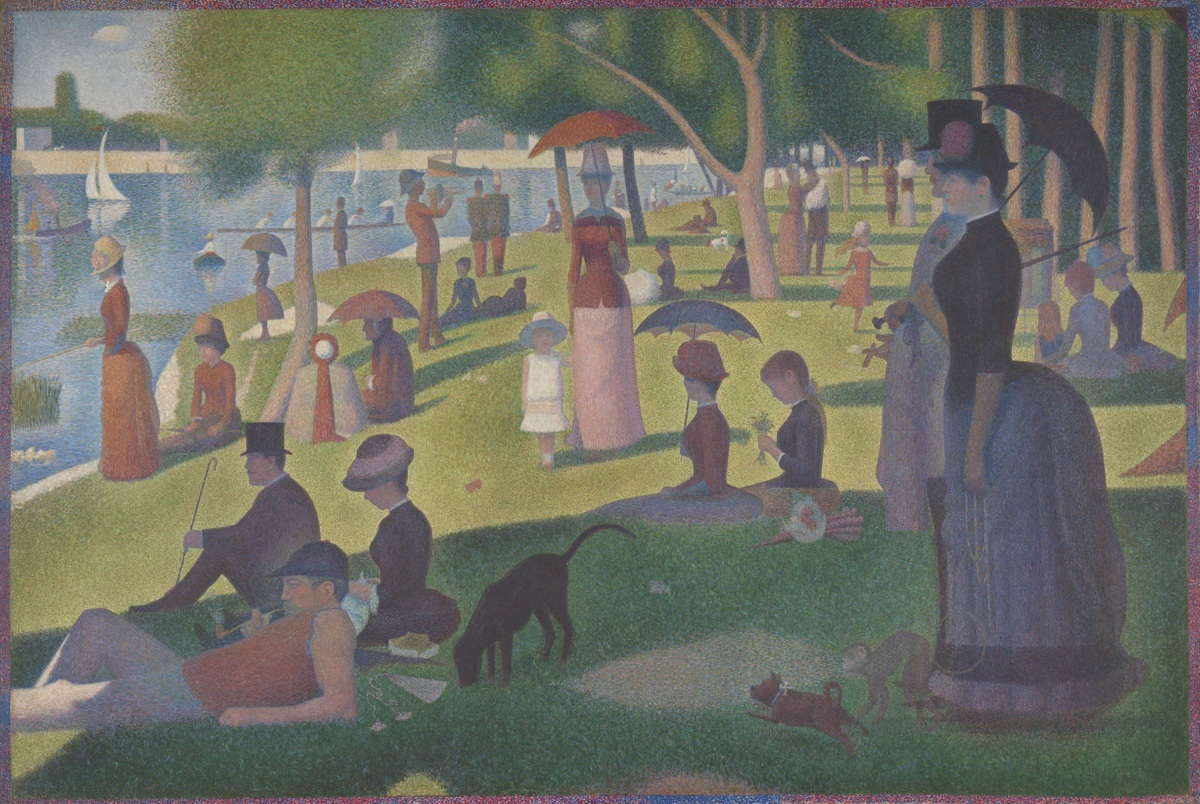
The painting measures about 2.08 × 3.08 meters. Its island setting is on the Seine near Paris. The museum’s collection data distinguishes the work’s dates from the year embedded in its title and records the later painted border. Read that title as an identification of the work, not as a claim that every mark was completed in 1884.
The illustration at the top of this guide is a conceptual scene about looking at pointillist art. The reproduction in this section is the historical painting used for the observations below.
First pass: read the large shapes
- Locate the strongest light-dark division. Follow the broad shadow across the foreground and compare it with the brighter grass farther back.
- Find the large upright forms. Look at the figures on the right and the vertical trees. Notice how they interrupt the horizontal sweep of the riverbank.
- Find an anchor near the center. The small girl in white faces outward. Compare the direction of her body with nearby profiles and backs.
- Trace a route into the distance. Follow the receding shoreline and shrinking figures. Record where your eye slows or changes direction.
Now describe the scene using only five simple shapes. You might choose a dark foreground band, a bright central field, a pale river wedge and two tall masses at the right. This rough map helps you see the composition before clothing, faces and anecdotes take over.
Ask which features make the scene feel still. Straight postures, repeated profiles and measured spacing are visible evidence you can discuss. “The people are bored” is a possible interpretation that requires more support; a face or posture alone may allow several readings.
Second pass: examine the marks without losing the whole
Move closer within the museum’s permitted viewing distance, or enlarge one area of the digital image. Compare the grass, a figure’s clothing and the river. Look for dots, short strokes, layered color and edges made from several adjacent hues. Then step back or reduce the zoom.
Seurat’s pointillist technique places small marks of color beside one another. Their relationships change how a larger area appears from a distance. The Art Institute’s discussion of science and art connects this practice with color investigation. The painting is also a constructed image: placement, contour, contrast and scale remain important even when the individual dots are too small to distinguish.
A screen image adds the display, image processing and room light to the chain. Use it to study structure and compare details. Exact historical color reconstruction requires other evidence. The color-management guide explains why reproduction conditions matter.
Compare planning with revision
The museum’s account describes smaller drawings and painted studies leading to the large canvas, along with later changes to figures and silhouettes. This was a sustained process of planning and revision. Select a preparatory work from the collection record’s related resources and compare one specific feature with the final painting.
On a narrow screen, swipe the table sideways or focus it and use the arrow keys.
| Feature | Observe in each image | Interpretive question |
|---|---|---|
| Figure placement | Position, scale and nearby empty space | How does the change redirect attention? |
| Silhouette | Contour, posture and overlap | Does the figure become easier to separate from its surroundings? |
| Light and shade | Large value areas and their boundaries | How does the scene’s rhythm change? |
| Surface | Visible marks at comparable image scale | Which differences reflect medium or size as well as intention? |
Keep the study’s title, date, medium and collection with your notes. A small oil study and a drawing can solve different problems; compare the feature each makes visible rather than expecting either to look like a reduced copy of the finished canvas.
Distinguish looking, interpretation and technical evidence
Use three sentences to organize a claim. Observation: “The central child’s white clothing contrasts with nearby colors.” Interpretation: “That contrast helps draw my attention toward the center.” Research question: “What do the studies or technical examinations reveal about when this figure took its present form?”
The Art Institute’s account of microscopic pigment research identifies zinc yellow in this painting as a material that darkened toward yellowish-brown, changing color relationships that included it. That finding comes from examining the paint, beyond what a viewer can establish from a screen image. A brighter online reproduction therefore needs its own explanation: ordinary image editing and a research-based reconstruction provide different evidence. Record the pigment, examination and source when discussing a conservation result.
Finish by writing one observation you initially missed and one question you want to pursue. On a museum visit, check the collection record for current display information before making a special trip. For another way to connect objects with their supporting documents, explore art records and provenance.