Sensi at Bellagio brought several cooking traditions into a restaurant organized around visible preparation. Its useful legacy is a design question: how can a dining room make cooking understandable and engaging without letting the spectacle overwhelm the meal? The sources below document the concept, rather than provide a current Sensi booking guide.
The December 2004 concept
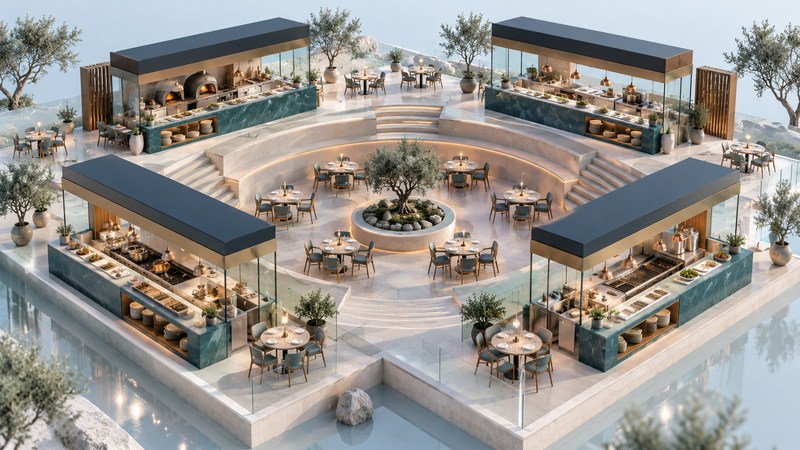
MGM’s December 27, 2004 Sensi release announced the restaurant as open in Bellagio’s new Spa Tower. Executive chef Martin Heierling’s menu drew on four named areas: Italian, Asian, grilled dishes and seafood. The release credited Japanese design firm Super Potato and described open kitchens, stone and water as parts of the experience.
The organizing idea was visibility. Preparation became something diners could observe alongside the finished dishes. This explains the contemporary emphasis on dining as theater, while leaving taste and service as questions that an opening announcement cannot answer independently.
What the kitchen designer’s record adds
CKP Hospitality Consultants’ Sensi project entry identifies its kitchen-design work with Super Potato and describes a glass working station intended to bring chefs and guests into closer contact. The entry labels the project 2005; MGM’s dated release establishes that the restaurant was already open in December 2004. A portfolio year and an opening announcement need not describe the same milestone.
Read the glass station as a design choice with consequences. A view can make a cooking process easier to follow, but the quality of that view depends on the seat, lighting and what happens at the station. An open kitchen is not automatically a cooking class: diners may see actions without hearing an explanation of ingredients or technique.
Swipe the table sideways, or focus it and use the arrow keys.
| Design question | What to observe or ask |
|---|---|
| Can you see the work? | Whether the station is visible from your actual table, rather than only from publicity photographs. |
| Can you follow it? | Whether staff can explain a preparation without interrupting service. |
| Does variety form a coherent meal? | Whether the dishes you want can arrive in a sensible order and pace. |
| Does the setting suit the occasion? | The balance between kitchen activity, conversation and comfortable seating. |
These are editorial evaluation questions, not measured findings about Sensi’s historic service.
Use current venue information for a visit
For a present-day Bellagio dinner, consult the resort’s current restaurant pages. Its official Harvest page supplies the current venue description, menu and reservation route. A surviving Sensi release or design portfolio is historical documentation, not a live restaurant listing.
If you are researching the room, keep the source’s date, named chef and designer together. Compare plans or photographs only when their dates and locations are established; a generic open-kitchen photograph cannot verify a particular renovation. For planning a restaurant booking more broadly, see choosing a venue and checking the reservation terms.