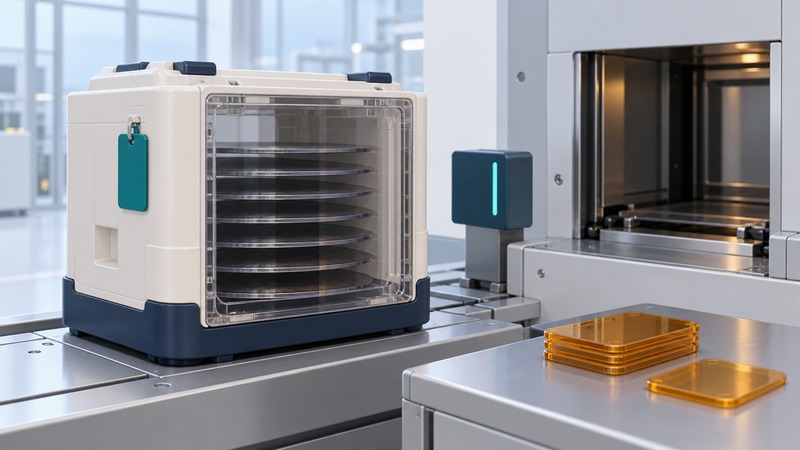
Wafer tracking depends on relationships: a carrier holds substrates, those substrates belong to manufacturing records and equipment reports where they are and what happened to them. RFID can identify the carrier at a checkpoint. Reliable traceability keeps that observation connected to the correct lot, slot map and process history.
This guide is for manufacturing and MES engineers designing or reviewing the information flow. It is an architecture and test-planning guide. Equipment interfaces, cleanroom compatibility and physical handling must follow the plant’s qualified processes and the exact equipment documentation.
Name each object explicitly
On a small screen, scroll sideways to read both columns.
| Object or record | What it represents |
|---|---|
| Carrier ID | The reusable carrier, such as a FOUP; it can persist across multiple loads. |
| Lot and substrate IDs | The manufacturing material being managed, independently of the current carrier. |
| Slot association | Which substrate or expected occupancy belongs to each relevant carrier slot at a given time. |
| Port or equipment location | Where the carrier or substrate was observed or managed. |
| Process event | A confirmed action or state change with its time, source and affected material. |
FOUP means front-opening unified pod. RFID tags can be mounted on such carriers, with readers at equipment or handling checkpoints. Balluff’s semiconductor RFID overview describes carrier identification applications. The actual frequency, installation and material compatibility depend on the chosen carrier, tag and reader.
Keep carrier identification distinct from directly reading an individual wafer’s marking. An intact carrier tag can identify an empty carrier, the wrong load or a carrier whose contents changed. The application must establish the current content association separately.
Separate reader, carrier and substrate services
The public scope of SEMI E99 covers the carrier ID reader/writer’s interface with an upstream controller. SEMI E87 addresses carrier management, including carrier-to-port association, CarrierID verification and slot-map verification in its defined scope.
SEMI E90 addresses equipment services for managing substrate information. These public descriptions identify the layers to discuss with suppliers; they are not a substitute for licensed specifications or the installed tool’s interface documentation. Record the implemented revisions and supported services.
For each interface, identify the authoritative source, timestamp meaning, acknowledgment and recovery behavior. An observation received by middleware, an accepted carrier association and a completed process are separate events. Document how the host and equipment resolve disagreement before normal processing continues.
Preserve history when a carrier is reused
The names and times above are invented. They illustrate an information-management failure mode rather than a prescribed SEMI message sequence. Store enough event and association history to explain the result, with stable event identifiers or another documented duplicate-detection method.
When material is split, merged or transferred between carriers, record the changed relationships explicitly. Preserve lineage according to the manufacturing process. A carrier ID alone cannot encode every evolving relationship or establish that a process step completed successfully.
Test mismatches and missing evidence
- Present the expected carrier and verify that the reader result, port association and host expectation agree. Save the message and decision evidence.
- Test an unexpected carrier ID, unreadable tag and duplicate observation in the supplier-approved simulation or test environment. Confirm the defined hold or exception path.
- Introduce a controlled slot-map disagreement and verify the documented host/equipment resolution. Use qualified plant procedures for any physical test.
- Replay a delayed event after carrier reuse and an already-accepted event after reconnection. Check that history and current associations remain correct.
- Test loss and restoration of the relevant interface. Reconcile the host and equipment views before accepting resumed normal operation.
Separate detection failure from a valid observation that conflicts with the expected process. Preserve the conflicting information and give the exception an accountable owner. Filling an unreadable ID from the last carrier seen can silently create an apparently complete but incorrect history.
Use a small, clearly labeled synthetic event set during adapter development. The downloadable worksheet includes the carrier-reuse walkthrough and expected outcomes. Software replay checks complement equipment acceptance; they do not demonstrate physical reader performance or cleanroom suitability.
Make the trace useful after commissioning
Retain carrier/tag mappings, interface versions, message definitions, time synchronization assumptions and acceptance evidence. Keep access to production recipes and material history within the plant’s authorized systems. Version changes to mapping or event logic so historical records remain interpretable.
Revalidate after changing carrier construction, tag placement, reader hardware, tool software or the association model. Begin investigations with the original observations and acknowledgments, then reconstruct the sequence. A traceability system earns trust when it explains an exception as clearly as a successful run.
Take the guide into your workflow
Download the working checklist (plain text). The editable text file includes its purpose, instructions, evidence fields and a link back to this guide. Record observed results and unresolved questions before making the decision.
Related reading
- Connect observations to accepted events
- Verify reader and tag compatibility
- Evaluate supplier evidence and integration ownership
- Explore all RFID guides
Researched and updated September 11, 2026. Recheck the linked primary sources when equipment, standards or operating requirements change.