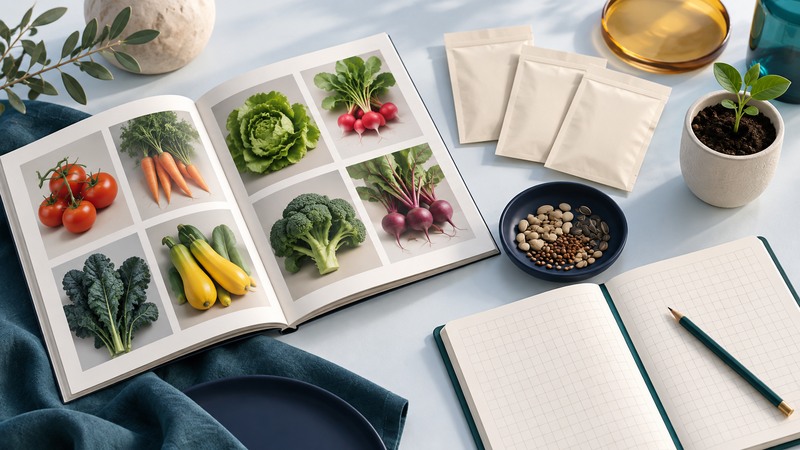
A seed catalog is most useful when you read it with a planting plan beside you. Choose varieties that fit your growing season, space and intended harvest, then compare quantities and delivery. The prettiest photograph answers only one of those questions.
Start with the space and the harvest
List the crops you use, the space available and the number of mature plants you can accommodate. Include support for climbing crops and access for harvesting. Decide whether you want a short concentrated harvest for preserving or repeated small harvests for fresh eating.
For each crop, write a few requirements before browsing: container suitability, plant size, maturity window, flavor or culinary use, and any locally important disease resistance. Separate essential requirements from interesting extras. That makes it easier to compare two plausible choices without buying both automatically.
The garden-design guide helps establish usable space. The seed-starting guide turns the selected packet's instructions into a growing schedule.
Translate the terms into decisions
| Catalog term | Meaning for your order | What to check |
|---|---|---|
| Days to maturity | An approximate interval to a defined harvest stage | Whether the clock starts at sowing or transplanting, and what counts as harvest |
| F1 hybrid | First-generation seed from a selected cross | Desired traits; saved offspring can differ from the purchased hybrid |
| Open-pollinated | A variety capable of producing similar offspring under suitable pollination conditions | Isolation and seed-saving requirements for that crop |
| Heirloom | A variety maintained over generations | Its actual performance and traits in your conditions |
| Disease resistance code | Resistance to a specified pathogen or strain | The supplier's crop-specific key and whether it addresses your local problem |
| Pelleted | Seed coated to make handling or sowing easier | Storage life and sowing instructions for that product |
| Treated | Seed carrying a specified treatment | The label's handling instructions and whether the treatment fits your purpose |
Johnny's catalog key and glossary illustrates these distinctions and identifies high and intermediate resistance separately. A resistance claim is specific to the named disease; keep normal crop care and monitoring in the plan.
Maryland Extension's planting guide explains maturity terminology and crop timing. When comparing a direct-sown crop with a transplanted one, check the starting point before adding the numbers to a calendar. Weather can shift the outcome.
If saving seed is a goal, add pollination to the plan before planting. Minnesota Extension's seed-saving guide explains why open-pollinated varieties can remain similar to their parents and how crossing changes that result. “Heirloom” alone does not describe the whole seed-saving process.
Compare two packets on a common basis
First confirm that both varieties meet the growing requirements. Then compare seed count, packet price, delivery charge and how many seeds you realistically expect to use. A lower price per seed may still mean spending more on surplus seed.
Avoid treating every seed in a large packet as a future plant you need. Record the plant target and space allocation, then add a reasonable margin informed by the seed lot and your experience. For an unfamiliar crop, a small trial often teaches more than a large order.
Use suppliers for their information as well as their stock
These are starting points for comparison, not a ranking or a promise of current inventory:
- Johnny's Grower's Library: crop instructions and planning resources alongside seed listings.
- Richters Herbs: herb seeds and plants; check botanical names and the specific culinary type you want.
- Territorial's vegetable catalog: vegetable varieties to compare by growth habit, use and seasonal requirements.
Before ordering, confirm the current product page, packet size, treatment, destination restrictions, shipping window and substitution policy. A catalog photograph can show an ideal specimen; useful growing details should still be available in the text. For native plants, look for locally appropriate species and clear origin information from a suitable regional source.
Make the order auditable
Keep one row per variety in a notebook or simple list: supplier, exact variety, seed count, sowing method, maturity convention, order date and planned planting place. Save the packet after sowing and record results against that name. “Red tomato” is a weak reference when you later want to repeat a success.
When the order arrives, compare it with the list and read storage instructions immediately. Keep seeds cool and dry as directed. Check any shorter-lived or specially handled products first. Organize packets by sowing date rather than by the order in which they arrived.
At the season's end, keep the observations that change a future order: flavor, usable yield, disease problems, actual harvest dates and surplus plants. Choose next year's varieties from that record and the current catalog information.