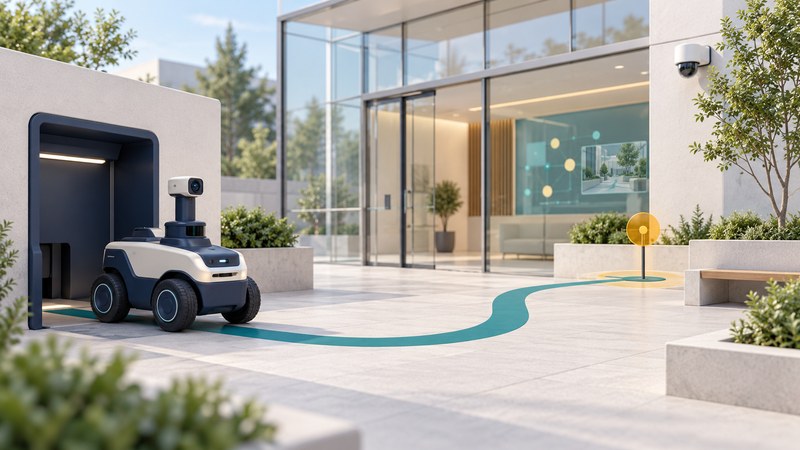
A modern security robot is a mobile observation system: it reaches a location, gathers evidence and helps a person decide what deserves attention. Recent AI advances expand how that evidence can be interpreted and how a robot can connect to other systems. Their value depends on the particular task, operating environment and response team.
This guide explains the technology and how to read claims about it. For route surveys, acceptance criteria and trial measurements, use the companion guide to planning and measuring a property pilot.
Five capabilities behind a patrol
Autonomy is specific to a function. A machine may follow its route and recharge automatically while people configure its mission, interpret unusual observations and handle incidents. Separate these steps when assessing a demonstration:
- Navigation: localization and route planning help the robot reach an observation point. Obstacle handling determines what happens when that route changes.
- Sensing: cameras and configured thermal, acoustic or environmental sensors collect different kinds of observations. Each has its own field of view and operating limits.
- Interpretation: a rule or learned model classifies an observation, identifies a change or summarizes an image. The output can include errors and uncertainty.
- Coordination: software schedules another observation, sends an alert or connects the robot to a building or operations system.
- Response: an authorized person checks the evidence and applies the site's procedures. Responsibility for a consequential action needs a named owner.
Progress in one layer does not automatically improve the others. A fluent description of a scene can coexist with poor visibility or a missed patrol. For a closer look at movement, see how autonomous navigation works.
What recent AI adds
Developments reviewed October 3, 2026. The examples below describe documented vendor functions and a published development plan. They establish the stated features and status, while performance at a particular property requires separate evidence.
| Example | Documented development | How to interpret it |
|---|---|---|
| Knightscope K5 | Mapped patrol routes, obstacle handling, automatic charging and browser-based operations management. | A vendor-described autonomous patrol workflow; event interpretation and human support remain separate questions. |
| Spot 5.2 and Orbit | Gemini-powered visual inspection, video inspections and integration with external data sources. | A software release description. Specific inspections depend on configuration and, for some functions, AIVI-Learning. |
| Knightscope K7 | A February 2026 investor presentation planned a limited release for the second half of 2026. | A dated plan. Confirm subsequent availability and field deployments directly before treating it as an operating system. |
Knightscope's K5 explanation describes route scheduling, charging and its Security Operations Center, as well as human support. The February 2026 K7 presentation illustrates why an announced timetable should retain its date.
Boston Dynamics' Spot 5.2 and Orbit overview describes connecting external sensor inputs to robot missions, including dispatch after a CCTV observation. Its visual AI can evaluate more than a fixed gauge reading: examples include site scans for transient conditions and video-based inspection. This makes the relationship between an observation, an interpretation and a follow-up action especially important.
A language interface can make a task easier to express, and a multimodal model can relate words to images. The operational question is which permitted robot action the request becomes. Check that a system can show its observation and the rule behind an escalation; a persuasive summary alone is weak evidence of what happened.
Choose the body for the observation
Wheeled patrol platforms suit routes whose surfaces, gradients, doorways and turning space match the machine. Legged inspection platforms can address different access problems, but their usable terrain, payload and battery requirements still need checking. Remote operation lets a person direct an investigation; its usefulness depends on communications, visibility and available operators.
These categories can overlap: an autonomous platform may offer remote control. Compare the complete observation task—where a sensor must be, what it must see, and how often it must return—before comparing appearances or promotional labels. A fixed sensor and a mobile robot may complement each other when one detects a change and the other supplies another viewpoint.
Follow one alert from observation to decision
This example separates detection, verification and response. It also shows why classifying a visible condition is different from inferring a person's intent. Keep alerts tied to observable conditions and make uncertainty visible to the reviewer.
Ask what the demonstration actually establishes
- Identify the configuration: robot, sensor, software version, service tier and operating conditions.
- Ask about misses as well as alerts: an alert log shows what triggered the system; a controlled evaluation is needed to reveal events it overlooked.
- Trace dependencies: which functions run onboard, which need a network, and what happens when a required service is unavailable?
- Check data handling: establish what is retained, who can access it and how the supporting evidence reaches the response team.
- Separate measured outcomes from plans: a prototype, a release note and an independently evaluated deployment answer different questions.
For an actual site decision, carry these questions into the property-pilot guide. For the longer story of machines sensing and acting in the world, explore the robotics history timeline.