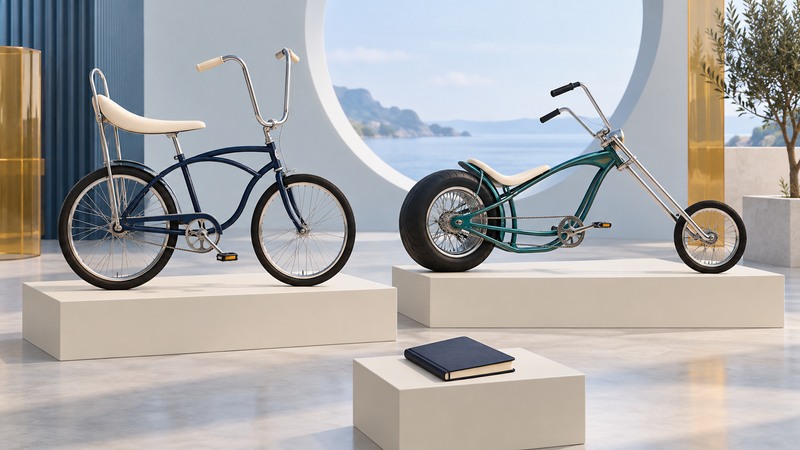
A useful Sting-Ray purchase starts with identifying which generation you are looking at. The name spans classic muscle bikes, the long 2004-era Orange County Choppers design and later heritage editions. Establish the bicycle’s identity, then decide whether your goal is a rideable cruiser, a documented collection piece or a restoration project.
Place the bicycle in the right family
Schwinn dates the original Sting-Ray to 1963 and the Krate line to 1968 in its Sting-Ray and Krate history. High handlebars, an elongated saddle and compact proportions define the familiar classic look. Later bicycles can repeat those visual cues.
Swipe this table sideways, or focus it and use the arrow keys.
| Family | Visual starting point | Evidence to request |
|---|---|---|
| Classic Sting-Ray and Krate | Compact muscle-bike frame; banana saddle and high bars | Frame markings, original sales records and a matching year/model catalog |
| 2004-era OCC chopper | Long, low motorcycle-inspired proportions and a broad rear tire | Exact model markings, frame serial, original manual and component photographs |
| Heritage reissues and special editions | Classic styling recreated in a later production run | Edition documentation, production markings and purchase records |
Schwinn's January 23, 2004 announcement, preserved within this independent historical post, identifies the OCC partnership and the motorcycle-inspired redesign. The source also contains collector commentary; use the dated manufacturer announcement for that historical distinction. Schwinn's 2013 Fritz Fifty announcement separately records earlier Krate reissues, including one in 2004. A year alone therefore leaves the family unresolved.
Build an identification record before ordering parts
Photograph both sides of the bicycle, the head badge, every serial or model marking, the fork, crank, hubs, brakes, saddle, chainguard and tire sidewalls. Transcribe the markings exactly and note where each appears. Preserve the photographs at readable resolution so a specialist can check ambiguous characters.
Compare the bike with a catalog or manual for the proposed model and year. Ask a knowledgeable Schwinn specialist to explain which details support the identification and which remain uncertain. Record the source title and page beside each conclusion. Paint color or a replacement decal can suggest a search direction; several consistent identifiers make a stronger case.
Keep the frame's identity separate from the ages of fitted components. A replacement wheel or saddle may make a bicycle useful while changing its originality. Avoid applying an online serial decoder until its coverage matches the bicycle's generation and marking system.
Separate riding condition from originality
Commission a bicycle mechanic's assessment if you intend to ride it. Ask about frame and fork damage, corrosion, repairs, steering, wheel condition, tires, bearings, brakes and secure attachment of the saddle and bars. For unusual or replaced components, request a compatibility check. Resolve structural concerns before a test ride.
Use Schwinn's owner's-manual resources to begin locating applicable instructions, and supply the exact model to Schwinn when the correct booklet is unclear. A general manual helps organize questions; a matching manual and inspection establish what applies to the bicycle in front of you. Have the mechanic explain its controls, intended use and required work.
For a collector, make a separate parts inventory with four labels: documented original, period replacement, modern reproduction, or unknown. Attach the evidence. A part that looks appropriate still needs provenance before it is described as original to that bicycle.
Choose the restoration goal before changing the finish
Photograph and inventory the bike before disassembly or refinishing. Decide whether to preserve surviving finishes, restore a documented configuration, or build a rider with disclosed replacement parts. Ask a restoration specialist about that goal before removing decals, stripping paint or replating components; those choices change the evidence available to a future owner.
Prepare separate estimates for essential mechanical work, missing model-specific parts and cosmetic work. Ask suppliers to confirm fit and availability against photographs and markings before buying. If a necessary part is unavailable, decide whether a documented alternative fits your goal or whether the project should wait.
Finish with a written description of the bicycle, its known changes and open questions. For a bike chosen primarily for dirt trails, use the mountain-bike selection and first-trail guide.
Download the Sting-Ray identification and restoration record to record evidence, estimates and next actions.
Researched and updated September 20, 2026. Use the linked sources for applicable documents and current service, access or event information.
Explore all motorsports guides.