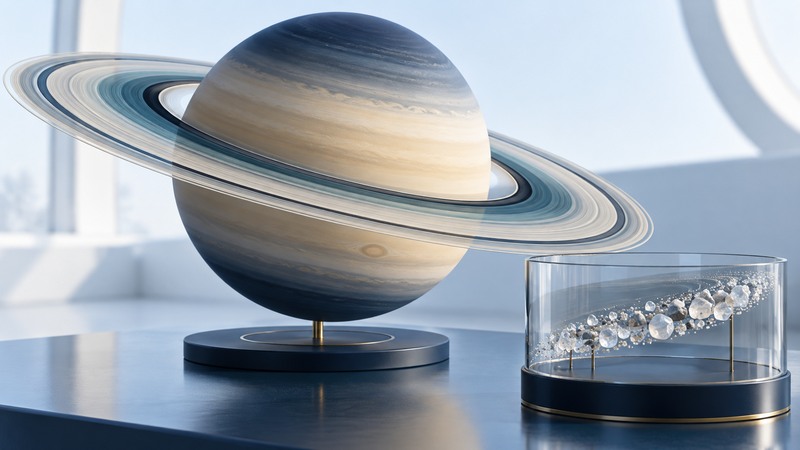
Saturn's rings are an orbiting population of particles shaped by gravity, collisions and interactions with moons. Their appearance changes with viewing geometry, while questions about their origin and age depend on models of how material moves and becomes contaminated. This guide helps you interpret both a telescope view and a scientific image.
Identify the main structure
The rings contain mostly water ice with other material mixed in. They are divided into named regions whose letters reflect discovery history rather than a simple alphabetic order outward. The bright A and B rings are separated by the Cassini Division; the C ring lies inward of B. Farther out, faint rings require different observing conditions and techniques. NASA's Saturn facts lists the complete sequence.
A dark gap in an image indicates less light reaching the detector from that location under those conditions. Ring density, particle properties, illumination and viewing angle all affect brightness. Some gaps contain material at much lower density than adjacent rings, so “gap” need not imply an empty region.
Individual particles follow their own orbits, with inner particles moving around Saturn more rapidly than outer ones. The ring system consequently behaves very differently from a single rigid disk. Gravity from moons can organize structures and produce waves; collisions also redistribute particle motion.
Why the rings seem to open and close
The rings lie approximately in Saturn's equatorial plane. As Earth and Saturn move around the Sun, our line of sight changes relative to that plane. When viewed more nearly edge-on, the broad ring surface becomes a narrow apparent line. The physical rings remain present.
Earth crossing the ring plane describes an observer's geometry. Saturn's equinox describes the Sun shining along the ring plane. The events are related through the system's motion but have different definitions. NASA's ring-plane crossing explanation also shows why a crossing can occur when Saturn is inconveniently close to the Sun on the sky.
Make a useful comparison between observations
For an observing session, first find Saturn's location and altitude for your site and time using an ephemeris or planetarium. Choose a night-time opportunity with an unobstructed view. A telescope can reveal the ring shape, but the detail you resolve depends on aperture, atmospheric steadiness, magnification and ring opening.
Record the date, time, site, telescope, magnification and seeing conditions. Sketch the apparent ring tilt and any confidently visible division. If comparing photographs, check image orientation and capture time before judging whether a feature moved. Processing, sharpening and exposure also affect apparent detail.
A failure to see the Cassini Division on a particular night can reflect limited contrast or resolution. Try again under steadier conditions and compare with the expected geometry, rather than treating the missing visual detail as a change in Saturn. The comet observing guide explains the location and time checks that also apply to planetary ephemerides.
What Cassini added to the picture
Cassini's extended observations revealed ring-moon interactions, fine structures and features made conspicuous by the low Sun at equinox. They also established Enceladus as the source of Saturn's diffuse E ring. NASA's Cassini ring-science overview gathers these results.
That matters because a ring can be both a structure and a flow of material. Particles are supplied, redistributed and lost. To understand the E ring's origin, follow the connection back to ice grains ejected from Enceladus. To interpret a dramatic narrow shadow, check how sunlight meets the ring plane.
Read ring-age estimates through their assumptions
A ring-age argument often begins with its present mass, its relatively clean ice and the rate at which incoming dust should darken it. Under particular assumptions about pollution and transport, Cassini measurements support a young age relative to Saturn. NASA's 2023 account summarizes evidence for that interpretation.
A later numerical study published in December 2024 proposed that impacts can remove much of the contaminating material instead of retaining it in the rings. If that mechanism is efficient, clean ice can persist longer, changing the age inferred from appearance.
The useful comparison is therefore between assumptions: incoming dust flux, retained fraction, mixing, mass and loss rates. A revised model can alter the inferred age without changing the underlying Cassini measurement. Treat a projected disappearance date in the same way: it depends on how a measured or estimated loss process is extrapolated.