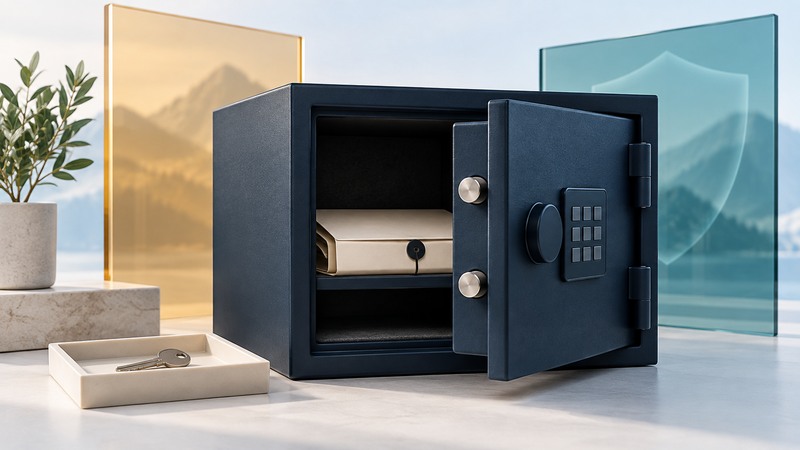
List the contents before comparing safes
Choose a SentrySafe by matching the exact model to what you need to store and the events you want it to withstand. Fire endurance, water resistance, theft resistance and everyday access are different questions. Record the evidence for each before buying.
Start with a short contents list: paper documents, media, jewelry or other valuables. Measure the largest folder or container in its intended orientation. Identify items you need frequently and people who may need authorized access while you are away. Store copies of essential records elsewhere so a single inaccessible location does not become your only recovery route.
Product names and family appearances can look similar. Copy the complete model identifier from the product page or existing unit, then find its matching manual. Keep the manual revision and purchase record in your private inventory. Serial numbers, keys and access codes need appropriate protection.
Read each protection claim separately
| Need | Evidence to find | How to interpret it |
|---|---|---|
| Fire | Named test/classification, exposure time and temperature, and eligible contents | The stated test conditions bound the claim; different contents tolerate different conditions. |
| Water | Verified water depth, duration and installation conditions | A limited resistance test is different from unrestricted submersion protection. |
| Theft | Relevant independent burglary rating if claimed, construction and approved anchoring | A lock style or fire classification alone does not establish a burglary rating. |
| Daily access | Lock type, user controls, batteries and authorized recovery process | Choose a method the authorized household can operate and maintain. |
As a model-specific comparison checked in September 2026, SentrySafe describes the SF123ES as UL Classified for one hour at up to 1700°F (927°C), with security and fire listed as its protection types. Its SFW123GDC page adds an ETL-verified water-resistance claim of up to eight inches for up to 24 hours. This comparison shows why the letters in a model number matter; it is not a recommendation or an independent product test.
Read the contents exclusions, especially for delicate valuables and older recording media. A broad “digital media” label should be checked against the model’s documentation for the particular item you intend to store. Ask SentrySafe to resolve conflicting product-page and manual information before relying on a claim.
Check usable fit and installation together
Compare interior dimensions with your measured folders, then allow for shelves, drawers, door pockets and the opening itself. Exterior dimensions determine whether the safe fits its location; they do not describe usable storage. Check the weight, delivery route, door swing and suitability of the supporting surface before arranging installation.
Anchoring can change the protection claim. The manual linked for SFW123GDC says its ETL water-resistance claim applies before a bolt-down kit is installed, and warns against wall mounting that compromises the fire rating. Use the model’s current manual and obtain manufacturer clarification for your unit before choosing an installation. Do not improvise holes through the case.
Use an appropriate installer when moving, supporting or anchoring the safe exceeds your equipment or experience. A renter should resolve permission and building constraints first. Balance removal resistance, water exposure and access needs as a single placement decision.
Prepare access and maintenance while the door is open
Follow the exact manual’s first-use sequence and verify the new access method with the door open as instructed before putting valuables inside. Confirm which codes can be changed, which users can be removed, and whether a key is a second lock, an override or a different mechanism. Those functions vary by model.
For electronic models, record the specified battery type and the supported response to a low-battery indication. Keep recovery information and any necessary keys outside the safe in a separately protected location. A fingerprint option still requires a plan for failed enrollment, an unavailable user or a power problem.
The linked SFW manual discusses internal moisture, desiccant and sensitive-content exclusions. Follow those instructions and inspect stored items periodically. If the lock behaves unexpectedly, stop forcing it, check the model-specific troubleshooting instructions and contact official support with proof of ownership as required.
Complete the comparison record with three decisions: why the chosen protection evidence fits your contents, how the installation preserves the claims you rely on, and how authorized access will work during an ordinary problem. An unanswered item is a reason to seek clarification before purchase.