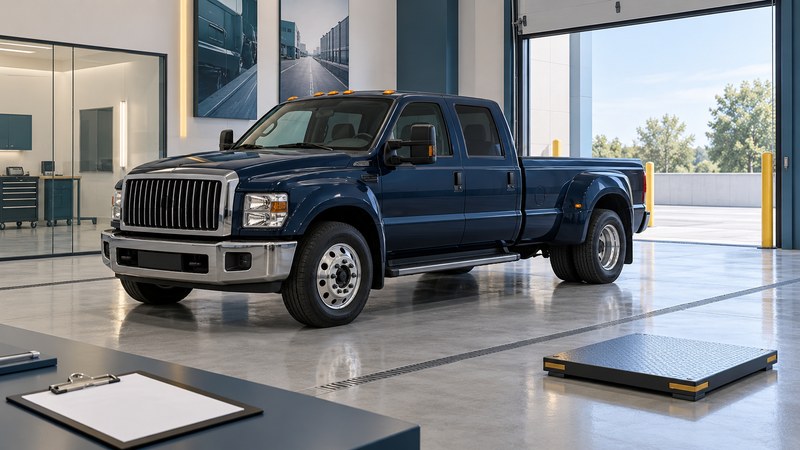
An International RXT ownership decision starts with a job description: people, cargo, trailer, routes, parking and service. Its commercial-truck origins make those requirements especially important. Build a record from the actual vehicle's labels, installed equipment and measured weights, then confirm that the places and support services you need can accommodate it.
The outcome is a practical ownership brief. It should identify requirements already met, measurements still needed and decisions that depend on a manufacturer, specialist or local agency.
Identify the RXT and its installed body
International's February 2005 launch release, reproduced by The Auto Channel, describes the RXT as a 4x2 crew-cab truck with hydraulic brakes. The related CXT and MXT have different configurations. Keep their names separate when researching parts, dimensions and intended use.
Record the chassis identity and build date, then identify the installed bed, hitch, auxiliary equipment and any later modifications. International's 2007 RXT Hauler announcement describes a fifth-wheel-oriented version, illustrating why the body and hitch arrangement matter. A family-level launch description is background; the individual truck's documented configuration governs the assessment.
Photograph readable labels and obtain the matching operator, chassis and body-builder documents. Ask a truck specialist to reconcile unclear or conflicting information before planning a loaded combination.
Keep ratings and measured weights separate
On a narrow screen, scroll the table sideways. Keyboard users can focus the table region and use the arrow keys.
| Record | Meaning | How to use it |
|---|---|---|
| GVWR | Manufacturer rating for the maximum loaded vehicle weight. | Compare with the actual loaded truck weight. |
| Front and rear GAWR | Manufacturer ratings for the individual axles. | Compare each axle with its own scale reading. |
| Combination and trailer limits | Applicable ratings for the truck/trailer combination and installed towing equipment. | Reconcile chassis, hitch, trailer and upfit documentation. |
| Actual weights | Scale readings for the intended loading arrangement. | Include occupants, fuel, equipment, cargo and the trailer load carried by the truck. |
| Tires, wheels and body equipment | Installed components with their own specifications and condition. | Have a specialist check compatibility and applicable limits. |
GVWR minus the truck's actual weight gives a gross-weight margin for that measured arrangement. Use axle readings and the other applicable limits alongside it. Load placement changes how weight is distributed; a remaining gross margin can coexist with an axle already at its limit.
Arrange weighing with a suitable scale operator and a qualified towing specialist when a trailer is involved. Keep dated tickets and describe the load on each. Ask the specialist to explain how the combination meets every applicable rating, including the installed hitch and the load transferred to the truck.
Check the route, parking and workshop
Measure the actual truck's height, length and width, including its installed equipment. Check entrances, turning space, overhead clearance and the place where passengers enter. Include the trailer when assessing the combined route and storage requirement.
Before choosing a service provider, give the workshop those dimensions and the truck's configuration. Ask whether its bay, lifting or inspection equipment and staff can support that vehicle and its upfit. Obtain a parts and service plan for chassis systems and separately for added body equipment.
International's body-builder resources list document S08315 for specified builds from October 1, 2005 through February 28, 2007. Its subject is electrical circuit diagrams. Use that precise scope when discussing electrical documentation; obtain vehicle-specific rating information from the appropriate labels and manufacturer records.
Confirm requirements for the intended use
Give your licensing and registration agency the truck and trailer ratings, intended private or business use, and operating jurisdictions. Ask which license class, registration, inspections and operating requirements apply. Give the insurer the same description and obtain a coverage answer for that use.
For US readers, the FMCSA driver overview explains federal commercial-license classes and the role of state licensing. Use the responsible state agency for the actual license decision and the relevant authorities for the intended operation. A pickup-shaped body or a recreational destination alone leaves important questions unanswered.
Example: a trailer trip needs three answers
Fictional plan: an owner wants to carry passengers and tools while towing a collector car. The seller supplies a broad towing claim, but the installed hitch paperwork is missing. The next steps are to identify the hitch and upfit, establish the applicable ratings, and obtain weights for the planned load.
At the same time, confirm storage access, a suitable service shop and the agency and insurance requirements. The trip plan becomes usable when the load, access and operating questions all have documented answers.
Keep an ownership-fit brief
Download the RXT ownership-fit record. Keep label photographs, scale tickets, manufacturer documents and dated agency responses with it. Revisit the brief whenever the body, hitch, load or intended use changes.
Explore Autos: vehicle guides, technology and design · Cars: buying, maintenance and ownership