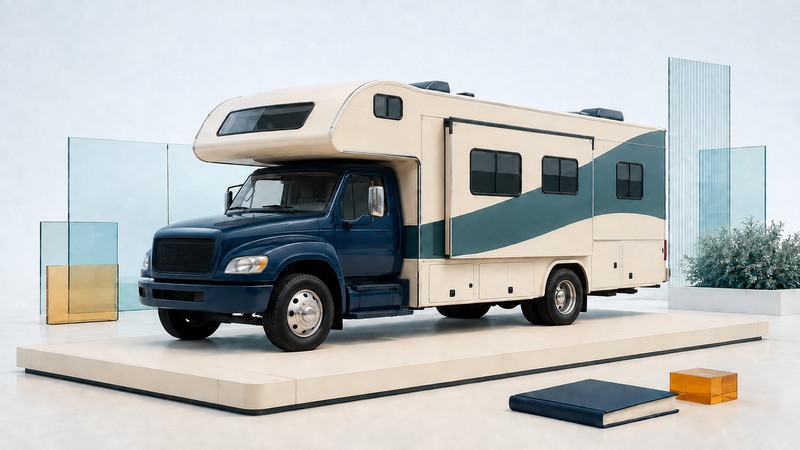
A truck-based motorhome’s usable carrying and towing allowance comes from its completed-vehicle ratings and actual loaded weights. Gather the coach, chassis, axle, tire, and hitch information before deciding what it can carry or tow. The lowest applicable limit governs each part of the combination.
This page began with a 2007 International DuraStar and Gulf Stream Conquest announcement involving Super Nova and Gladiator Enduramax motorhomes. Its advertised “up to” towing figure described the launch range. An individual coach needs its own configuration, labels, documentation, and scale evidence.
Read the completed coach as well as the chassis
Photograph the completed-vehicle certification and weight labels, chassis identification, and hitch label. Record model years and serial numbers for both chassis and coach; these may differ. Obtain the correct manuals through the manufacturers, including the Gulf Stream owner-manual archive for older Gulf Stream motorhomes.
Swipe the table sideways, or focus it and use the arrow keys.
| Limit | What it limits | Evidence to collect |
|---|---|---|
| GVWR | Complete loaded motorhome | Completed-coach certification and actual loaded total |
| GAWR | Load supported by each axle | Each axle rating and corresponding scale reading |
| GCWR | Complete loaded combination | Applicable coach and chassis documents plus combination weight |
| Hitch limits | Trailer weight and supported vertical load | Installed hitch label and manufacturer conditions |
| Tires and wheels | Load at each wheel position | Correct size, ratings, inflation guidance and measured distribution |
| Trailer limits | Complete trailer and its axles | Trailer certification, equipment ratings and loaded measurements |
Gulf Stream’s motorhome manual, printed pages 12–14, distinguishes these ratings and states that its designated GCWR can differ from the chassis figure, with the lower figure controlling. It also explains that a higher-rated replacement hitch does not increase the motorhome’s permitted towing load. Apply the documents for the actual completed coach.
Collect any separate maximum trailer-weight rating and the requirements for brakes, hitch configuration, towing equipment, and modifications. A receiver’s label is one limit in that system. A towed car needs its own manufacturer-approved towing method and equipment checks, including any dolly or trailer involved.
Prepare a representative travel load
Weigh with the people, fuel, water, supplies, accessories, and luggage planned for the trip. Write down tank levels and which items are aboard so the ticket can be interpreted later. Water moved between fresh and waste tanks changes location; adding fresh water while retaining waste can also increase total load.
Use a suitable scale and the operator’s instructions to obtain the coach’s axle loads and total, and the complete combination when towing. Wheel-position weighing helps assess side-to-side loading against tire and wheel limits. An acceptable axle total alone can conceal an overloaded side.
Keep uncoupled and coupled measurements clearly labeled. Tongue load is carried partly through the tow vehicle; in a coupled ticket it is already included in the tow vehicle’s axle loads. Add those loads to the trailer axle loads to obtain the combination weight. Adding the full trailer weight again would count the supported tongue load twice.
Work through a fictional scale record
All figures below are invented pounds (lb), using a conventional trailer without a weight-distributing hitch. They are neither Super Nova specifications nor a loading recommendation. Assume a 26,000-lb coach GVWR, 33,000-lb GCWR, 10,000-lb front GAWR, 17,500-lb rear GAWR, and a hitch limited to 10,000 lb trailer weight and 1,000 lb tongue load.
Swipe the table sideways, or focus it and use the arrow keys.
| Check | Measured or calculated load | Assumed limit | Difference below limit |
|---|---|---|---|
| Coach total, coupled | 24,800 | 26,000 | 1,200 |
| Front axle | 8,400 | 10,000 | 1,600 |
| Rear axle | 16,400 | 17,500 | 1,100 |
| Complete combination | 32,000 | 33,000 | 1,000 |
| Complete trailer at hitch | 8,000 | 10,000 | 2,000 |
| Tongue load | 800 | 1,000 | 200 |
The listed checks pass for these invented inputs. Tire and wheel capacities, side-to-side loading, trailer ratings, equipment compatibility, braking requirements, and the manufacturers’ towing conditions still need their own checks.
The uncoupled coach leaves 33,000 − 24,000 = 9,000 lb under GCWR for the complete trailer, before the other limits are applied. A 10,000-lb trailer would bring this combination to 34,000 lb, exceeding GCWR by 1,000 lb even though the hitch’s gross trailer rating is 10,000 lb. Adding more coach cargo reduces that combination allowance further.
Allow for the effect of rear overhang
Loads behind the rear axle can increase rear-axle load by more than their own weight while unloading the front axle. Gulf Stream illustrates this leverage in its motorhome manual’s weight-distribution section. It is a reason to check axle loads after a proposed equipment change, not merely subtract the item’s weight from a payload estimate.
Ask the coach manufacturer or a qualified specialist about a proposed rack, lift, frame extension, or hitch change before installation. Extra suspension support does not by itself revise certified ratings. If a limit is exceeded, remove or appropriately redistribute load and reweigh; confirm that fixing one limit has not created a problem elsewhere.
Download the motorhome ratings and scale record. It keeps coupled and uncoupled readings separate and includes the fictional example above. For motorcycles, tools, and event supplies, use the companion race-weekend support planning guide to prepare the inventory before weighing.
Researched and updated September 7, 2026. Recheck applicable model documentation, support resources, and local or event rules before acting.