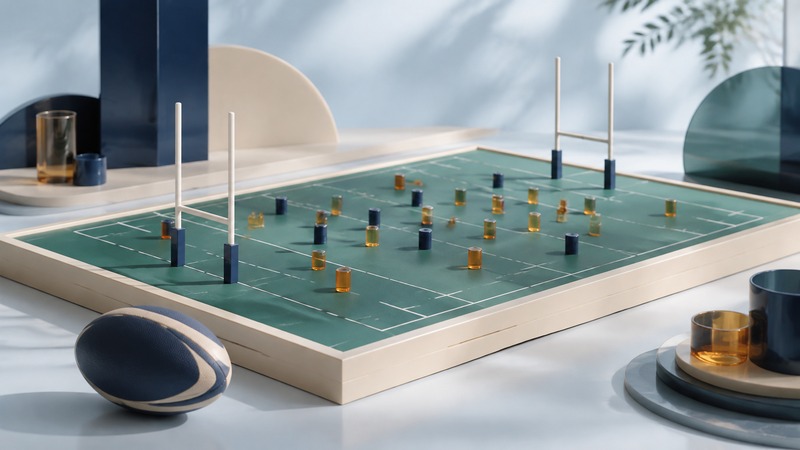
Rugby union is a contest for possession and territory in which teams carry, pass and kick an oval ball toward their opponents’ in-goal area. This guide explains the fifteen-a-side game first, then shows how rugby sevens and rugby league differ.
Identify which rugby you are watching
On a narrow screen, scroll the table sideways. Keyboard users can focus it and use the arrow keys.
| Format | Players per side on the field | Main feature to recognize |
|---|---|---|
| Rugby union fifteens | 15 | Possession can continue through successive tackle-and-ruck phases. |
| Rugby union sevens | 7 | Union with specific variations and normally seven-minute halves. |
| Rugby league | 13 | A tackle-count structure and play-the-ball restart after a tackle. |
World Rugby publishes the sevens team rules and time variations. The Australian governing body’s rugby league laws hub links its separate code. Junior, community and modified formats can add further variations.
In union, passes travel sideways or backward relative to the passer’s action; players can kick forward, subject to offside rules. That creates a distinctive pattern: runners support from behind while the team tries to advance. The forward-pass and knock-forward law explains the relevant infringements.
How rugby union points add up
On a narrow screen, scroll the table sideways. Keyboard users can focus it and use the arrow keys.
| Score | Points | What happens |
|---|---|---|
| Try | 5 | The attacking team grounds the ball in the opponents’ in-goal under the scoring laws. |
| Conversion | 2 | A successful goal kick following a try. |
| Penalty goal | 3 | A successful goal kick from a penalty. |
| Dropped goal | 3 | A successful drop-kick at goal during play. |
| Penalty try | 7 | The referee awards it for qualifying foul play; there is no conversion attempt. |
Goal kicks pass above the crossbar and between the posts. See World Rugby Law 8 for the scoring conditions and kick requirements. Rugby league uses different values, including four points for a try, so always establish the code before interpreting a scoreboard.
A tackle begins the next contest
In union, a tackle occurs when the ball carrier is held and brought to ground. The tackler must release and move away; the tackled player must make the ball available as the law requires. Watch whether arriving players stay on their feet and approach legally. Law 14 describes the responsibilities around the tackle.
A ruck forms when at least one player from each team is in contact, on their feet, over the ball on the ground. It creates offside lines and restricts handling. Players generally join from behind their own offside line; a player legally handling before the ruck forms has specific conditions to satisfy. The illustrated ruck law helps explain calls about entry, feet and hands.
A maul has a ball carrier held by an opponent with at least one teammate bound on, all on their feet. The ball is held above the ground. That is a useful visual distinction from a ruck, where the ball is on the ground. Law 16 covers formation and how a maul ends.
As a spectator, follow where the ball emerges and how quickly the defenders reorganize. The same team may carry through several phases before finding space or choosing a kick. League’s six-tackle framework creates a different rhythm; union has no equivalent fixed six-tackle possession limit.
Recognize the restart and the referee’s signal
A scrum is a bound formation used for specified restarts, often after a knock-forward. A lineout organizes a contest for a throw after the ball goes into touch. Watch the throw, the contest and where the next receiver stands. The details depend on the reason for the stoppage; see the official scrum and touch and lineout laws.
When a penalty is awarded, a team’s choice reflects field position, score and time. A kick at goal may earn points immediately; a kick toward touch may seek a better attacking position. An advantage signal means the referee is allowing play to develop following an infringement. Listen for the reason given before assuming that the last visible collision caused the whistle.
World Rugby’s laws site includes official signals, clarifications and current trials. Local tackle-height rules and competition-specific disciplinary arrangements should be checked with the relevant organizer.
Start through a suitable club or program
Choose a program for your age, experience and preferred level of contact. Ask which code it teaches, what beginner sessions involve, and which kit it requires. Touch and tag versions provide other entry routes. Learn tackling, scrummaging and lifting through qualified instruction and the program’s progression.
The standard union clothing framework includes a jersey, shorts, underwear, socks and boots, with limits on additional equipment. Check permitted clothing and your organizer’s requirements before buying protective items. Arrange any required mouthguard and use boots appropriate to the surface and rules.
For a useful comparison with another oval-ball game, the Australian football guide explains marks, handballs and goals-and-behinds scoring.