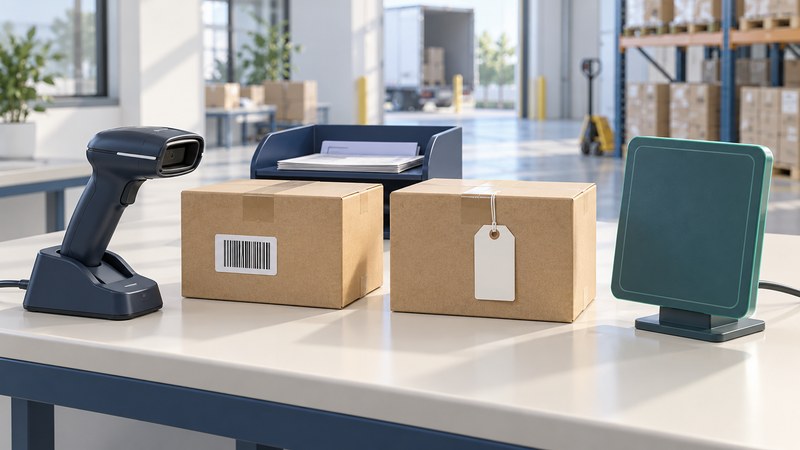
RFID and barcodes can support the same warehouse task through different capture methods. A barcode scanner selects a visible symbol; an RFID reader can collect responses from several tags in its radio field. A reliable mixed workflow turns those observations into one agreed inventory result, with an explicit way to resolve items that need individual attention.
Start with the task and the identity required to complete it. Retaining a barcode fallback is useful only when staff know what its data identifies and how the fallback joins the same transaction.
Choose the identity before the capture method
A product identifier answers “which kind of item?” A serialized identifier answers “which particular item?” A carton or pallet can also have its own identity, linked to its contents. Record which level each receiving, counting or shipping task needs.
GS1’s explanation of the Electronic Product Code explains the connection between barcode-based GS1 identifiers and their encoding on RAIN RFID tags. Matching identities requires decoding their representations; the displayed barcode text and raw RFID hexadecimal string can look different while referring to the same object.
A retail barcode containing only a GTIN cannot distinguish two units of that product. Where a fallback must identify a single tagged unit, provide a controlled serialized barcode, a validated item lookup, or a supervised exception process. Document leading-zero handling, serial formatting and the mapping to warehouse item numbers.
Assign a capture method to each step
On a small screen, scroll sideways to read all columns.
| Task | Possible primary capture | Required control |
|---|---|---|
| Receive a known group | RFID in a bounded receiving session | Compare unique expected identities with observed identities. |
| Resolve one missed item | Barcode or controlled manual lookup | Recover the same identity level used by the receiving session. |
| Pick a specific unit | Directed barcode scan or suitably bounded RFID | Verify the requested item, location and serial where required. |
| Count mixed stock | RFID with barcode exceptions | Define scope, freeze or reconcile movements, and count each identity once. |
Define the start and end of the session. Nearby stock, items carried back through a portal and repeated reads need explicit treatment. Keep the capture method in the evidence record even when both methods produce the same business identity. That makes recurring radio or label problems visible.
Reconcile a small mixed receiving session
The result is 3 ÷ 4 = 75% initial RFID coverage and 4 ÷ 4 = 100% reconciled identity coverage for this tiny fictional session. These are different measures. The example illustrates bookkeeping, not expected equipment performance. Repeated observations must remain available for diagnosis without adding stock.
If the fallback scan for D instead returns only a product code shared by all four cartons, hold that exception for identification. Adding one anonymous unit would conceal whether D arrived or another carton was counted twice.
Make fallback and replay deliberate
- Keep the current session open while the exception is resolved; record the item, reason and operator action.
- Search the existing session for the recovered identity before adding it.
- Confirm the physical item and expected shipment association.
- Commit the completed business event using a stable transaction reference.
- If a connection fails, recover the transaction status and follow the application’s replay rules before submitting another receipt.
Separate missed reads, damaged barcodes, unknown identities and application rejections in the log. Each points to a different owner. A readable tag with an unrecognized identity is a data exception; increasing reader power will not supply the missing item mapping.
Prove coexistence before expanding it
Run a known population through normal work, deliberate repeat scans, out-of-scope stock, damaged labels and a disconnected session. Compare the final warehouse records with the physical test set. Check that fallback never creates a second receipt and that staff can recognize unresolved items.
Measure elapsed work time, initial RFID coverage, fallback count and final discrepancies separately. Keep the same definitions before and after a change. Scale the tested workflow after operations and the system owner can reproduce it; retain the original evidence when tags, packaging or software change.
Keep a working record
Download the editable rfid technology working record (plain text). Save a copy for each evaluation. It includes instructions, evidence fields and source links; record unresolved questions with their owner before signing off.
Related reading
- Understand product and serialized EPC identities
- Turn reads into warehouse events
- Measure read reliability
- All RFID guides
Researched and updated October 3, 2026. Recheck the relevant source documents when equipment, software or requirements change.