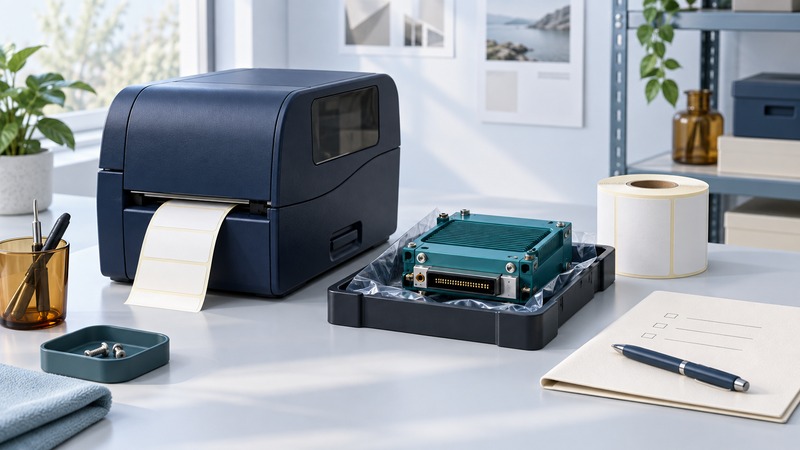
An RFID-ready printer is worth considering when a documented upgrade can turn the exact machine you own into the printer/encoder your labels require. Treat “ready” as a question to resolve with a supported parts list, installation responsibility and a successful media trial.
Begin with the model, serial number, print resolution, installed options, firmware and service history. Then describe the finished label: dimensions, inlay, surface, encoded data, print quality and required throughput. This makes upgrade and replacement proposals comparable.
Establish the exact upgrade path
Ask the manufacturer or authorized service provider for written compatibility between that printer and a specific current kit. Include regional radio configuration, firmware prerequisites, installation instructions, warranty consequences and support availability. A family-level brochure is useful for screening; the model and serial configuration determine the order.
For a current example, Zebra’s ZT400 RFID specification describes field-upgradeable technology and a ZT411 on-metal option up to 300 dpi. The family also includes higher-resolution printing configurations. Those statements must be read together: a maximum resolution advertised for the printer family does not establish that every RFID option supports it.
Use the ZT411 technical specifications as a model-specific reference, then obtain the applicable kit documentation. The same verification method applies to other brands; this example is not a product ranking.
Compare three complete proposals
On a small screen, scroll sideways to read all columns.
| Option | Evidence needed | Cost and interruption to include |
|---|---|---|
| Upgrade the installed printer | Exact kit compatibility, supported installer and remaining service life. | Kit, labor, freight, validation, downtime and temporary labeling. |
| Buy a preconfigured printer | Ordered resolution, RFID/media support, region and delivered configuration. | Printer, setup, accessories, software changes and training. |
| Replace with another platform | Representative print/encode trial and integration proof. | Migration, label-format changes, support, spares and retraining. |
Ask every bidder to price the same workload and trial, with taxes, delivery, warranty and support stated consistently. Identify one-time and recurring charges separately. The usable comparison is the total effort to deliver accepted labels over a chosen period, including what happens to the existing machine.
Make the media trial decisive
Supply samples of the intended label construction and the data/print format. Agree a run long enough to include loading, calibration, normal operation and recovery from a controlled error. Record print speed, encoding settings, media lot and the number of attempted, accepted and rejected labels. Verify encoded content independently with a compatible reader and compare printed and electronic identities.
A readable loose label is only part of the result. Apply representative labels to the intended objects and check the downstream read task. On-metal labels have a construction and thickness that can affect printer handling as well as RF performance. Confirm these details with the media and printer suppliers before committing to a volume order.
Have an operator perform a roll change and follow the documented exception procedure. Record wasted labels and time to resume. The RFID printing guide covers the operational encoding workflow in more detail; this decision should establish that the chosen hardware can support it.
Use a complete fictional cost comparison
The cheaper path can still be inappropriate if the existing printer has poor remaining service life or cannot meet the required resolution and media combination. Conversely, a supported upgrade can preserve familiar operation and an already integrated print path. Record the evidence that makes either conclusion true for your installation.
Accept the installed result
Keep the installed kit identity, firmware, regional settings, configuration export and trial report with the asset record. Confirm who owns support calls and which supplier investigates printer-versus-media failures. Retain a known-good label sample and encoding file for later diagnosis.
Close the purchase after the agreed acceptance run, operator handover and recovery demonstration. Revisit the decision when the label construction, destination region, software or equipment support status changes. A future upgrade promise should remain an unresolved dependency until there is a documented orderable path.
Keep a working record
Download the editable working record (plain text). It includes purpose, instructions, evidence fields and this guide's source links. Save a separate copy for each evaluation and record unresolved issues with their owner.
Related reading
Researched and updated September 20, 2026. Recheck source documents when equipment, software or applicable requirements change.