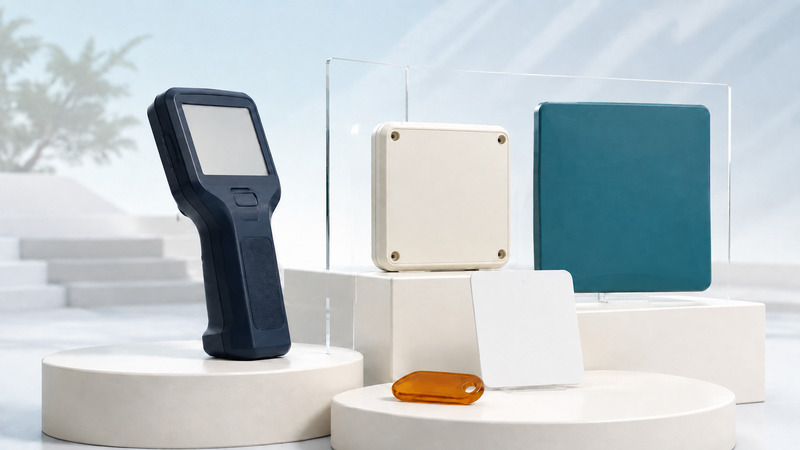
Choose an RFID reader by starting with the tag and the job. A reader that detects a label across a warehouse is not necessarily able to read a door credential, and a phone that opens an NFC link does not automatically read a retail UHF label. “RFID compatible” needs a more precise description before it becomes a useful buying criterion.
Write down the exact tag or credential family, the information you need, and the action that should follow a read. Then ask a supplier to demonstrate that complete sequence with your own samples. A successful beep is only the beginning.
Frequency is the first filter, not the whole specification
On a small screen, scroll the table sideways to read all columns.
| Family | Common context | What to verify |
|---|---|---|
| Low frequency (LF) | Animal identification and some access or industrial systems. | Exact tag protocol and supported encoding; one LF reader is not a universal animal or access reader. |
| High frequency (HF), including NFC | Contactless cards, library tags and phone tap interactions. | Supported ISO protocols, tag type, application commands and any required authentication. |
| UHF / RAIN RFID | Item and asset identification, often with multiple labels in a read zone. | Air interface, permitted regional configuration, tag encoding and performance on the actual item. |
Manufacturer portfolios illustrate why these distinctions matter. NXP’s HITAG family includes LF products supporting particular animal and industrial identification standards. Its CLRC663 plus HF reader frontends list several different protocols, including ISO/IEC 14443 and ISO/IEC 15693. Those are component capabilities, not a promise that every finished reader implements every application.
For RAIN, the RAIN Alliance’s technology overview separates tags, readers, antennas and software, and calls for controlled numbering practices. A reader can report an identifier that your business application does not recognize. Conversely, a software problem does not necessarily mean the radio failed.
Ask the supplier to name the exact tag IC or tag family used in the demonstration. If a card is protected, establish how the application will obtain authorized access to its data. Detecting a card or reading an exposed identifier does not establish permission to read protected records or use that identifier as a secure credential.
Choose where the reader belongs in the work
A handheld lets a person choose the search area, investigate exceptions and move around awkward items. That can suit shelf counts or finding a specific asset. It also makes results depend on the operator’s path, pace, battery state and instructions. Test the whole shift’s handling, not just the first comfortable minute.
A fixed reader can monitor a repeatable point such as a doorway or conveyor. It needs a defined zone, suitable mounting and a way to distinguish passing items from nearby stock. A desktop reader can make a deliberately small transaction area useful at a service counter. Embedded modules require additional product engineering; they are not complete workplace readers.
For a concrete fixed-reader example, Zebra’s FX9600 specification describes antenna-port options and power arrangements including PoE and PoE+. Read the exact configuration and power requirements rather than assuming that a network socket supplies everything. Cabling, connectors, mounting, environmental rating and replacement access belong in the installation plan.
The longest possible range is often the wrong target. If the job is to record cartons entering one door, reading stock through the adjacent door can be a defect. Describe the intended items, the surrounding items that must be excluded, the permitted motion and the time available to make a decision.
Check the route from the device into your system
Establish how the reader communicates with the application: a vendor SDK, a documented API, a supported standard interface, or a keyboard-style output. Ask for a working sample on the operating system and software version you will actually use. “Bluetooth” or “USB” describes a connection, not the complete data contract.
GS1’s Low Level Reader Protocol specification defines an interface between readers and client software. A reference to LLRP should lead to questions about implemented features, supported versions and tested client combinations. Do not infer that a particular device exposes it merely because the radio supports Gen2.
Check whether each report includes the identifier, reader or antenna, timestamp and useful status. Determine what happens during a network interruption, whether events can be replayed, and how duplicates are handled. A keyboard-style reader may be convenient for a form but unsuitable when the application needs rich event metadata.
Also establish who manages device credentials, updates and configuration backups. A remotely managed reader needs an owner after installation. Ask how long the manufacturer supports the device and how an update can be tested before it reaches an operational doorway.
Make the acceptance test resemble the intended job
Use representative items, including awkward packaging, worn tags and the normal range of orientations. Keep a known list of what should be present. Include an empty-zone run and nearby tagged stock so you can detect unwanted reads as well as missed ones. Test the application result, including an exception or outage, rather than accepting only the reader’s tag count.
Agree in advance how many misses, unwanted reads and delayed transactions are acceptable for that workflow, and what the fallback will be. A stock count with a reconciliation step has different consequences from an automated action that immediately moves goods. Avoid transferring an impressive laboratory rate into a production guarantee.
Use the reader selection and acceptance checklist to capture the evidence behind each claim. For repeatable measurements after choosing a system, continue with the RFID optimization guide. For phone-based taps, use the more specific NFC guide.
Related resources
- Understand EPC Gen2 and RAIN compatibility
- Review RFID privacy and data handling
- Explore all RFID resources
Researched and updated September 5, 2026. Check the linked official sources for specifications and policies that apply to your equipment and application.