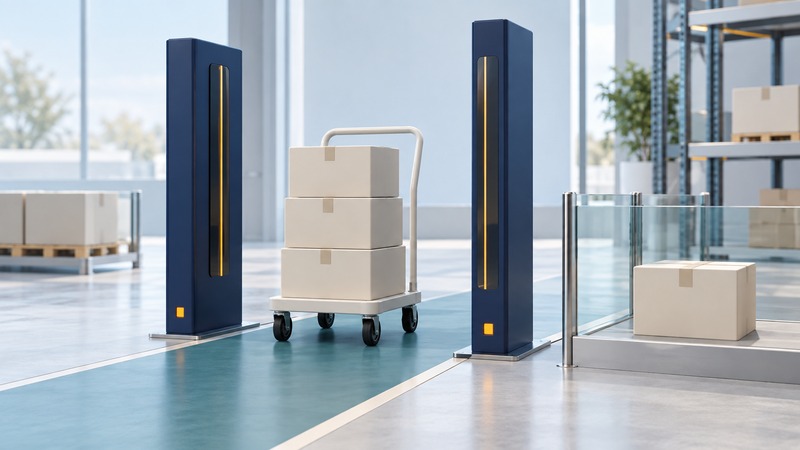
An RFID gate reader detects tags within a radio field. A useful portal system goes further: it determines which observations belong to a particular passage, handles uncertainty and gives the receiving application enough evidence to act correctly.
Start by defining the passage: which lane, objects, direction and time window count? A warehouse dock, conveyor checkpoint and library gate can use different tags, frequencies and decision rules. The portal’s shape alone establishes none of those choices.
Define the boundary and the tags
Confirm whether the application uses HF, UHF or another RFID technology and match the reader and antennas to the actual tags. HF gates and UHF warehouse portals are distinct implementations. A broad throughput claim from one product cannot be transferred to another tag population or workflow.
Draw the intended travel lane, nearby staging stock and adjacent portals. Include the approach and departure areas, allowed traffic speed and normal load configurations. State whether the system must read every item, recognize a container or merely detect an authorized tag. These produce different acceptance tests.
On a small screen, scroll sideways to read both columns.
| Scenario | Expected evidence |
|---|---|
| Normal forward passage | Expected items captured and assigned to one passage; correct downstream event. |
| Cart stops or reverses | A defined result for an incomplete or reversed movement, without inventing a completed shipment. |
| Stationary stock beside the lane | Nearby tags remain excluded or explicitly flagged as uncertain. |
| Adjacent portal active | Reads are attributed to the correct lane; neighbor activity does not silently suppress expected items. |
| Two closely spaced loads | The system separates their passage windows or reports ambiguity according to the design. |
| Reader or network interruption | The system exposes the gap and follows its documented recovery and reconciliation process. |
Tune for the intended population
Use a known set of tags attached to representative goods. Record identities, packaging, orientation, speed, antenna arrangement and configuration. Count expected items captured, missed items and unintended reads separately. A single tag tested in the center of the opening cannot represent a loaded cart.
Impinj’s example inventory configurations describes portal tuning as a balance of tag population, sensitivity, speed and nearby-reader interactions. It recommends adjusting power to read intended tags while limiting stray reports. Its settings apply to the documented reader interface; use the current instructions for the installed model.
Change one relevant variable and repeat the same test. Higher power may capture a difficult item and also include stock beyond the lane. Record both effects. Check the installed region and permitted configuration; copy neither a power value nor a reader mode from an unrelated deployment.
Require evidence of direction and completion
A tag appearing in a read stream establishes an observation. Passage direction may require an appropriate antenna sequence, supported locating feature, additional sensors or another validated method. Ask the integrator to describe the actual evidence and to show how it behaves when a load pauses, turns around or approaches sideways.
Define the start and end of a passage window and how observations are associated with it. Handle repeated reports of the same tag without creating duplicate items. If two loads overlap and the system cannot separate them reliably, expose the exception instead of silently assigning tags to the most recent trigger.
For a shipment or receipt, compare the accepted passage with the expected manifest and other required workflow evidence. The RFID integration guide covers identity mapping, deduplication, retries and committed events. Portal logic should preserve its observation evidence for that process.
Accept the installed workflow
Run the scenario set at realistic speeds and load densities, including awkward but permitted tag positions. Use repeated trials and retain failed runs. Set acceptance criteria before observing results; the number of repetitions and tolerated exceptions should reflect the operational consequences.
Measure the time staff spend resolving misses and ambiguous passages. A portal with a high read rate can still create excessive manual work if it frequently assigns nearby tags to a load. Compare the full task with its prior process when judging whether the deployment helps.
At handover, save antenna locations, device and firmware versions, configuration, scenario results and recovery procedures. Set retest triggers for changed packaging, tag supplier, staging layout, neighboring readers or passage speed. Test software changes that alter passage windows or event attribution as carefully as radio changes.
Use the gate for its validated identification purpose. Machinery guarding, vehicle barriers and personnel safety functions require their own approved design and verification. An inventory read zone is not a protective barrier.
Take the guide into your workflow
Download the working checklist (plain text). The editable text file includes its purpose, instructions, evidence fields and a link back to this guide. Record observed results and unresolved questions before making the decision.
Related reading
- Measure capture and stray reads
- Compare zones and coordinate tracking
- Choose compatible readers
- Explore all RFID guides
Researched and updated September 11, 2026. Recheck the linked primary sources when equipment, standards or operating requirements change.