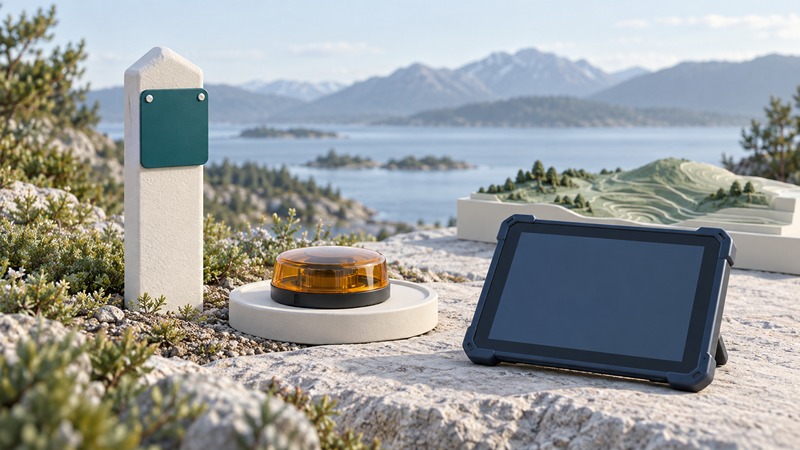
An RFID field marker gives a compatible reader a way to identify a physical reference and retrieve associated information. Its usefulness depends on the record behind that identity: what the marker refers to, who installed it, how its position was established and what has changed since then.
This guide is for field-record and asset-information teams. It covers record design and verification for surface data stakes and documented electronic-marker systems. Surveying, utility locating and excavation follow their own qualified procedures and applicable requirements.
Separate marker identity, position and asset meaning
On a small screen, scroll sideways to read all columns.
| Fact | Evidence to preserve |
|---|---|
| Marker identity | Readable identifier, marker family, compatible reader and how the ID was obtained. |
| Marker position | Coordinates, reference system, collection method, date, uncertainty and whether the value is measured or approximate. |
| Associated asset | Controlled asset reference, relationship to the marker, installation evidence and current status. |
A marker may identify a valve location, a documented reference point or a record associated with nearby infrastructure. State that relationship literally. A point used to identify an asset does not by itself describe the full route of a buried line or establish a legal property boundary.
Electronic markers also vary in capability. 3M's utility-marking overview distinguishes EMS markers from EMS-ID markers with a serial number and programmable text. Ask which functions the exact marker and reader support. A device that detects a marker frequency may provide less information than a reader supporting its stored data.
Create a record that can survive staff changes
Use a stable asset identifier in the managed system and store the marker identifier as an associated reference. Record manufacturer/type, installed purpose, responsible organization and lifecycle status. Keep observations separate from edits to the authoritative record so a field discrepancy can be investigated.
For coordinates, include the coordinate reference system and units, measurement method, date and reported accuracy or uncertainty. Preserve the distinction between a surveyed coordinate and a point selected on a map. If the team cannot establish those details, mark the location quality as unresolved rather than presenting more decimal places as greater accuracy.
Attach dated photos showing the marker and useful surrounding context, subject to the organization's access rules. Record the relationship to the referenced asset in plain language. Identify who approved the association and where installation evidence is retained. Protect sensitive infrastructure records according to the operator's policy.
Verify both the read and the returned information
The 3M Dynatel 7420 operator's manual (July 2015) documents model-specific marker reading, writing and read-history functions. It is useful evidence of that device's workflow, not a universal procedure or a claim that every current model behaves identically. Use current instructions for the actual equipment in service.
During record acceptance, read the marker with the compatible device and compare its ID and any stored fields with the approved asset record. Confirm which fields came from the marker and which were fetched from a database. Record the database revision or retrieval time, especially if a tablet can use an offline copy.
A successful write should be followed by a documented read-back check using the supported process. Test with controlled samples before altering operational markers, and preserve the prior approved record. Establish who may write field data and how duplicate or incorrect identifiers are handled.
Make unresolved field observations useful
- Unreadable marker: record the intended reference, reader/type, time and observed conditions; route the issue through the approved asset-verification process.
- Readable marker with no database match: retain the exact ID and evidence, and ask the record owner to investigate.
- Database record conflicts with physical context: preserve both observations and prevent an automatic authoritative update.
- Replacement marker: record the retired and new identifiers, effective date and approved asset association.
- Offline edit: reconcile with intervening changes before accepting it into the current record.
These outcomes should remain visible in the field application. A blank search result must not be interpreted as proof that no asset exists. Keep the unresolved issue attached to the work order until an authorized person closes it with evidence.
Keep utility safety and survey decisions in their proper process
For U.S. digging work, PHMSA's 2026 National 811 Day guidance directs people to contact 811 before digging and follow the damage-prevention process. An RFID record, map point or marker read does not replace that process. Applicable notice periods, responses and field procedures must come from the relevant jurisdiction and operator.
For property boundaries, retain the marker's provenance and involve the responsible qualified survey professional. Avoid converting an equipment read into a boundary determination. This guide's worksheet captures evidence and ownership; it is not an excavation clearance, utility-location certificate or survey result.
Revisit records after maintenance, resurfacing, marker replacement, asset retirement or database migration. A reliable marker program combines readable hardware with disciplined record updates and a clear process for uncertainty.
Keep a working record
Download the editable working record (plain text). It includes purpose, instructions, evidence fields and this guide's source links. Save a separate copy for each evaluation and record unresolved issues with their owner.
Related reading
Researched and updated September 20, 2026. Recheck source documents when equipment, software or applicable requirements change.