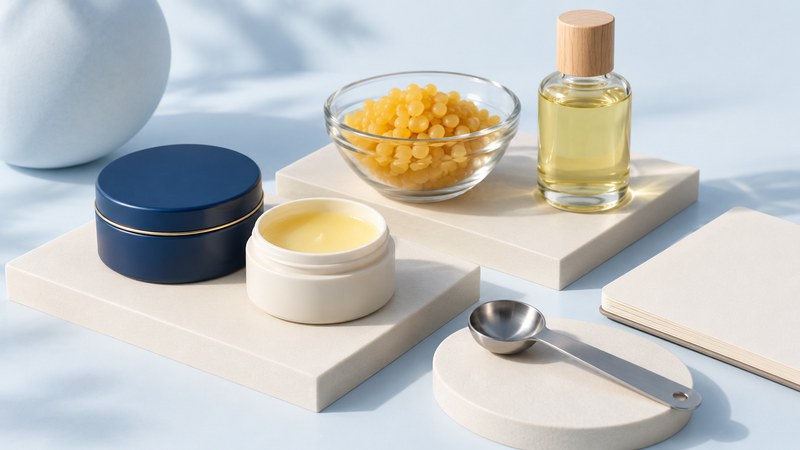
A homemade balm can be a small formulation project using wax and oils. The recipe below makes 40 grams before transfer losses and leaves out colour and fragrance. It is a cosmetic balm with no established SPF, shelf life or clinical benefit; use a labeled sun-protective lip product outdoors.
Weigh a 40-gram batch
This is a scaled, unflavoured adaptation of the four base ingredients in Bramble Berry’s Soap Queen large-batch recipe. Its base ratio is 2.7 parts beeswax, 3.8 coconut oil, 1.7 sweet almond oil and 1.2 avocado oil by weight. The amounts below are rounded to 0.1 g and sum to 40.0 g. Colour and flavour are omitted. This adaptation has not been physically tested by Yenra.
| Ingredient | Mass | Role in this formulation |
|---|---|---|
| White beeswax | 11.5 g | Gives the balm structure. |
| Coconut oil, solid type | 16.2 g | Provides a softer oil phase as the mixture cools. |
| Sweet almond oil | 7.2 g | Liquid oil component; avoid if unsuitable for your allergies. |
| Avocado oil | 5.1 g | Liquid oil component. |
| Total | 40.0 g | Before losses on tools or in the pouring vessel. |
On a narrow screen, swipe the table or focus it and use the arrow keys.
Use fresh ingredients sold for cosmetic/lip use and check each supplier’s specifications. Fractionated liquid coconut oil is a different material from ordinary solid coconut oil. Changing a wax or oil changes the formulation, so record substitutions as a new experiment. If an ingredient is unsuitable for you, choose another supported formula or a suitable finished product.
Prepare tools and containers
Gather the scale, a heat-safe pouring vessel, a double-boiler setup, a dry stirring tool, heat protection for your hands and clean lip-balm containers rated for hot filling. Prepare more container capacity than the expected yield; nominal container volume and balm mass are different measures.
Work on a stable surface away from children and pets. Clean the tools and containers and let them dry fully. Arrange the containers before heating so you can pour without rushing. Follow the equipment and container suppliers’ instructions; avoid pouring hot material into packaging whose temperature suitability is unknown.
The Handcrafted Soap and Cosmetic Guild’s method uses gentle melting, combining and prompt filling. The process below applies that sequence to this weighed formula. Hot wax, oil, water and equipment can burn.
Melt, mix and fill
- Weigh each ingredient separately. Record the actual masses, supplier names and lot or purchase details.
- Gently heat the beeswax in the double boiler. Keep water out of the balm and prevent the water pan from boiling dry. Use controlled heat rather than a direct flame against the oils.
- When the wax is mostly melted, add the coconut oil, then the liquid oils. Stir until the blend is uniformly liquid with no visible wax pieces. Avoid prolonged heating.
- Remove the vessel carefully using heat protection. Pour into the prepared, suitable containers on the stable surface.
- Leave the containers undisturbed until the balm is fully cool and set. Close and label them with the ingredients and batch date.
Allow several hours for setting before assessing texture. Make the first batch small enough to evaluate at the temperature where you intend to store and use it. The number of containers filled depends on their capacity and transfer losses.
Evaluate the batch and keep it clean
If the balm is unexpectedly soft, compare the actual masses and coconut-oil type with the formula before changing it. If it feels grainy or uneven, review whether every solid melted and whether the mixture was uniform before pouring. Record observations; do not fix texture by adding water or improvised food ingredients.
Keep the containers closed, clean and away from heat. Use clean hands or a clean applicator and keep the balm for personal use. FDA’s cosmetic contamination guidance identifies raw materials, preparation, packaging, storage and finger contact as possible contamination routes. A water-free formula still requires care.
Yenra has not established a safe shelf life for this batch. FDA’s shelf-life guidance explains why formulation, use and storage matter. A date copied from an ingredient bottle cannot validate the finished product. Discard a batch with an unusual smell, visible contamination or unexplained change; normal appearance alone cannot prove microbial safety.
Stop using a balm that stings, burns or irritates. The American Academy of Dermatology’s chapped-lip guidance recommends non-irritating products and notes that fragrance and some flavourings can irritate already chapped lips. Seek medical assessment for persistent problems rather than repeatedly changing recipes.
Keep sun protection separate
For outdoor use, the AAD recommends a lip product labeled SPF 30 or higher and reapplication every two hours. This homemade recipe has no tested SPF. Adding a powder or an oil with an online SPF claim does not establish sunscreen performance.
On a ski trip, pack an appropriate labeled product and follow its directions. Keep the homemade project focused on understanding texture, measurements and clean handling. Use the ski-day planning guide for weather and travel checks.