Graphene is famous for strength, conductivity, thinness, and transparency. A single sheet is only one atom thick, with carbon atoms arranged in a hexagonal lattice. In an ideal crystal, that lattice can be extraordinarily strong. In a real device, however, graphene can still tear.
That tension between ideal strength and practical fragility is why rebar graphene is interesting. The material borrows its name from reinforced concrete: steel bars do not make concrete unbreakable, but they can carry load, slow cracking, and keep damage from spreading cleanly through a structure. Rebar graphene applies the same design idea at nanoscale, using carbon nanotubes as reinforcing elements inside or alongside graphene.
Why Graphene Needs Toughness
Strength and toughness are related but not identical. Strength describes how much stress a material can withstand before failing. Toughness describes how much energy it can absorb as a crack forms and grows. A very strong material can still be brittle if a small flaw lets a crack run quickly through it.
That distinction matters for graphene because practical sheets are not perfect. Chemical vapor deposition, transfer steps, wrinkles, grain boundaries, contamination, holes, and handling damage all create places where cracks can begin. For flexible electronics, sensors, transparent conductors, membranes, and wearable devices, surviving bending and stretching can be as important as having impressive ideal properties.
| Property | What it describes | What to check |
|---|---|---|
| Strength | Stress at yielding or failure. | Load, cross-sectional convention, defects and loading direction. |
| Fracture toughness | Resistance to extension of a crack. | Crack geometry, calculation method and units such as MPa·m1/2. |
| Flexibility | How readily a structure bends. | Thickness, bend radius and repeated-bending durability. |
How Rebar Graphene Works
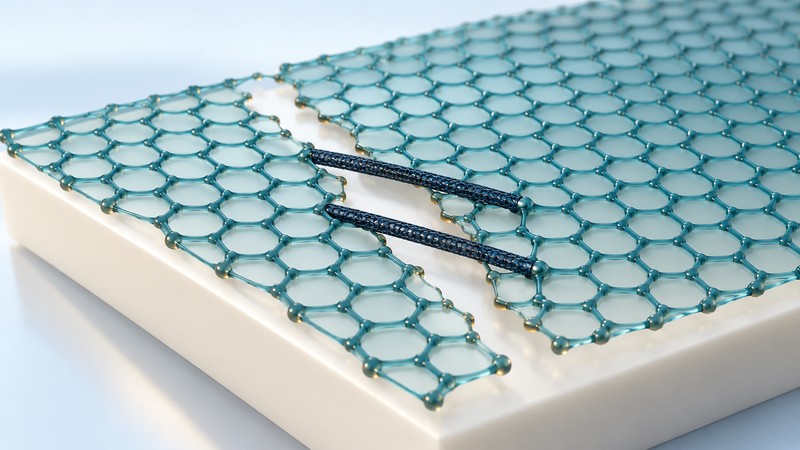
In rebar graphene, carbon nanotubes provide reinforcing paths through a graphene sheet. The nanotubes can bridge a crack after it opens, forcing the crack to take a more difficult route rather than slicing straight across the material. A crack that zigzags, branches, or pauses at reinforcement consumes more energy than one that travels cleanly through an unreinforced sheet.
The reinforcement is all carbon, which is part of the appeal. A nanotube-graphene hybrid can preserve many of the electrical, thermal, optical, and chemical advantages that make carbon nanomaterials attractive, while improving mechanical tolerance where pure graphene is vulnerable.
The Rice University Test

Rice University researchers reported in 2018 that fracture-resistant rebar graphene was more than twice as tough as pristine graphene in their tests. Materials scientist Jun Lou, graduate student Emily Hacopian, chemist James Tour, and collaborators examined how nanotube reinforcement changed the way graphene failed under tension.
The team made rebar graphene by spin-coating single-walled carbon nanotubes onto a copper substrate and growing graphene on top by chemical vapor deposition. They then cut microscopic samples, mounted them for electron-microscope testing, and pulled them apart while measuring the force required to propagate cracks.
What the Cracks Revealed
The nanotubes did not prevent failure forever. They changed the failure path. In unreinforced graphene, a crack can run relatively directly once it finds a weak point. In rebar graphene, nanotubes diverted the crack, bridged gaps, and sometimes helped preserve conductivity after partial damage.
Table 2 of the original paper reports a critical stress intensity factor of 10.50 ± 5.73 MPa·m1/2 for seven notched rebar-graphene specimens. The authors compare this with a previously reported graphene value of about 4.0 MPa·m1/2. These fracture-mechanics units combine stress with the square root of a length; they are different from a tensile strength in MPa.
The calculation used a measured average film thickness of 0.7 nm. The spread across specimens and the comparison with earlier work matter: the result supports a toughening strategy under the reported tests, rather than a guaranteed multiplier for every graphene film.
Role of Simulation
Mechanical testing revealed the failure paths, while molecular dynamics simulations explored how nanotubes could redirect and bridge cracks. The simulations reproduced the broad reinforcing mechanisms, with different numerical values from the experiments; sample size and reinforcement structure affected the comparison.
That combination of experiment and simulation is important for two-dimensional materials. Electron microscopy can show snapshots of deformation, but simulations can fill in fast atomic-scale steps that are hard to observe directly.
Where It Could Be Useful
Rebar graphene points toward tougher carbon films for flexible electronics, transparent conductors, strain sensors, membranes, soft robotics, foldable displays, and electrically active textiles. These applications often need materials that remain conductive while bending, stretching, vibrating, or being handled repeatedly.
The concept may also inform other two-dimensional materials. Molybdenum disulfide, hexagonal boron nitride, transition-metal dichalcogenides, and layered heterostructures all face their own versions of crack sensitivity, transfer damage, and reliability limits. Reinforcing the architecture may become as important as improving the chemistry.
Limits and Tradeoffs
Adding nanotubes is not a free upgrade. Reinforcement can change transparency, sheet resistance, surface roughness, defect density, and manufacturing complexity. Alignment, bonding, nanotube purity, tube length, tube distribution, and compatibility with existing device processes all affect performance.
There is also a scale problem. A small laboratory sample can be tested carefully under a microscope; a commercial film must be made uniformly over large areas, transferred or integrated cleanly, and survive packaging and use. The practical question is whether the added toughness is large enough to justify the added process steps.
A Design Lesson
The deeper significance of rebar graphene is that atomically thin materials can be engineered like structures, not merely selected like substances. A sheet of graphene is not just carbon; it is a lattice, a set of defects, a crack path, a transfer history, and a mechanical architecture. Carbon nanotube reinforcement gives researchers another way to design that architecture.
For graphene to move from remarkable material to reliable component, it must do more than perform well when perfect. It must tolerate flaws. Rebar graphene is one route toward that more durable version of two-dimensional carbon.
Keep a research-reading record
Use the editable nanotechnology research worksheet (Markdown) to record the material, measured outcome, units, comparator and remaining questions. It works in Obsidian or an ordinary text editor.