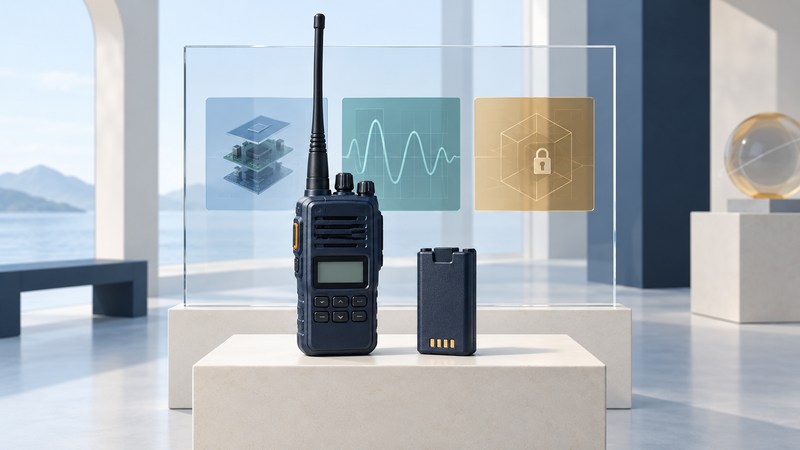
The Harris AN/PRC-152 is a useful case study in bringing multiband RF hardware, software-defined waveforms and programmable cryptography into a handheld radio. Its significance becomes clearer when those layers are read separately. This retrospective uses public technical descriptions and keeps the original AN/PRC-152 distinct from the later AN/PRC-152A.
On a narrow screen, swipe tables sideways or focus them and use the arrow keys.
Read the radio in four layers
| Layer | Role | Question it answers |
|---|---|---|
| RF hardware | Antennas, filtering, conversion and amplification | Which frequencies and signal levels can the hardware support? |
| Waveform software | Modulation, coding, framing and protocol behavior | How is information exchanged with compatible peers? |
| Software architecture | Component interfaces and application management | How is waveform software organized on the platform? |
| Cryptographic subsystem | Defined protection of communications and keys | Which security modes and conditions apply? |
Power, cooling, packaging and controls connect all four. Software flexibility operates inside those physical and system limits. A new software feature needs compatible processing resources, interfaces and RF behavior as well as an approved implementation.
Use a dated brochure as a bounded source
Harris’s April 2012 AN/PRC-152 brochure, DS-321M (PDF) describes a single-channel radio with a standard 30–512 MHz range, an SCA v2.2 environment and Sierra II programmable cryptography. It identifies GPS and several waveform or hardware capabilities as options. Those details explain the platform’s architecture; they should remain attached to that brochure revision and configuration.
Read a frequency range as one dimension of capability. To establish compatibility, the waveform, channel parameters, enabled options and other system requirements also matter. A shared tuning frequency alone leaves most of that question unanswered. Likewise, an optional feature in a family brochure is a prompt to identify the installed variant.
What the Software Communications Architecture contributes
The Joint Tactical Networking Center’s explanation of SCA describes a framework for creating, configuring and managing waveform applications on radio hardware. Standard interfaces support reuse and portability of software components. They address how a radio platform is organized.
- Waveform application requests platform services
- Software architecture defines component interfaces and management
- Processing and RF hardware supply supported resources
Architecture conformance, waveform interoperability and cryptographic approval answer different questions. A structured software environment helps integration; interoperable communications still require implementations that agree on the actual protocol. JTNC’s account is useful for understanding that distinction without assuming every SCA radio runs every waveform.
Read certification and options at their documented scope
The NATO information-assurance product entry lists AN/PRC 152 under communications encryption, with a COSMIC TOP SECRET classification and reference MCM-0118-2006. That is a specific published product entry. It should not be silently substituted for the scope of a different national approval or a different radio variant.
For historical writing, identify the authority, product, reference and date. For any operational decision, the controlling documentation and authorized configuration determine applicability. The presence of a named cryptographic module in a brochure is only part of that evidence.
Optional GPS supplies position information. An architecture framework manages software components. A waveform controls communication behavior. Explaining their separate jobs is more useful than treating them as one undifferentiated list of advanced features.
Keep the 152 and 152A separate
The later L3Harris AN/PRC-152A product page describes wideband networking, narrowband and UHF SATCOM capabilities and SCA v2.2.2 compliance. Its specifications belong to that later model. The additional letter is important when comparing documents or identifying an artifact.
The AN/PRC-152 illustrates a major engineering direction: extending a radio through software within a defined hardware and security architecture. It also shows why careful model identification remains necessary even when products share a family name.