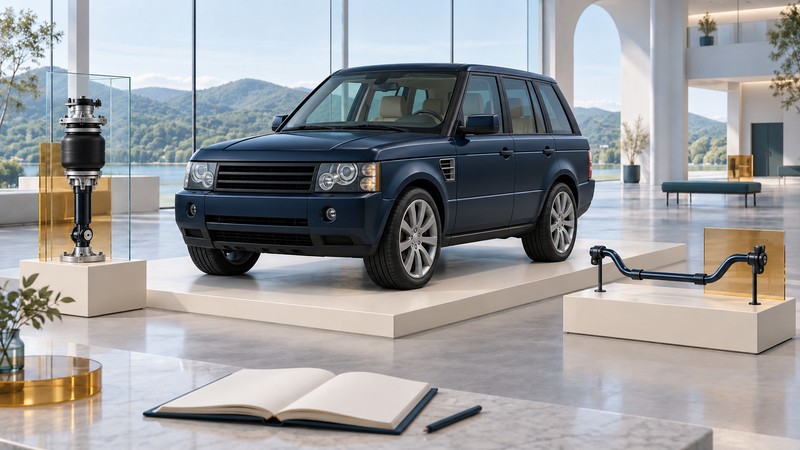
For an early Range Rover Sport, identify the suspension equipment first, then record what it does and what a specialist can verify. Air suspension, Dynamic Response and Terrain Response have different jobs; separating them makes a viewing and a workshop discussion much more useful.
This guide uses the US-market 2006 HSE and Supercharged as its reference. Bring the VIN, build information, matching owner handbook and service invoices. The full-size Range Rover and Land Rover LR3 have separate guides and equipment records.
Establish which systems the vehicle has
The 2006 Land Rover North American brochure, preserved on SlideShare, lists Electronic Air Suspension as standard. Its equipment pages show Dynamic Response included with Supercharged and available as an HSE package, with delayed availability noted. Treat an HSE badge as the beginning of an equipment check: obtain the build record and have the installed hardware identified.
Record model year and market separately from first-registration date. Add any suspension conversion, replacement control module or other alteration, including the invoice and reason. A seller’s phrase such as “suspension replaced” needs a list of parts and the work performed before it becomes useful evidence.
On a narrow screen, scroll the table sideways. Keyboard users can focus the table region and use the arrow keys.
| System | Function in the period brochure | What to establish on this vehicle |
|---|---|---|
| Electronic Air Suspension | Air springs support automatic load leveling and selectable ride heights. | Factory equipment, fitted components and documented repairs. |
| Dynamic Response | Hydraulic actuators in the anti-roll bars control body roll. | Whether fitted; service history and specialist assessment of the hydraulic system. |
| Terrain Response | Coordinates several vehicle systems for selected driving conditions. | Matching handbook, fitted controls and any displayed faults. |
Record observations with their conditions
Start while the vehicle is parked on a suitable level surface. Note the date, whether it has recently been driven, its load and the displayed suspension setting. Photograph the stance from consistent positions with the owner’s permission. These details help a workshop interpret a later change; a single photograph alone gives limited evidence.
Have the owner demonstrate permitted ride-height changes using the matching handbook. Keep people and objects clear of the vehicle’s movement. Observe the requested setting, the indicated result and the exact wording of any warning. Record a repeated request or an interrupted demonstration as an observation, leaving the cause for diagnosis. Avoid repeated cycling merely to force a result.
For operating instructions and warnings, use the handbook matching the vehicle through Land Rover owner information or a retailer. Do not work underneath a vehicle supported by its air suspension. Leave underbody inspection and system testing to a properly equipped specialist.
Ask for findings that connect symptom and system
Give the workshop your notes before it begins. Ask it to identify the fitted systems, read relevant fault information and explain which further checks support its conclusion. Useful findings state what was observed, under what conditions, and what remains uncertain. A component name or fault-code printout on its own is an incomplete repair explanation.
- For a height concern: ask how the workshop distinguished control, supply and leakage questions, and whether it reproduced the reported behavior.
- For Dynamic Response: request a separate assessment of the fitted hydraulic equipment, its condition and any warning history.
- For past repairs: match invoices to components and mileage, then ask what verification followed the work.
- For a proposed repair: obtain an itemized scope and the follow-up check that would demonstrate success.
A successful parked height demonstration answers a limited functional question. A purchase assessment also needs the wider mechanical inspection, service history and an appropriate road evaluation by the inspecting professional.
Example: one invoice, two separate questions
Take a system record to the viewing
Download the Range Rover Sport system record. Complete the identity and equipment fields first, record observations without diagnosing them, and give the remaining questions to the inspecting workshop. Keep each subsequent invoice alongside the issue it resolved.
Explore Autos: vehicle guides, technology and design · Cars: buying, maintenance and ownership