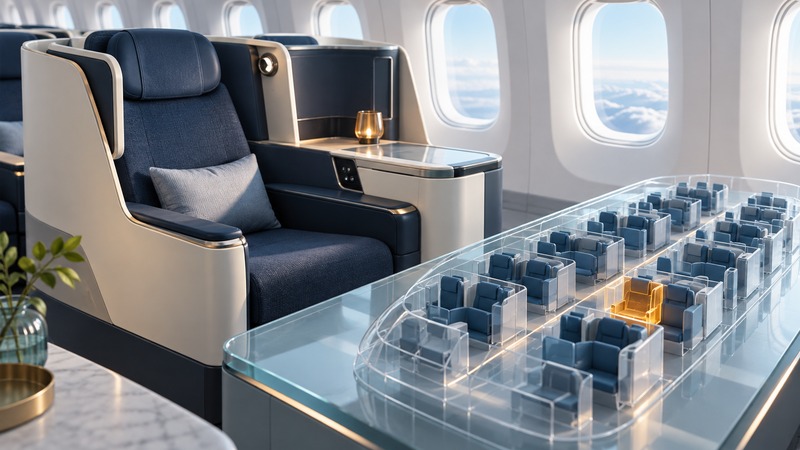
Choose Qantas international business class by looking at the exact flight and cabin. Start with the operating airline, then the aircraft, the seating diagram and the services included in your ticket. That sequence helps you judge the features you value—sleep, aisle access, privacy or traveling together—before paying for the trip.
On a narrow screen, scroll tables sideways. Keyboard users can focus a table and use the arrow keys.
Identify what will operate each sector
Read the “operated by” information on every flight. A Qantas flight number can appear on a partner-operated service, whose seat and onboard experience need their own check. For Qantas-operated flights, open the aircraft details in the booking and compare them with the official fleet and seat-map pages.
Qantas' business-class guide describes fully flat Business Suites on its A380, A330 and 787 aircraft. Its smaller aircraft have other business seating. International describes the journey; it does not by itself identify a bed, a suite or a cabin layout.
Record the flight date, aircraft type, map configuration and your chosen seat. Aircraft assignments and seating can change, so repeat the check after a schedule change and again when check-in opens.
Read the seat map in two passes
| First check | Then compare | Why it matters |
|---|---|---|
| Aircraft and configuration | Cabin sizes and the matching map in your booking | A generic fleet page may list more than one arrangement. |
| Aisles and access | Whether reaching the aisle crosses another seat | This affects movement during a long overnight flight. |
| Seat position within the row | Window proximity, console position and nearby passenger | Seats that share a row label may offer different privacy. |
| Service areas | Galleys, toilets, bassinets and cabin entrances | These locations help you judge likely activity, without guaranteeing noise levels. |
| Traveling companion | Centre seats, dividers and ease of conversation | Adjacent letters alone may not mean seats feel close together. |
The Qantas 787-9 seat map marks cabin boundaries and facilities. Qantas' 787 fleet page lists a 236-seat arrangement with 42 Business, 28 Premium Economy and 166 Economy seats. Match the configuration to your flight rather than treating that number as a universal 787 specification.
The A380 map uses separate decks and a different cabin arrangement. A preferred row number on one aircraft cannot simply be carried over to another.
Turn preferences into a short list
For sleep
Prioritize a fully flat seat, convenient aisle access and a position whose nearby facilities suit you. Consider departure time and time available after meal service. Seat width, bed width and footwell space describe different parts of the experience; look for the feature that matters to your sleeping position.
For a solo trip
Compare window-side positions and the way each seat's console separates you from the aisle. Use current cabin photographs alongside the map to understand privacy. A map shows relationships well but may simplify the shell and footwell.
For two people
Compare centre pairs, divider arrangements and how easily you can talk. If you prefer separate window seats, confirm whether you are comfortable being across an aisle or in different rows.
For accessibility or a child
Discuss boarding, transfers, seat suitability and any restraint or assistance requirements with Qantas before purchase. The seat maps direct accessibility questions to the airline; choose through the supported process rather than inferring suitability from an empty seat on the diagram.
Compare two acceptable flights
If an aircraft change removes an important feature, inspect the new map and contact the booking provider about the options under the ticket terms. Reconfirm the seat assignment and associated assistance requests.
Check lounge, baggage and connectivity separately
Qantas' business guide describes priority services and access to applicable Business or partner lounges. Confirm the particular airport, terminal, opening hours and guest conditions for your itinerary. A long connection is easier to assess when you know where the eligible lounge is and whether reaching it fits the transfer.
Read the baggage entitlement on the ticket, including any partner sectors. For internet access, verify the aircraft and route using Qantas' current service information; a premium cabin alone does not establish Wi-Fi availability. The Wi-Fi preparation guide explains the checks.
Keep a small decision record: operating carrier, aircraft/map, bed and aisle access, preferred seat, lounge and connection requirements. That record gives you a useful set of items to recheck whenever the booking changes.