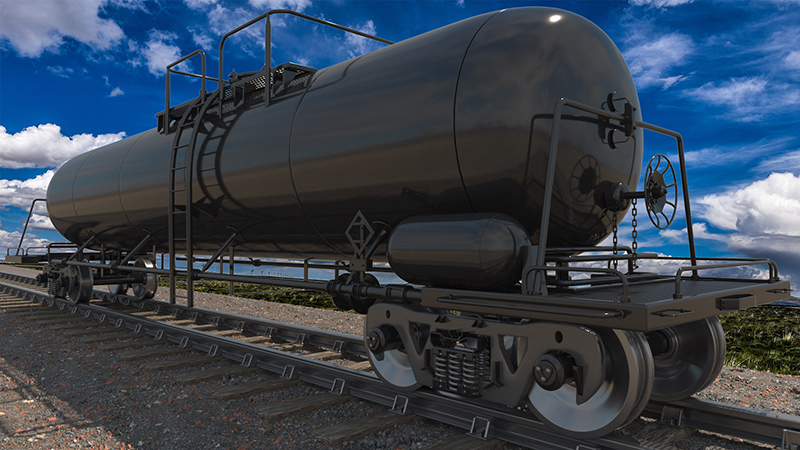
The tank car shown here has a dark exterior finish covering its cylindrical body, fittings, ladder, platform, frame, and running gear. These surfaces do not all experience the same exposure or movement, so a real coating specification may divide the car into several zones rather than treat it as one uniformly painted object.
Protective railcar coatings are engineered layers that separate steel, aluminum, and other substrates from water, oxygen, salts, sunlight, chemicals, and mechanical damage. They also provide color, markings, cleanability, and a consistent fleet appearance. On a cargo tank or hopper, an internal coating or lining can perform a different and more safety-critical job: preventing the commodity from attacking the container, preventing contamination of the load, or both.
The right system is therefore not simply the “toughest paint.” It is the combination of substrate preparation, primer, intermediate coat, finish coat or lining, application conditions, inspection, and maintenance that fits a defined railcar, cargo, environment, and service life.
Why rail equipment is difficult to protect
Railcars may remain in service for decades while moving among coastal air, industrial pollution, rain, snow, ultraviolet radiation, road salt carried across grade crossings, desert heat, freeze-thaw cycles, and long periods of condensation. Cars flex, vibrate, couple, brake, and receive impacts during loading and unloading. Ballast, coal, ore, grain, fertilizers, cleaning solutions, and transported chemicals add abrasion or chemical exposure.
Corrosion begins when a metal, an electrolyte such as water, oxygen, and an electrical path form an electrochemical cell. A coating interrupts that cell by acting as a barrier, by inhibiting corrosion at the surface, or—in the case of a properly formulated zinc-rich primer—by providing sacrificial protection to steel. Damage that exposes bare metal can restart corrosion, and water can then travel beneath a poorly adhered film.
Different railcar zones need different answers
| Area | Principal exposures | Common priorities |
|---|---|---|
| Exterior body or tank jacket | Weather, ultraviolet light, condensation, salts, impact, cleaning | Corrosion resistance, color and gloss retention, repairability |
| Underframe, ends, trucks, and equipment supports | Ballast impact, grime, water traps, oils, vibration, difficult access | Edge coverage, abrasion resistance, flexibility, inspectability |
| Tank interior | Specific liquid or gas cargo, cleaning chemicals, temperature and pressure cycles | Chemical compatibility, continuity, adhesion, traceable inspection |
| Hopper, gondola, or dump surfaces | Sliding bulk cargo, impact, erosion, retained product and moisture | Abrasion resistance, product release, contamination control |
| Passenger and locomotive exterior | Weather, high-speed debris, washing, graffiti, frequent public view | Appearance, cleanability, color stability, fast repair |
| Hidden seams and insulated spaces | Trapped moisture, crevices, limited inspection access | Complete coverage, compatibility with insulation, long-term barrier protection |
Areas that must remain uncoated—such as certain bearing, braking, electrical contact, gasket, data-plate, or mating surfaces—must be identified and masked. Paint on the wrong component can be as problematic as missing paint on steel.
How a multilayer exterior system works
A conventional heavy-duty system divides the work among layers:
- Surface preparation removes oil, salts, rust, mill scale, failed paint, and other contaminants while creating a profile the new coating can grip.
- Primer bonds to the prepared substrate and supplies corrosion protection. Depending on the specification, it may be zinc-rich, inhibitive, epoxy, or another technology.
- Intermediate or build coat adds barrier thickness, fills the profile, and helps keep water and ions away from the metal. High-build epoxy is common in severe service.
- Finish coat provides weathering, ultraviolet resistance, color, gloss, cleanability, and an additional barrier. Polyurethane, acrylic polyurethane, polysiloxane, and acrylic finishes are among the options.
- Stripe coats and detail work add material at welds, edges, bolts, cutouts, and other places where sprayed film tends to pull thin.
Some products combine functions as direct-to-metal or primer-finish coatings. They can reduce labor and turnaround time, but fewer coats do not automatically mean equal performance. The system still has to meet the required surface preparation, film thickness, exposure, application window, and repair plan.
Common coating chemistries
| Coating family | Where it helps | Important limitations |
|---|---|---|
| Zinc-rich primer | Sacrificial corrosion protection for properly prepared carbon steel | Requires correct surface preparation, application, and overcoating; not suitable for every cargo or exposure |
| Epoxy | Strong adhesion, chemical resistance, and high-build barrier protection | Usually chalks and loses appearance in sunlight unless protected by a UV-resistant finish |
| Epoxy phenolic or novolac epoxy | Tank and vessel linings requiring greater chemical or temperature resistance | Cargo-specific compatibility and cure are critical; films can be less forgiving of flexing or application defects |
| Polyurethane | Durable exterior color and gloss with resistance to weather and abrasion | Two-component spray systems may contain isocyanates and require stringent exposure controls |
| Polysiloxane | Weathering and color retention with a durable protective film | Application, recoat, and repair compatibility must follow the product system |
| Waterborne acrylic | Lower solvent emissions, rapid drying, and useful direct-to-metal or finish applications | Early water resistance, temperature, humidity, flash rust, and surface cleanliness can constrain application |
| Alkyd | Economical, easy-to-use maintenance coating for moderate exposures | Generally lower chemical and immersion resistance and slower cure than many two-component systems |
| Vinyl ester, rubber, polyurethane, or polyurea lining | Specialized chemical, abrasion, impact, or flexible lining service | Selection depends on exact cargo, temperature, cleaning, movement, and application conditions |
“Epoxy” or “polyurethane” identifies a broad chemistry, not a complete specification. Resin design, pigments, curing agent, solids content, film thickness, substrate, and application quality can produce very different results within the same family.
Interior tank coatings and linings are a separate discipline
An exterior coating protects a car from the environment. An internal tank lining may be part of the containment strategy for a corrosive or reactive hazardous material. The lining must be compatible with the exact commodity, concentration, impurities, loading temperature, pressure, cleaning process, and expected dwell time. Compatibility data for one chemical or temperature should not be extrapolated casually to another.
For U.S. specification tank cars, 49 CFR 180.509(i) requires owners of protective internal coatings or linings used with materials corrosive or reactive to the tank to establish inspection methods, acceptance criteria, and records for the coating-or-lining and commodity combination. The rule generally limits the inspection interval to eight years unless documented service history or scientific analysis supports a longer interval. Facilities must follow the owner's written procedure, while qualification also incorporates applicable federal and Association of American Railroads requirements.
Inspection can include visual examination, thickness checks, adhesion testing where specified, and low- or high-voltage holiday detection to locate discontinuities. The correct holiday-test voltage and method depend on the lining type and thickness. Excess voltage can damage a sound film; insufficient voltage can miss defects.
Specifying a coating system
A useful specification starts with service rather than a brand name. It should define:
- substrate, car type, zone, and whether the work is new construction, full renewal, overcoating, or spot repair;
- atmospheric environment, temperature range, condensation, ultraviolet exposure, salts, chemicals, abrasion, and cleaning;
- cargo identity and concentration for every cargo-contact surface;
- required design life and the planned inspection and maintenance interval;
- surface-cleanliness and surface-profile requirements;
- coating products as an approved system, including stripe coats, nominal dry-film thickness, colors, and recoat windows;
- application limits for steel temperature, air temperature, relative humidity, dew point, ventilation, and cure;
- inspection hold points, test methods, sampling frequency, acceptance criteria, repair procedures, and records;
- worker-safety, environmental, waste, overspray, and containment requirements.
ISO 12944-5:2019 provides current guidance on protective paint systems for steel structures across different environments and preparation grades. It is a useful framework, but a moving railcar has service details beyond a stationary steel structure, so owner, manufacturer, regulatory, and cargo-specific requirements still govern.
Surface preparation determines whether the system can work
Many premature coating failures begin at the substrate. Painting over oil, soluble salts, tightly packed corrosion product, moisture, or an incompatible aged film can leave a visually attractive surface with a short service life.
A typical full-renewal sequence includes condition assessment; removal of grease and other visible contamination; control of soluble salts; abrasive blasting or another specified cleaning method; dust removal; measurement of the surface profile; and prompt priming before flash rust or contamination returns. Existing lead-, chromium-, or other hazardous-metal-containing coatings require characterization, containment, worker protection, and waste handling appropriate to the jurisdiction and facility.
AMPP maintains recognized steel-preparation standards including SSPC-SP 1 solvent cleaning, SSPC-SP 6/NACE No. 3 commercial blast cleaning, and SSPC-SP 10/NACE No. 2 near-white metal blast cleaning. The specification must name the required standard rather than merely say “blast clean.” AMPP's surface-preparation committee lists the principal methods and standards.
The abrasive also creates an anchor profile. Too little profile can reduce adhesion; too much can leave peaks insufficiently covered by the primer. ASTM D4417 provides field methods for measuring the profile of blast-cleaned steel.
Application control
Correctly prepared steel can still fail if coating materials are mixed, thinned, sprayed, or cured outside their limits. Quality control should confirm product identity and shelf life, batch numbers, component ratio, induction time where required, pot life, thinning, spray equipment, wet-film thickness, and cure between coats.
Condensation is a particular risk on large metal cars. Many product data sheets require the substrate to remain at least 3°C (5°F) above the dew point, but the coating manufacturer's stated limits control. Inspectors record air temperature, steel temperature, relative humidity, dew point, and weather throughout the work—not just at the beginning of a shift.
Edges, welds, pits, crevices, stiffeners, ladders, and complex fittings deserve special attention. Spray patterns tend to bridge recesses and leave sharp edges thin, which is why stripe coating and visual access matter. Ventilation and lighting are especially important inside tanks and covered cars, where confined-space controls may also apply.
Inspection and performance testing
Inspection should verify the work against the written specification at defined hold points. Common checks include:
- pre-work condition, contamination, and compatibility of retained coating;
- surface cleanliness, soluble salts where relevant, dust, and anchor profile;
- environmental conditions during preparation, application, and cure;
- wet-film and dry-film thickness, including detailed areas and repair zones;
- appearance, runs, sags, pinholes, overspray, dry spray, misses, and edge coverage;
- adhesion when required and appropriate to the coating and substrate;
- holiday or porosity testing for specified linings;
- cure verification before handling, assembly, loading, cleaning, or service.
ASTM D7091 describes nondestructive dry-film-thickness measurement, while ASTM D4541 covers pull-off strength using portable adhesion testers. Results depend on the instrument, substrate, method, and failure plane, so a test number is meaningful only with a defined procedure and acceptance criterion.
Laboratory exposures help compare candidate systems. Cyclic tests that combine salt, wet-dry cycling, ultraviolet radiation, and condensation can represent more mechanisms than continuous salt fog alone. Even so, laboratory hours should not be converted directly into years of rail service. ASTM D5894 expressly treats its cyclic corrosion/UV procedure as a comparative test and warns against assuming a universal acceleration factor.
Recognizing coating failure
- Rusting and undercutting: corrosion appears at holidays, damage, edges, or beneath a poorly bonded film.
- Blistering: liquid, vapor, ions, or osmotic pressure lift the coating from the substrate or another coat.
- Delamination: layers separate because of contamination, weak surface preparation, excessive recoat time, incompatible materials, or inadequate cure.
- Cracking and checking: a film becomes too brittle, too thick, poorly cured, or unable to follow thermal and mechanical movement.
- Chalking, fading, and gloss loss: ultraviolet exposure degrades the surface binder or pigments; epoxies are especially prone to cosmetic chalking outdoors.
- Erosion and abrasion: cargo, ballast, washing, or repeated contact wears away the coating.
- Pinholes and holidays: small discontinuities expose the substrate and can be critical in immersion or cargo-contact service.
- Softening, swelling, or discoloration: the coating is chemically attacked or insufficiently cured.
Failure analysis should identify where separation occurred and why before specifying a repair. Applying more coating over active corrosion, soluble salts, trapped cargo, or a weak underlying layer merely conceals the cause.
Maintenance and lifecycle planning
A fleet program benefits from consistent condition ratings, photographs, defect maps, coating history, cargo history, and repair records. Inspect high-risk areas such as lower sidewalls, ends, welds, roof attachments, water traps, jacket seams, hatches, outlets, and loading zones. Schedule washing or decontamination where deposits hold moisture or interfere with inspection.
Spot repair is appropriate when damage is local and the surrounding coating remains sound and compatible. Overcoating can extend service life when the existing film is well adhered, cleanable, and compatible with the new material. Broad underfilm corrosion, embrittlement, contamination, or multiple unknown layers may justify full removal. A small compatibility patch can reveal lifting, wrinkling, bleeding, or poor adhesion before an entire car is coated.
For U.S. tank cars, qualification and maintenance are regulated under 49 CFR Part 180, Subpart F. The rules require written programs, acceptance criteria, inspection records, and reporting. They also require protective coating after certain jacket-removal repairs unless effective protection already remains. Regulatory inspection is a minimum safety framework, not a substitute for more frequent condition-based maintenance.
Worker safety and environmental performance
A lower-VOC label is only one part of environmental performance. High-solids and waterborne coatings can reduce solvent emissions; plural-component equipment can improve mixing and build; efficient spray methods can reduce overspray; and reclaimed abrasive can reduce waste. Longer coating life may avoid repeated blasting, painting, downtime, and material use. Product choice should still consider cure energy, hazardous ingredients, cleaning, repairability, and end-of-life waste.
Facilities may be subject to federal, state, and local air rules. In the United States, major sources coating miscellaneous metal parts and products may fall under 40 CFR Part 63, Subpart MMMM, which limits hazardous air pollutants from applicable surface-coating operations. Site-specific permits and local VOC limits can add or change requirements.
Worker protection must address abrasive-blast dust, noise, confined spaces, flammable vapors, solvents, pigments, and reactive components. Two-component polyurethane coatings may contain isocyanates that can irritate and sensitize the respiratory system and skin. NIOSH emphasizes substitution where feasible, enclosure and ventilation, worker isolation, training, and correctly selected protective equipment. NIOSH summarizes isocyanate hazards and controls.
From a 2017 product launch to a system-level view
This article began with Axalta's October 2017 introduction of Tufcote protective railcar coatings, described at the time as high-build products for railcars, storage tanks, and heavy equipment. That announcement captured enduring requirements—corrosion resistance, chemical protection, weathering, chip resistance, application efficiency, and appearance—but a current rail coating decision cannot be reduced to a product family.
The durable result comes from matching a complete, documented system to the asset and its service: correct preparation, compatible layers, controlled application, independent inspection, cargo-specific lining management where applicable, and repairs made before small defects become structural corrosion.
Standards and technical references
- AMPP surface-preparation standards for blast cleaning, power-tool cleaning, waterjetting, abrasives, soluble salts, and profile.
- ASTM paint and protective-coating standards for inspection and comparative testing.
- ISO 12944-1 for the framework and terminology of corrosion protection by paint systems.
- 49 CFR 180.509 for U.S. specification tank-car inspection and internal coating or lining requirements.
- American Coatings Association overview of rail rolling-stock coatings for the major car categories and performance demands.