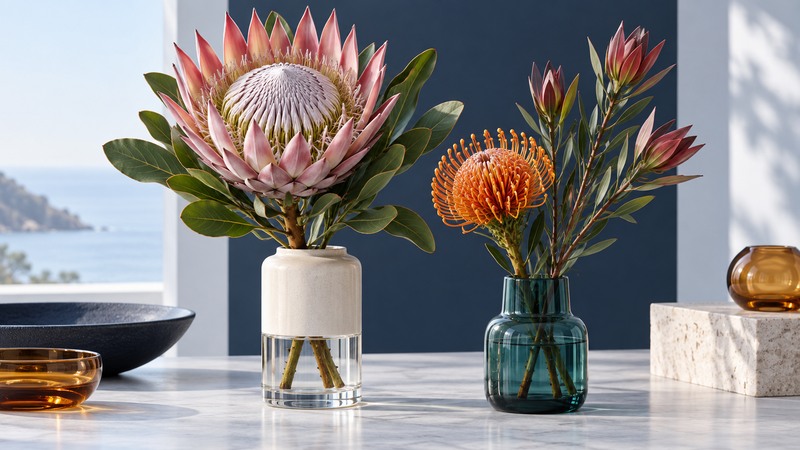
Proteas make striking cut flowers, but choosing an arrangement and growing a living shrub are different projects. Start with the botanical name. It tells you which plant you have and helps you find care that fits its climate, roots and growth habit.
What florists mean by protea
The word can refer narrowly to the genus Protea or more loosely to several members of the family Proteaceae used in arrangements. Recognizing the difference helps when ordering stems or reading a plant label.
| Name you may encounter | Typical visual character | Useful distinction |
|---|---|---|
| Protea, including king protea | A substantial flower head framed by conspicuous bracts | The head contains many small flowers |
| Leucospermum, or pincushion | Rounded heads with projecting styles that resemble pins | A related genus with its own species and growing requirements |
| Leucadendron, or conebush | Often valued for colored bracts, foliage and cone-like structures | Frequently provides contrast and structure in bouquets |
| Banksia | Often a dense spike or head of many flowers | A separate related genus; identify the species before choosing care |
The University of Hawai‘i's Proteaceae overview explains the family's floral structures and cultivated groups. Its horticultural discussion is useful background, while individual cultivar advice should come from current grower information.
SANBI's king protea profile describes Protea cynaroides as a South African shrub. The pink or cream outer structures are bracts surrounding the many small flowers. Cultivation in Australia, New Zealand, Hawaii and other regions is distinct from the species' native distribution.
Choose cut stems for the intended arrangement
Ask the florist for the type, stem length and expected appearance as it ages. Check that the head is sound, the supporting stem is firm and the foliage is in good condition. Large heads need a vase with a stable base and enough weight to support the arrangement.
Decide whether one large flower is the focus or whether several smaller forms will share the vase. A single king protea can occupy substantial space. Measure the display location and allow clearance for people moving past it. Check stems in person when shape and size matter for a specific event.
Care for the flowers when they arrive
- Unpack promptly and inspect the stems.
- Use a clean vase and clean cutting tool. Recut the stem ends and remove leaves that would sit below the waterline.
- Add clean water and use a commercial cut-flower preservative according to its directions when recommended for the stems supplied.
- Keep the vase in a cool display location away from direct heat and strong sun.
- Check water frequently, refresh it regularly and remove deteriorating plant material.
Resendiz Brothers' protea care guidance emphasizes recutting, removing submerged leaves, preservative use and frequent water checks. Its cut-flower instructions concern harvested stems; they are separate from fertilizer advice for a living plant.
The RHS guide to conditioning cut flowers explains why clean containers, refreshed water and a cooler position support vase life. Follow any specific instructions from your supplier, especially for a mixed bouquet with different needs.
When leaves darken or the water clouds
Cloudy water is a reason to clean the vase, refresh the water and remove submerged or decaying leaves. Darkened protea foliage can have several causes, including postharvest carbohydrate depletion discussed in the Hawai‘i overview. Adding water may support hydration but cannot reverse already damaged leaves. Contact the supplier when fresh stems arrive in poor condition.
For a dried display, start with sound material. Resendiz Brothers notes that proteas can be hung upside down in a dark location to dry. Expect color and texture to change. Keep the finished arrangement dry and handle brittle stems gently.
Decide whether a living protea fits your site
Growing a plant requires the exact name and a suitable environment. For king protea, the RHS plant profile recommends full light under glass or a sheltered, frost-free outdoor position with well-drained, relatively poor neutral-to-acid soil. That profile is a starting point for this species, not a prescription for every Proteaceae plant.
Before buying, answer five questions:
- What species or cultivar is offered, and how large will it become?
- Can it survive the site's winter conditions, or is suitable protected growing space available?
- Does the root zone drain effectively through the wettest season?
- Is the proposed medium and feeding program appropriate for that plant?
- Can the seller provide regional growing advice and explain establishment care?
Many cultivated Proteaceae are sensitive to excessive phosphorus. The Hawai‘i overview discusses this sensitivity; avoid automatically applying a general high-phosphorus “bloom booster.” Ask for a suitable feeding program for the exact plant and medium. Poor growth has several possible causes, so investigate drainage and root conditions before increasing fertilizer.
A practical decision example
Use garden design to evaluate a permanent planting location. For another group whose care depends strongly on identity, explore the orchid picture guide.