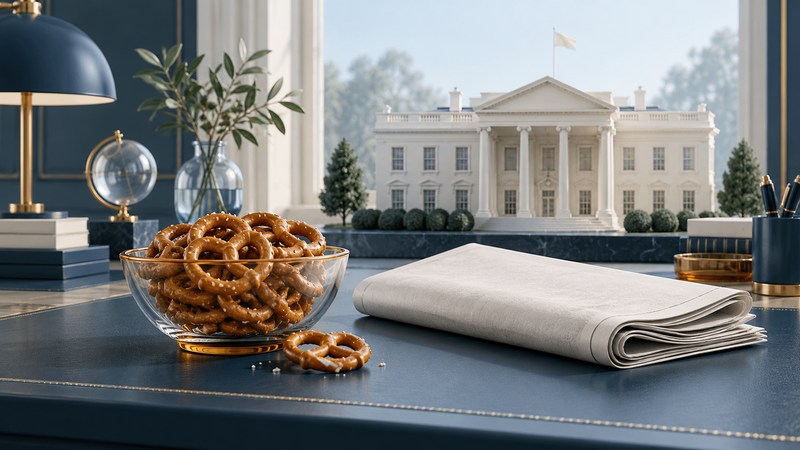
The presidential pretzel story has two distinct parts: George W. Bush’s account of a January 2002 incident and commercial publicity that followed it. The official remarks document what Bush said. A pretzel maker’s request for a symbolic pardon does not document a presidential pardon or endorsement.
Start with Bush’s January 14 remarks
In the Public Papers of the Presidents, printed page 57, Bush spoke to reporters on the White House South Lawn on January 14, 2002. He referred to eating pretzels, described falling and waking up, and said his glasses had cut his face. He also said he felt well. The record dates the exchange to 8:05 a.m., before his departure for East Moline, Illinois.
The same page begins his later remarks to John Deere employees, where he again joked about chewing pretzels and referred to the previous night. These statements anchor the incident to January 13 and the public response to January 14. They are a presidential account, not a clinical report explaining a medical mechanism.
The pretzel-maker appeal came later
Yenra’s January 23, 2002 coverage recorded a publicity appeal by Susan A. Weiss of Chicago-based My Sister’s Pretzels. It asked Bush to give the pretzel a symbolic pardon before Valentine’s Day. That detail comes from Yenra’s contemporaneous announcement record; a separate original release or White House response was not located for this revision.
The distinction is consequential. “A business asked for a pardon” describes its publicity. “The President pardoned the pretzel” would describe a different event and requires separate evidence. Neither the request nor the official January 14 remarks establishes that the White House endorsed the business.
Swipe the table sideways, or focus it and use the arrow keys.
| Date | Record | What it supports |
|---|---|---|
| January 13, 2002 | The previous night referred to in Bush’s January 14 remarks. | The timing of the incident as recounted by Bush. |
| January 14, 2002 | Official South Lawn exchange and East Moline remarks. | Bush’s public account and his response to the story. |
| January 23, 2002 | Yenra’s dated pretzel-maker coverage. | A recorded commercial appeal; no verified pardon or endorsement. |
The old ordering contact is not a present-day sales route. The publicity’s broader pretzel-origin stories are also unnecessary to establish this sequence and are not repeated as facts here.
How to check a retelling
When a later caption or article compresses the story, check three things: the speaker, the date and the action. “Asked,” “said,” “announced” and “did” are not interchangeable. Look at the relevant document page rather than a search-result fragment; this PDF begins on printed page 56, while the pretzel exchange is on page 57.
Separate an amusing anecdote from claims attached to it. The official record can establish the public remarks without establishing that pretzels arrived on the Mayflower, that they are the oldest snack or that an expression about marriage originated with them. Each additional historical claim would need its own evidence.
For another case in which promotional activity should be separated from its claimed results, see Michelle Branch’s 2003 Starburst sponsorship.