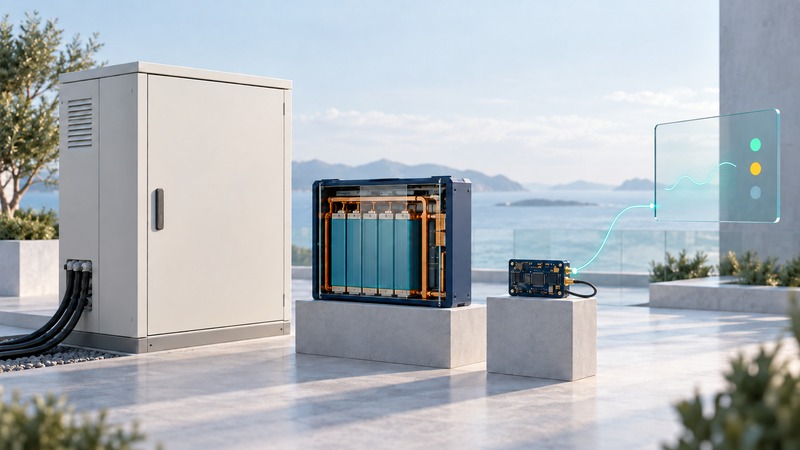
A cable power-supply transponder carries measurements and alarms from a field power system to a management system. The useful question is whether the information is timely, correctly interpreted and connected to a response. A healthy-looking dashboard needs both a working power system and a working telemetry path.
Follow the measurement to the operator
In a hybrid fiber-coaxial cable network, field power supplies support equipment along the distribution plant. A monitored supply can report utility, output and battery conditions through a status-monitoring interface. A DOCSIS-based transponder uses the cable data network to carry that information upstream.
The EnerSys Alpha XM3.1-HP technical manual documents status monitoring, battery information, alarms and transponder functions for that product family. Its interface and configuration details apply to the specified hardware and software. For another supply, obtain the matching manual and management definitions before comparing capabilities.
Sketch four links in your review record: the measured condition, the supply controller, the transponder and communications path, and the monitoring application. Add the response owner at the end. This simple sketch makes it easier to locate a missing dependency when a report stops arriving.
Give each signal a precise meaning
On a narrow screen, scroll the table horizontally. Keyboard users can focus the table and use the arrow keys.
| Reported item | Meaning to establish | Follow-up evidence |
|---|---|---|
| Utility condition | Which input condition or threshold triggered it? | Timestamp, current supply mode and recovery event |
| Battery measurement | Individual battery, string or calculated value? | Units, sensor location, age and test conditions |
| Output alarm | Which output and load are affected? | Corresponding service or downstream measurement |
| Missing status | How old is the last valid sample? | Power, RF path and management-system checks |
| Alarm cleared | Did the condition recover or was the record acknowledged? | Clear event, fresh measurements and remaining actions |
Treat a measured battery voltage, an estimated remaining capacity and a demonstrated runtime as separate entries. Document the source and assumptions of any estimate. An authorized capacity test or operating record provides a different kind of evidence from an instantaneous dashboard value.
Read the timeline before deciding what happened
Fictional polling example: a management system receives a normal reading at 10:00. Its 10:05 poll gets no reply. The observation establishes a missed report five minutes after the last confirmed normal sample. It leaves the onset and cause unresolved.
A later device event log could narrow the timing. A customer-service alarm could establish a separate service impact. Keep those observations together while preserving what each actually measures.
Check whether timestamps represent measurement, device event creation or server receipt, and whether clocks agree. Distinguish a pushed event from a periodic poll. During a communications outage, the time when a stored event finally arrives may differ from the time the condition occurred.
Review monitoring as an end-to-end service
Ask the network owner for an acceptance record showing the expected condition, received report, displayed severity and response assignment. Include recovery and stale-data handling. Testing should follow the operator's approved maintenance process with the actual monitoring platform; this guide supplies review questions rather than network commands or equipment procedures.
Before accepting a dashboard, resolve three practical questions: who receives an actionable alert, how they distinguish an old sample from a current one, and how restoration is verified. For the wider power, fuel, access and network dependencies behind backup claims, continue with communications power continuity.
Power telemetry review record
Download the power telemetry review record (plain text). Save a copy and fill it in with your own evidence. Instructions, units, assumptions and the fictional example are included.