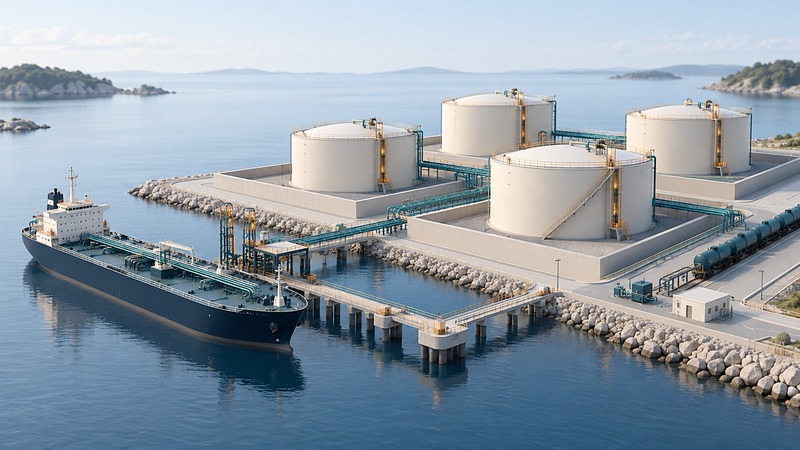
A fuel storage terminal receives, holds and dispatches petroleum products or other specified liquids. To understand its role, distinguish how much its tanks can hold from how much product is present, available to a particular customer or moving through the facility over time.
Begin with the terminal's product list, tank-capacity definition, transport connections and dated operating information. Crude oil, gasoline components, jet fuel and other products require compatible services; a site's total storage figure does not establish capacity for every product.
Keep volume and flow separate
On a narrow screen, scroll the table horizontally. Keyboard users can focus the table and use the arrow keys.
| Quantity | Meaning | Question to resolve |
|---|---|---|
| Tank capacity | A stated storage-volume limit | Is it geometric shell capacity, rated capacity or usable working capacity? |
| Inventory | Product physically present at a specified time | Which products, tanks and measurement basis are included? |
| Available space | Space that can accept a specified incoming product | What is unavailable through commitments, segregation or maintenance? |
| Throughput | Volume moved over a stated period | Are receipts, deliveries or both being counted? |
Write the units beside every number: cubic metres or barrels for storage, and volume per hour, day or year for flow. If a report gives tonnes, a conversion to volume requires the relevant density and conditions. Avoid converting a mixed-product total with one unexplained density.
Trace a shipment through the terminal
Follow the chain from incoming transport to reception, allocated tank space, any documented blending or treatment service, and dispatch. Check the product specification at both ends. An available berth helps only when the vessel, transfer equipment, tank allocation and onward connection are all suitable.
Milford Haven provides a concrete example of the distinction between storage and access. Impala's 2024 sustainability report describes a liquid-bulk terminal and three marine jetties there. Its global network listing, checked in September 2026, lists 1.4 million cubic metres for Milford Haven. These operator descriptions establish the listed facility and scale; they do not disclose current inventory, customer space or shipment schedules.
For any terminal, request a dated specification rather than assuming all transport modes exist. Confirm berth and vessel limits, supported pipelines, rail or road loading arrangements, and operating windows as applicable. A terminal can have ample storage while a particular dispatch route remains constrained.
Use a simple inventory balance
Fictional five-day plan
A product starts with 60,000 cubic metres in a hypothetical terminal. Planned receipts total 30,000 cubic metres and deliveries total 40,000 cubic metres. Ignoring measurement adjustments and other losses for this exercise, closing inventory is 60,000 + 30,000 − 40,000 = 50,000 cubic metres.
Average deliveries are 40,000 ÷ 5 = 8,000 cubic metres per day. Dividing the closing stock by that rate gives 6.25 days. That is a simplified stock-to-delivery ratio under the stated assumptions; actual coverage also depends on usable stock, product mix, future receipts and changing demand.
Check the sequence as well as the totals. If all receipts arrive before deliveries, peak inventory can exceed the closing balance. Rework the schedule by day or shipment when evaluating tank space. Confirm working capacity and committed space before treating the resulting headroom as available.
Read expansion and resilience claims carefully
For an expansion, identify whether the announced number concerns added tanks, loading rate, berth access or a new product service. Record whether the work is proposed, permitted, under construction or operating. Compare the promised improvement with the actual bottleneck and with supporting transport availability.
Ask the operator for the relevant inspection, environmental and emergency-planning information. A public explanation can identify these responsibilities without supplying operating instructions for hazardous-liquid equipment. Reliability also depends on power, maintenance and access during disruption.
Finish a terminal brief with the product, volume basis, inventory date, counting convention for throughput and transport route. The offshore-pipeline guide explains another part of the supply chain; the Strategic Petroleum Reserve guide applies similar distinctions to public inventory and release data.
Terminal stock-balance worksheet
Download the terminal stock-balance worksheet (plain text). Save a copy and fill it in with your own evidence. Instructions, units, assumptions and the fictional example are included.