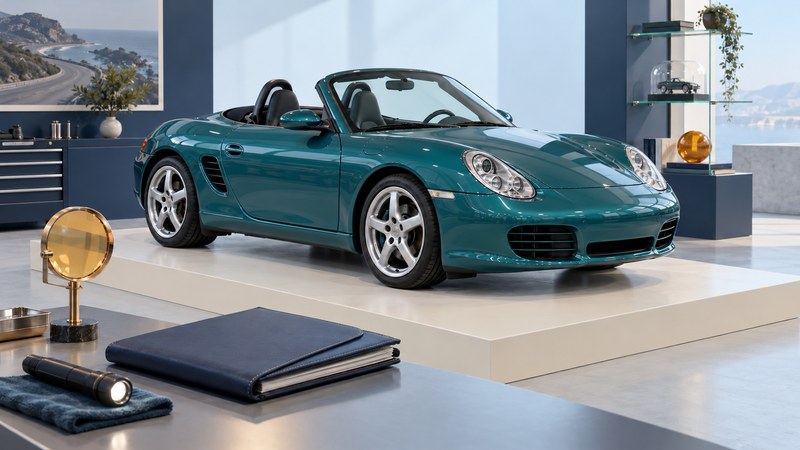
Identify the 2005 car before booking
A useful Boxster inspection starts with a specific car and a specific ownership plan. Tell the specialist whether you want occasional dry-weather trips, regular commuting or long touring journeys. That helps them connect condition, service needs, roof function and luggage compromises to your decision.
Porsche’s Classic overview of the type 987 dates the second generation’s introduction to November 2004. For the 2005 model year, establish whether the car is the 2.7-liter Boxster or the 3.2-liter Boxster S, and identify its actual transmission. Keep later engines and the PDK introduced for 2009 separate from this assessment.
Send the VIN, build and model-year information, odometer reading, engine/transmission documentation and advertised modifications before the appointment. Ask the specialist to resolve any mismatch between the advertisement, vehicle and records.
Make the service file readable
On a narrow screen, scroll the table sideways. Keyboard users can focus the table region and use the arrow keys.
| Claim or observation | Evidence to collect | Question for the specialist |
|---|---|---|
| Regularly serviced | Dated invoices with mileage and itemized work | Which requirements are documented, due or unsupported for this exact car? |
| Engine or bearing work completed | Invoice, workshop, component details, date and mileage | What was actually done, what applies to this engine, and what remains to assess? |
| Roof works | Parked demonstration and repair invoices | Does the complete cycle finish correctly, and what condition checks are included? |
| Recently fitted tires or suspension | Specifications, dates and installation records | Are fitment, condition and any modifications appropriate for this vehicle? |
Put invoices in date and mileage order. Flag long gaps and unexplained changes in recorded mileage. A service-book stamp is a useful pointer; the itemized invoice shows the work performed. Ask for the market-specific maintenance schedule and have the specialist mark the items supported by records.
Check the roof, cabin and touring fit
Arrange a parked roof demonstration following the matching owner manual, with adequate clearance and everyone away from moving parts. The archived Porsche 2005 owner manual (PDF), publication WKD 987 021 05, provides the roof precautions and operating conditions in its Mobile Roofs section. Record incomplete movement, warning messages or unusual sounds for the technician; leave adjustments and emergency operation to qualified help.
Look for visible staining, dampness, damaged fabric or seals and water marks in accessible cabin and luggage areas. Ask the specialist what they can inspect for water entry and what would need additional testing or access. A dry visit gives only a limited observation; keep any history of leaks in the brief.
Sit in both seats with the roof closed and try entry and exit in a realistic parking space. Bring the bags you intend to use and try the separate front and rear luggage compartments. Keep the trial within the manual’s loading instructions. Two seats and luggage that fits comfortably are a more useful touring test than adding advertised compartment volumes together.
Ask for findings with boundaries
Agree the inspection scope in writing: records review, road evaluation where appropriate, underside access, relevant diagnostic checks, roof and body observations, and photographs of important findings. Ask which areas will remain uninspected and whether further engine investigation would be justified by the evidence. The general inspection guide provides a framework for commissioning the work.
For an intermediate-shaft bearing or other engine claim, ask the specialist to establish applicability and interpret the actual documentation. Avoid treating a model-year label, an online failure percentage or a seller’s phrase such as “sorted” as proof of the installed component or future condition. Record precisely what can be established and the remaining uncertainty.
Separate diagnosis, work and ownership fit
Sort the report into immediate concerns, confirmed initial work, scheduled maintenance and unanswered questions. Get written estimates for the items that matter to the purchase, including parts availability and downtime. Check VIN campaigns with Porsche; for a US car, save the NHTSA recall result too. Its search has limits, including older and already-completed recalls, so resolve gaps with the manufacturer.
Save the working record
Download the worksheet (plain text). Record the evidence and unresolved questions, and keep it with the vehicle documents, manuals and inspection quotations.
Explore Autos: vehicle guides, technology and design · Cars: buying, maintenance and ownership