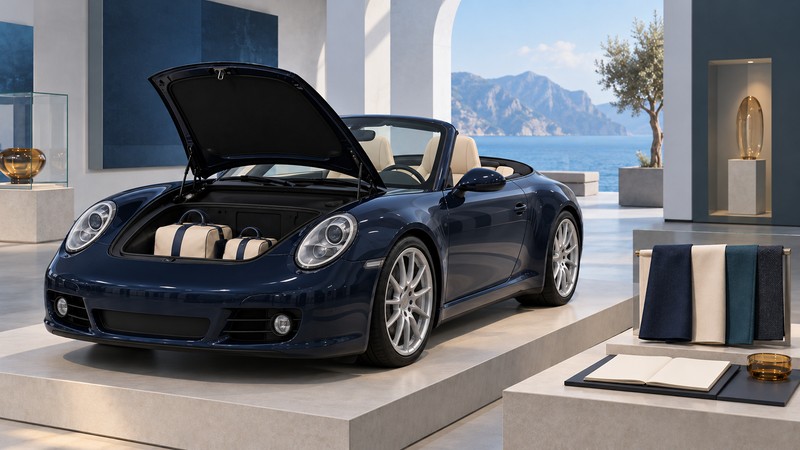
For an early 997 Carrera 4 or 4S Cabriolet, judge three things together: the exact car, the roof’s demonstrated condition and whether the seating-and-luggage arrangement works for your trips. The all-wheel-drive badge answers only part of that question.
This guide starts with the US 2006 models. Keep later 997 revisions, the Turbo and the sliding-roof Targa in their own specification records. The separate 911 Carrera guide provides related context.
Separate Carrera 4 from Carrera 4S
The November 2005 North American launch announcement preserved by Automotive Intelligence identifies a 3.6-liter flat-six rated at 325 hp SAE for Carrera 4 and a 3.8-liter engine rated at 355 hp SAE for Carrera 4S. Both were offered as Cabriolets. Record the model designation, market, transmission and original options from vehicle-specific documents before comparing advertisements.
Porsche’s June 2005 English-language Carrera brochure explains the Cabriolet and all-wheel-drive systems on printed pages 36–39 and 76–77. This is an international brochure, with a market-variation notice; use it for the mechanism and body-style explanation, then verify US equipment on the car’s original specification.
On a narrow screen, scroll the table sideways. Keyboard users can focus the table region and use the arrow keys.
| Area | What to record | What the result establishes |
|---|---|---|
| Vehicle identity | VIN, US model year, Carrera 4 or 4S, transmission and options. | Which specification and handbook apply. |
| Soft top | Fabric, window and seal observations; owner’s complete permitted demonstration. | Visible condition and operation at that viewing. |
| Wheels and tires | Each fitted size, make/model, date marking and professional condition assessment. | The actual combination to compare with Porsche requirements. |
| Everyday fit | Required occupants, seat settings, bags and roof configuration. | Whether your specific trip arrangement works. |
Watch a complete roof demonstration
Begin with the top closed. Observe the fabric, seams, rear window and visible sealing surfaces without pulling trim apart. Note stains, dampness or a musty smell as findings to investigate, including where and under what conditions you noticed them. A dry cabin on one day cannot establish performance in every weather condition.
Ask the owner to demonstrate opening and closing while parked, following the matching handbook and keeping the movement area clear. Watch the complete sequence, including the windows and final roof position. Record any interruption, unusual noise or warning in the owner’s words and your own observations. Do not force a mechanism or improvise an emergency-closing procedure.
If the demonstration cannot be completed, record the reason and arrange a specialist roof assessment before relying on the car for open-top use. Ask what was checked and what remains uncertain. A functioning switch, a moving roof and a correctly completed closure are different observations.
Treat all-wheel drive and tires as separate checks
The period Porsche brochure, printed pages 76–77, describes a viscous coupling that distributes drive between the axles. That explains the system’s role; it does not establish the condition of the fitted tires or their suitability for your intended conditions.
Have the inspecting professional compare the complete wheel-and-tire combination with the requirements for that car. Record front and rear sizes separately, the tire models, visible date codes, condition and any replacement history. Obtain the appropriate pressure and replacement guidance from the matching handbook and Porsche information, rather than copying figures from another 911 variant.
For a planned cold-weather or wet-weather trip, make tire suitability a specific question for the specialist. Keep the answer separate from the presence of all-wheel drive. The pre-purchase assessment should also cover the wider mechanical condition and documented service history.
Try the journey you actually plan
Set the driver’s seat first, then assess each passenger position you need. Bring your usual bags to a permitted viewing and try them in the front luggage area without pressing against the lid or interfering with closure. Record the arrangement with the roof up and down, and identify where any removable wind deflector will go.
Check access, visibility and comfort with the people who will use the car. Write down which configuration you demonstrated: two occupants for a weekend is a different requirement from carrying rear passengers. Follow the handbook’s loading and restraint requirements; a successful bag trial establishes fit, not a new load limit.
Save the roof and trip-fit record
Download the Carrera Cabriolet roof and trip-fit record. Keep each observation attached to the date, vehicle and configuration tested.
Explore Autos: vehicle guides, technology and design · Cars: buying, maintenance and ownership