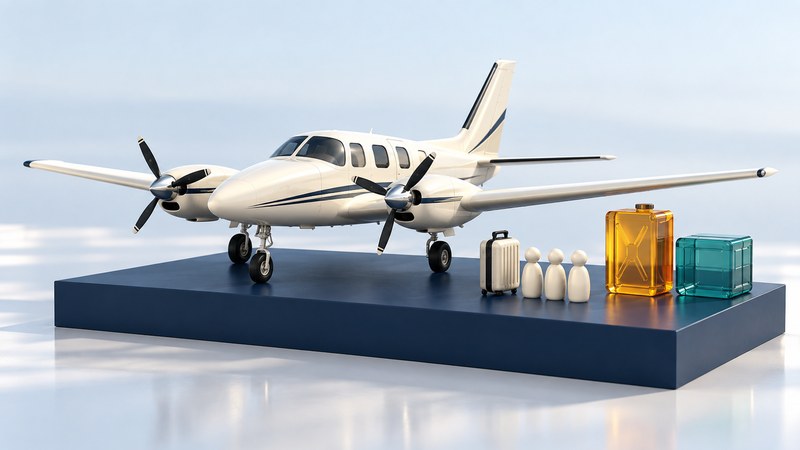
A piston twin uses two piston engines to drive propellers. To judge whether one suits a journey or ownership plan, start with the load and mission, then use the particular aircraft’s records and approved performance data. Seat count, fuel capacity and maximum range describe different constraints that have to work together.
Begin with the job the airplane must do
Write a representative mission: airports, passengers, baggage, required arrival time and acceptable stops. For an ownership inquiry, include how often that mission occurs and which alternatives remain workable when conditions prevent it. A brochure is more useful once you have questions to ask of it.
This page originally described the proposed RT-700 in 2005. The proposal’s amenities and projected performance are insufficient evidence for present availability or certified capability. Evaluate any aircraft offered today by its exact model, serial number, documents and current support arrangements.
Account for people, baggage and fuel together
Useful load generally represents the weight available above the aircraft’s empty weight for items such as occupants, baggage and usable fuel, using the definitions in its records. Full tanks consume some of that allowance. Seat availability and load availability therefore need separate checks.
The response is to have a qualified pilot assess a different load, aircraft or mission using approved data. Reducing fuel casually would leave the fuel requirement unresolved. An acceptable total weight also needs the required weight-and-balance assessment for where the load is placed.
Ask what the range calculation includes
Manufacturer pages illustrate why footnotes matter. The Diamond DA62 overview includes an interactive range calculation with an explicit note excluding additional fuel for taxi, takeoff, climb, descent and reserve. Read that note before comparing the display with a figure based on a complete mission.
On small screens, focus this table and use the arrow keys to scroll.
| Topic | Record | Follow-up |
|---|---|---|
| Load | Occupants, baggage and planned fuel, with units | Who verifies aircraft-specific weight and balance? |
| Range | Power, altitude, load and included reserves | Does the proposed trip fit with the required margins? |
| Runways | Airports and expected conditions | Which approved performance assessment applies? |
| Cabin | Seats, access, baggage space and installed equipment | Can the actual group and luggage be accommodated? |
| Support | Records, inspections, parts and training | Who will evaluate condition and continuing support? |
Use the mission questions worksheet to prepare an inquiry. It deliberately leaves performance decisions with the qualified people who have the aircraft’s data.
Understand what the second engine changes
The FAA’s multiengine transition chapter explains that an engine failure affects both performance and control, with training and proficiency central to safe operation. Losing one engine changes thrust balance and the power available to overcome drag; the resulting climb capability must come from the aircraft’s performance data.
Ask an instructor or operator how the aircraft’s documented one-engine-inoperative performance relates to the intended terrain, load and conditions. A general claim of “twin-engine safety” cannot answer that mission-specific question. Keep operating speeds and procedures tied to the exact aircraft and approved training.
Make the next step concrete
A serious shortlist should leave you with comparable mission assessments, cabin evidence and clearly identified questions about records and support. For charter, verify the operator and contract. For ownership, arrange an independent technical review and appropriate instruction before relying on the airplane for the intended work.