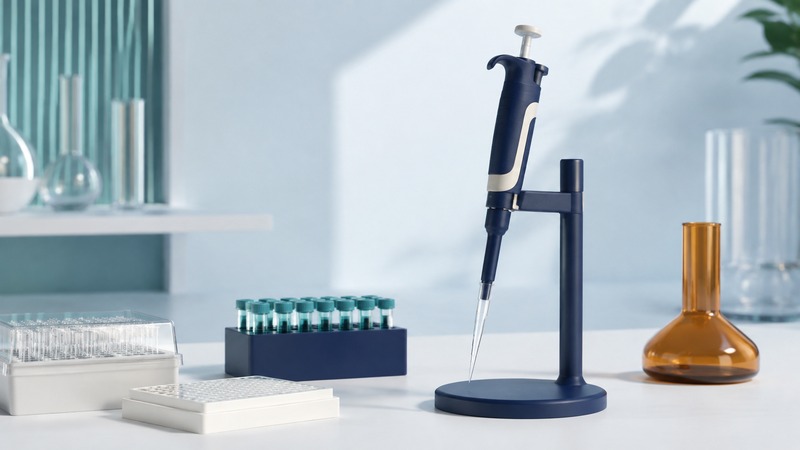
Reliable pipetting depends on the pipette, its tip, the liquid, the environment and the operator or automated method acting together. A precise-looking volume setting is not evidence that the same volume reached the destination. The useful goal is a transfer that is suitable for the assay and can be checked.
Start with the required volume and liquid properties, then examine the pattern of error. Consistently low transfers and highly variable transfers call for different investigations. This guide explains those distinctions without substituting a general web article for the instrument manual or your laboratory's validated procedure.
Choose the system for the transfer
Use a pipette whose specified operating range includes the intended volume, with compatible tips that fit and seal correctly. Compare the manufacturer's performance specifications at the volume of interest; a specification at maximum capacity is not automatically the performance at a much smaller setting. Never set a pipette outside its allowed range.
Air-displacement instruments use an air cushion between piston and liquid. Positive-displacement systems place a piston in the disposable liquid-handling component. Eppendorf's guide to application-specific consumables (PDF) explains these principles and the importance of matching the consumable to the task. Liquid viscosity, volatility and temperature can make a method that works with water unsuitable for another liquid.
For a multichannel transfer, check more than the total amount delivered across the plate. A single poorly seated tip or underperforming channel can produce a localized problem that disappears in an average. Define whether the assay depends on absolute volume, the ratio between additions, consistency across wells, or all three.
Control the transfer before changing the calibration
Follow the instrument's prescribed aspiration and dispensing technique. Keep immersion depth, angle, movement speed and waiting time consistent for the method. Rushing aspiration, trapping an air bubble or changing how the tip contacts the receiving vessel can change the delivered amount. Appropriate pre-wetting and temperature equilibration can also matter.
Eppendorf's comparison of pipetting techniques distinguishes forward and reverse pipetting and discusses challenging liquids. Reverse pipetting aspirates an excess and leaves some liquid behind after the intended dispense; it is not simply forward pipetting performed backward. Do not force the remaining excess into the destination when the method calls for it to remain in the tip.
Changing technique changes the procedure. Record the choice and verify it with the actual liquid or a justified representative system. A technique that improves one reagent may consume more sample or be inappropriate for a different instrument. Use the manufacturer's instructions for the exact button sequence, tip treatment and disposal.
Investigate the pattern rather than guessing
On a small screen, scroll the table sideways to read all columns.
| Observed pattern | Possible contributors | Check before accepting results |
|---|---|---|
| Consistently low or high delivery | Technique, unsuitable liquid method, leakage, temperature or adjustment. | Verify setup and method; compare with a suitable reference procedure. |
| Large spread between transfers | Bubbles, inconsistent timing or depth, poor tip fit, contamination or wear. | Observe repeated transfers and inspect the instrument and consumables. |
| One channel differs from the others | Tip seating, channel condition or a local dispensing problem. | Evaluate channels separately instead of only averaging a whole plate. |
| Good water check, poor assay performance | Liquid properties, adsorption, carryover, mixing or assay effects. | Investigate the complete assay workflow and actual reagent behavior. |
| Results drift during a run | Changing liquid level, evaporation, temperature, timing or equipment condition. | Review the run sequence and controls at appropriate positions. |
These are possible causes, not diagnoses from symptoms alone. Record what you changed and repeat an appropriate check. Making several changes at once may restore a result while leaving the source of the problem unknown. If there is visible damage, persistent leakage or failed checks, follow the laboratory's service and out-of-use procedure.
Same mean, different repeatability
Consider two fictional sets of five delivered volumes for a target of 100.0 microliters. These values are already expressed as volume; they are not raw balance readings. Both sets average 99.1 microliters, but their spread differs markedly.
On a small screen, scroll the table sideways to read all columns.
| Quantity | Series A | Series B |
|---|---|---|
| Volumes (µL) | 99.0, 99.2, 99.1, 99.3, 98.9 | 97.1, 101.1, 99.1, 100.1, 98.1 |
| Mean volume | 99.1 µL | 99.1 µL |
| Mean minus target | −0.9 µL (−0.9%) | −0.9 µL (−0.9%) |
| Sample standard deviation | 0.158 µL | 1.581 µL |
| Coefficient of variation | 0.160% | 1.595% |
The relative mean error is 100 × (mean − target) / target. The sample standard deviation uses n − 1 in the denominator; the coefficient of variation is 100 × standard deviation / mean. Series A is more repeatable in this example, yet its mean is still below the target. Repeating a biased transfer more consistently does not remove the bias.
Download the fictional replicate volumes (CSV) and pipetting-check worksheet (CSV). These are teaching and record-planning aids, not calibration certificates. Five invented readings and the rounded statistics above do not constitute a test to ISO 8655 or establish a universal pass/fail threshold.
For actual calibration, use the applicable procedure, environmental controls, reference equipment and uncertainty evaluation. Eppendorf's calibration procedure for pipettes and dispensers (PDF) distinguishes systematic and random error and documents gravimetric testing. Converting measured mass to volume requires the relevant corrections and conditions; treating every milligram as exactly one microliter is not a complete calibration method.
Verify the workflow that produces the result
An automated liquid handler repeats programmed actions, including wrong ones. Check the plate definition, tip type, channel mapping, liquid level assumptions, aspiration and dispense settings, dead volume and mixing steps. A correct total reagent calculation does not prove that the right wells received it.
Use a documented development and verification process appropriate to the assay. Start with an inspectable run plan, check representative positions and channels, and include controls that can reveal carryover or inconsistent transfer. Keep software and method versions with the results. Reassess relevant performance after changing a tip type, reagent, instrument component or method parameter.
Acceptance criteria should come from the measurement requirement and applicable procedure. A low coefficient of variation can coexist with an unacceptable mean error; a passing instrument check can coexist with an invalid assay. Record what was tested, under which conditions, and how the conclusion relates to the work you intend to perform.
Related resources
- Experimental units, replication and blocked comparisons
- Liquid-handling automation
- Sample preparation and evidence in mass spectrometry
- Explore all science resources
Researched and updated September 6, 2026. Consult the linked primary sources for methods, evidence, and limitations.