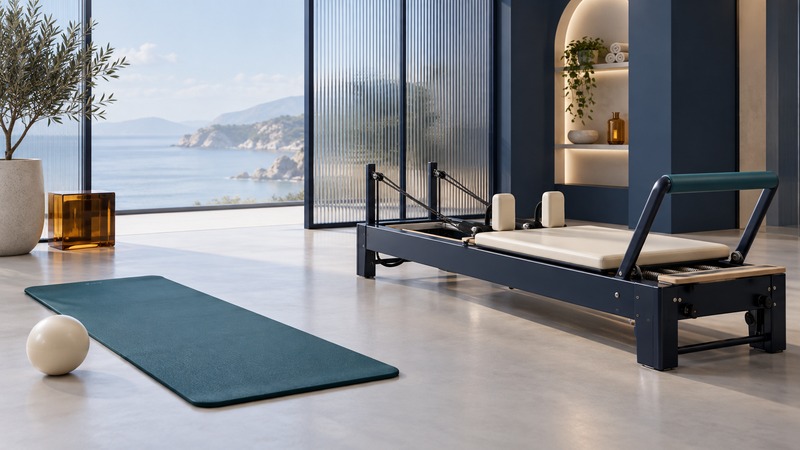
Choose a Pilates class by its starting level, teaching approach and instructor preparation. The words “beginner” and “certified” are useful only when you understand what the class includes and which credential the teacher holds.
Choose the class format
Pilates uses controlled movement with attention to strength, flexibility, balance and posture. Mat classes use floor space and may include small props. A reformer uses a moving carriage and springs; instruction includes equipment setup as well as movement. More elaborate apparatus does not by itself establish that a class suits your needs.
| Format | Ask before booking | What to look for |
|---|---|---|
| Beginner mat group | How much getting down to and up from the floor is involved? | A pace that allows explanation and suitable alternatives |
| Introductory apparatus session | Will someone teach the machine setup and supervise changes? | Clear orientation and attentive equipment instruction |
| Private lesson | How will the session address my starting point? | Time for questions, observation and individual adjustments |
| Recorded video | Can I follow the positions and judge suitability independently? | Explicit intended audience and manageable instructions |
The NHS beginner Pilates video offers an example of a clearly described recorded class. Its safety information distinguishes general exercise from treatment and advises getting individual guidance when health concerns affect suitability. A recording cannot watch you and respond to your technique.
Separate training from certification
A teacher-training certificate documents completion of a particular school’s education. An independent professional certification adds an assessment against that organization’s requirements. Ask for the precise name of each credential and the equipment covered.
As checked September 15, 2026, the National Pilates Certification Program’s FAQ describes two pathways: comprehensive eligibility includes at least 450 hours of education covering mat and multiple apparatus; mat eligibility includes at least 100 hours of mat education. Education is a prerequisite to the certification exam, not proof that the exam was passed.
Use the NPCP certified-teacher directory to match the name, certification type and expiration. A mat credential has a different scope from comprehensive preparation. The directory is one verification route, not a guarantee of the right teacher for every person.
For prospective teachers: the updated comprehensive eligibility requirements have a stated effective date of January 1, 2027, with a transition provision. Check the current candidate handbook and your expected application date before committing to training. Students choosing a weekly exercise class usually need to verify the teacher’s current preparation, rather than master the application rules themselves.
Ask how the teacher will work with you
- Describe your goal, experience and any relevant health restrictions before booking.
- Ask about training on the equipment used and experience teaching people with similar needs.
- Ask what happens if a movement is uncomfortable or too difficult.
- Clarify class size, supervision, required introductory sessions and clothing or footwear requirements.
- Ask about consent for hands-on guidance and how to request verbal instruction instead.
If you are seeking rehabilitation or treatment, verify the relevant clinical qualification and how the class relates to your care plan. A fitness credential alone does not establish a healthcare license. The trainer-selection guide provides a broader interview process.
Evaluate the first lesson
Arrive early enough to discuss the setup. Expect explanation, opportunities to ask questions and a version of the movement you can manage. For apparatus, follow the instructor’s directions for springs, carriage, footbar and getting on or off. Avoid copying another participant’s settings.
After class, record what you understood, which movements need clarification and whether you felt able to speak up. Continue when the teaching and progression suit you. For a broader routine, connect Pilates with suitable aerobic and strength activity using the weekly fitness principles.
Explore the fitness library
Browse fitness guides for planning, equipment, food and movement. Source links appear alongside the guidance they support.