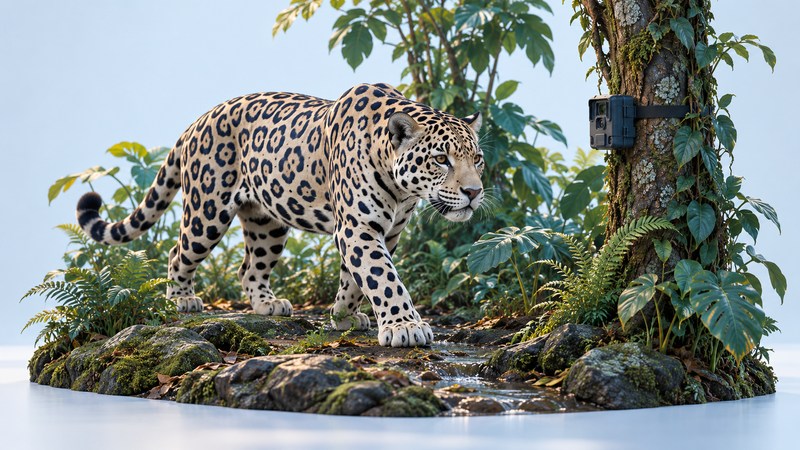
A jaguar photograph can document a remarkable encounter. To understand what it establishes, check the animal's features, the image's origin and the observations that accompany it. A verified photograph records presence at a place and time; evidence about residence, breeding or population change requires a wider study.
Identify the animal before interpreting the headline
Jaguars, Panthera onca, are robust cats with broad heads and powerful bodies. Their coats commonly carry dark rosettes, often with smaller spots inside. Panthera’s jaguar guide illustrates the pattern and compares jaguars with leopards. Compare several features together, including body proportions, the head and the pattern across the flank. Image angle and lighting can obscure all of them.
The U.S. Fish and Wildlife Service's jaguar account provides species information and links to conservation records. Consult verified reference photographs when comparing an uncertain image. A dark coat does not by itself identify a species, and a close crop can conceal the proportions that distinguish one spotted cat from another.
In an American setting, consider an ocelot or a young mountain lion among possible look-alikes where appropriate. A photograph circulating online may also have been made in a zoo or on another continent. Geography helps only after the claimed location has been checked. The hero above is a conceptual illustration, not a wildlife sighting or an identification standard.
Follow the picture back to its source
- Find the original photographer, monitoring project or wildlife agency.
- Record the capture date separately from the upload or news date.
- Check whether the image was cropped, enhanced, composited or generated.
- Look for the original caption and any accompanying sequence or report.
- Preserve the original file and explain any uncertainty when asking for identification.
Camera timestamps can be incorrectly set. Treat them as metadata to verify, not automatic proof of date. Reverse-image searching can help find earlier appearances, but the earliest result you find may still be a repost. Ask what establishes the location and who has reviewed the identification.
When reporting a possible rare animal, share precise coordinates privately with the responsible wildlife agency. Publicly, a broad location is usually enough to discuss the evidence. Avoid approaching, baiting or pursuing the animal to improve a photograph.
Separate photographs, individuals and populations
| Evidence available | Reasonable interpretation | Further information needed |
|---|---|---|
| One verified image | An animal was present at the documented time and place. | Repeat observations to understand subsequent use |
| Many images | The cameras recorded multiple frames. | Whether frames represent separate encounters or individuals |
| Same identified animal over time | Repeated use by that individual is supported. | Movement information and study duration to assess residence |
| A survey-based abundance estimate | A model estimates population size within its stated scope. | Sampling design, detection assumptions and uncertainty |
Scroll the evidence table horizontally on a small screen.
A long-term camera-trap study in Belize illustrates why sampling duration and individual detection matter when interpreting jaguar records. Researchers can compare coat patterns to distinguish individuals, with attention to the body side and image quality. The 2018 U.S. Jaguar Recovery Plan (PDF) places records, range and monitoring in a broader conservation framework. Read it as a dated plan and check subsequent agency documents for changes.
Check the date and purpose of a range map
Historical range, recent confirmed occurrence, suitable habitat and legally designated critical habitat are different map layers. Read the legend and date before using one as evidence for another.
In 2014, the U.S. Fish and Wildlife Service designated jaguar critical habitat in Arizona and New Mexico. That historical action illustrates why a legal assertion from an earlier sighting report can become obsolete. Use the current species record and linked rules for decisions about legal status or particular land.
Keep a short evidence note
Save the image source, claimed capture date, broad location, reviewer, identification features and strongest supported conclusion. Our wildlife image record provides those fields. For another example of interpreting remote observations, see penguins, sea ice and satellite evidence.