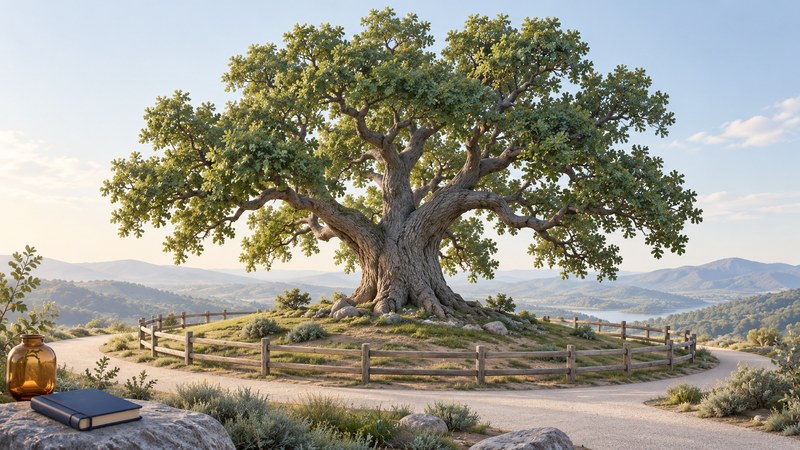
Old Glory, the Pico Canyon oak, is a valley oak whose preservation became a public cause. The tree was ultimately relocated to Pico Canyon Park, where visitors can encounter both a living tree and the history of the choices made around it. Its story joins development, community advocacy, specialist tree work and continuing stewardship.
From threatened tree to protected landmark
The county's 2024 landmark packet (PDF) reconstructs the dispute and move. Its account places community advocacy alongside the development proposal:
- 1999: An oak-tree report for the development proposed removing trees, including Old Glory. SCOPE, the Santa Clarita Organization for Planning the Environment, opposed the plan.
- November 2002: John Quigley began a tree-sit that brought wider attention to preservation. The county records a 71-day stay.
- 2003–2004: After Valley Crest withdrew from the relocation project, Senna Tree Company took on the move. The county dates the relocation's start to January 20, 2004 and describes transport roughly a quarter-mile.
- 2008: Pico Canyon Park was dedicated on March 19, according to the county's park listing.
- 2024: The county's historic-resources database documentation confirms that the Board of Supervisors adopted Old Glory's County Landmark designation on September 24.
The landmark packet identifies the species as Quercus lobata and treats its roughly 400-year age as an estimate. The documented sequence explains how the tree reached the park; its estimated age conveys a different kind of historical information.
Read measurements and record claims in context
Descriptions of a large tree move may refer to the living tree, the boxed root mass or the entire transported load. Before comparing impressive numbers, check what was measured, the units and the date. A photograph of a tree on a transporter tells one part of the story; follow-up records answer questions about its later condition.
Old Glory's historical record recognition also needs a date attached. The county's packet describes Guinness recognition in 2007. The current Guinness entry for largest tree transplanted names Yonggyeri Ginko in South Korea. Old Glory's significance rests on its own preservation history, even as record listings and their comparisons change.
Look at a valley oak as habitat
The U.S. Forest Service's valley-oak account describes a California native whose acorns, cavities and woodland setting support wildlife. When looking at a mature oak, notice several scales at once: the canopy as shelter, branches as perches, and the ground beneath as part of the tree's setting.
Use a quiet observation from a permitted viewing area. Record a bird using a branch, a patch of shade or the silhouette of the crown. Describe only what you can see. Identifying a species or assessing tree health can require closer evidence and specialist knowledge.
The long time embodied in a mature tree is part of the preservation question. A newly planted tree and an established canopy contribute at different stages. A thoughtful account considers immediate habitat, future planting and the space needed for continuing care.
Visit with the current park information
Pico Canyon Park is at 25600 Pico Canyon Road, Stevenson Ranch, California. The county lists trails, picnic tables and restrooms, with seasonal operating hours. Use that listing to check arrangements before traveling; the broader Santa Clarita Valley location can be more useful than searching for a park in the city alone.
- Stay on permitted routes and observe the tree from outside protective fencing.
- Read available interpretation, then compare the story with the visible setting.
- Record the date of any photograph so later comparisons have context.
- Contact the park about access needs or concerns; leave watering, pruning and other care to the responsible staff.
A simple field note can contain the date, viewing location, one visible feature and one historical question. That is enough to turn a short stop into a more attentive visit.
Use the story to ask better preservation questions
Old Glory provides a case to investigate, with circumstances particular to this tree. For another threatened mature tree, ask what alternatives were considered, which assessments informed the decision, who will fund long-term care, and how success will be measured over time.
Keep the decision and the evidence together. A relocation plan is a proposal; transport documents establish a move; later observations describe survival and condition at particular dates. This sequence helps readers understand both the achievement and the continuing responsibilities.
For a home planting project, begin with the garden-design guide's site and mature-size planning. For another perspective on caring for living collections, explore Fairchild's conservation work.